
Slann
Warden
Tenth Spawning
- Messages
- 6,633
- Likes Received
- 18,853
- Trophy Points
- 113
Introduction
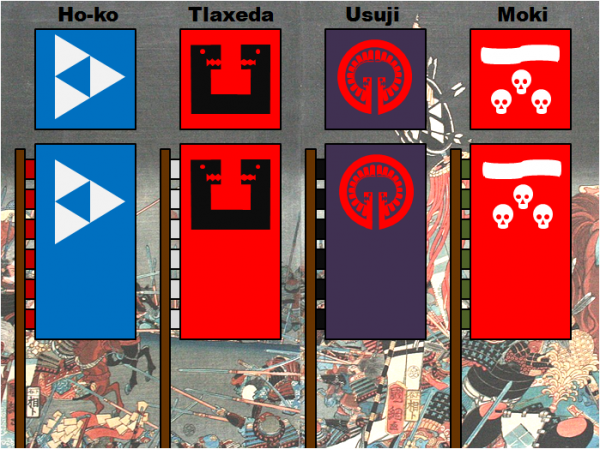
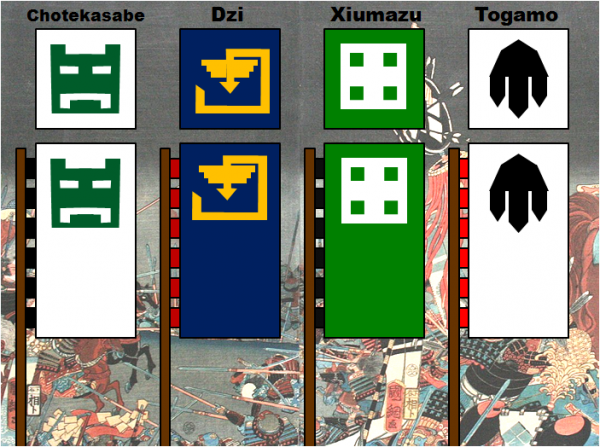
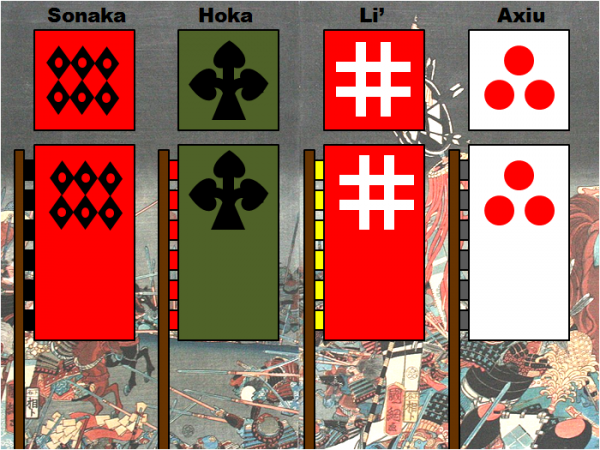
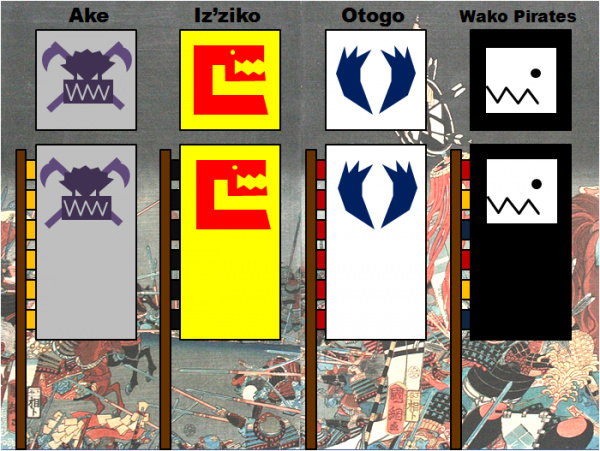
So I have to start this thread with an amazing quote from Lord @Slanputin from another fantastic thread on the Dragon Isles. This quote got me thinking about what really happened when Lizardmen society fell apart across the Old Ones empire when they disappeared. Odds are it was a gradual process, sped up by varying degrees of slann intervention and daemon invasions. It also got me thinking about the piece I did on pirates, and how it would be fun if I made up an altered warhammer timeline with the Dragon Isles based on Sengoku-period Japan!
This was back in june… so far I have a decent amount of backstory done, and I recently entered another test short story about one of the major characters. Hope you enjoy the lore!
Links
Lizardmen Version of the Lore of the Flies- concerning the lore of the Dragon Isles
Never Lie to a Samurai- my short story based on the saurus-samurai
Pirates of the Dragon isles- my earlier short-story entry on the contest thread, also on the Dragon isles. Not necessarily related to this continuity just yet, but I am trying to figure out a way to make it work.
History of the Dragon Isles
Early History
Eons prior to the Great Catastrophe, the skink priests had presided over their Lizardmen brethren through edicts from far Lustria, transmitted by the slann directly to the main communication node at the temple-city of Koa. These High Priest controlled the denizens of Koa and the outlying cities and territories of the Dragon Isles, as well as ancient (and now lost) minor temples and shrines as far away as Ind and Cathay.
Around -5600 IC (Imperial Calendar), the polar gates of the Old Ones collapsed. At the time, no Slann were present in the Dragon Isles, for the island was only ever inhabited by saurus, skinks, and kroxigors. With the loss of contact with the Old Ones and the Slann came incursions of orcs, goblins, ogres, beastmen, and chaos-daemons flooding over the dragon isles from the mainland.
Immediately following the Catastrophe, the skinks priests were able to maintain control over their fellow skinks and the powerful saurus legions thanks to the threat of a common enemy: vast hordes of enemies on their doorstep ready to tear down their temples and wipe them from existence. The saurus and skink legions of the Dragon Isles stood strong against the threat of extinction, and eventually triumphed and fought the hordes back across the ocean, or into the depths of the deepest and remotest jungles of the Isles.
After the Fall
When the revolts began, the Emperor’s shogun was unable to keep the armies together. The saurmurai commanders and the regional military powers had fragmented, and the Isles were plunged in even greater despair. Newly spawned saurus cohorts, lost to the world, reverted to their animal instincts and decimated the countryside and skink populations. Brigands ran rampant; the saurus daimyo governors were only able to maintain order by use of force in their isolated provinces. Skink fought skink; saurus fought saurus as the Old Ones were increasingly forgotten in the wake of the growing power of the warrior caste.
- Ake Zuhuanchi- excerpt from “Never Lie to a Samurai."
In the centuries following the Catastrophe, the memory of the Old Ones and a Slann were but a distant memory to the surviving inhabitants.
The High Priest of the skinks was still the undisputed ruler of the Dragon Isles, but had grown distant from the Lizardmen populace. The High Priest was given the title Emperor, to distinguish him over all other priests, later given the appellation Slann-Emperor, (or more formally, the Tzlan-Emperor) by his fellow priests. Considered on a higher plane than other skinks and saurus, for he is the one who communicates directly with the Old Ones on their behalf. The Slann-Emperor and his spawn-children are all considered direct descendants of the Slann and the Old Ones.
The skinks priests as a whole became increasingly fanatical and religious, ordering the construction of great temples and mountain shrines, in memory of the lost Slann and Old Ones. Many sacrifices were sent to the heavens wreathed in flames and incense, but no prayers were ever answered. Some skinks turned to the worship of the embalmed remains of past High Priests, enshrined in the Holy Temple at Koa. Still others turned to the worship of the ancient communications apparatus and engine portals where the ancient instructions used to come from.
Many worship wooden and golden idols made in the image of the Old Ones and the Slann. One of the most popular deities is the Fat Slann, golden idol of an immensely fat Slann, meant to be a representation of plenty, and an aspect of the Slann Emperor.
With the growing religious fervor of the skink populace and degeneration of their ancient and efficient bureaucracy, the skink priests unable to maintain order amongst the Saurus veterans, who begin to assert themselves for dominance.
Growth of the Saurus Class
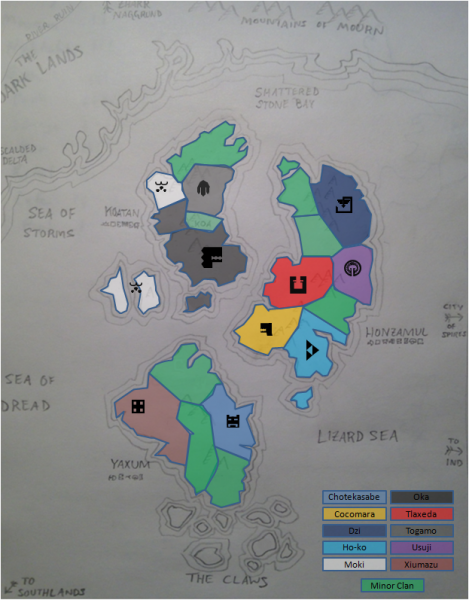
Many small Lizardmen tribes on the outskirts of the Dragon Isles, cut off from the constant reminders of civilization, began to fall to barbarism. They rejected the rule of the skink temples and began to fight amongst each other in crazed bloodlust, and in some cases saurus and skinks were rumored to turn on each other in cannibalism.
The saurus legions themselves become disenchanted with the non-rule of the Slann-Emperor and the religious excesses of the skink priests.
The enclaves of saurus legions and veterans break into clans and tribes with various hunting grounds, doing little more than stealing what they need to survive. Some hunt for sport, others gather gold and riches. Few motivated by ideals other than personal freedom, and the time-honored tradition of the warrior class: might makes right.
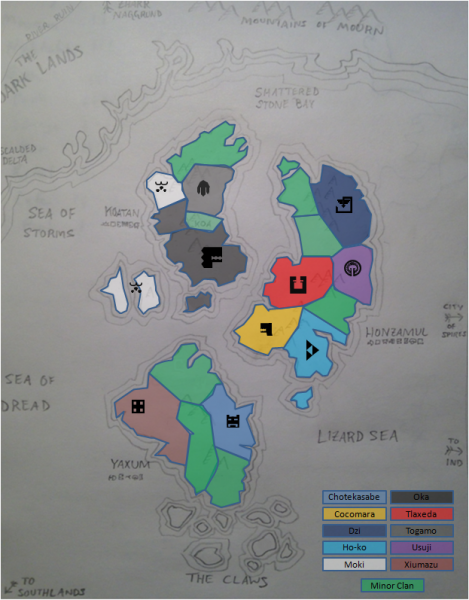
Clans spring up along power lines formed from control of spawning pools, headed by the most powerful Oldbloods of each spawn-clan known as daimyo. No single clan held sway over the entire Isles, which led to competiton amongst the saurus clans. Fortresses and cities were built around the spawning-pools, becoming the focuses of the saurus power struggles. The saurus orchestrated constant moving patrols to hunt down trespassers in their lands, and fought skirmishes and eventual wars of conquests against their neighbors to gain more power to their realms.
A warrior code is developed amoungst the saurus clans, to stand as a replacement to the blind obedience of the past and the anarchy of the barbaric saurus clans. Loyalty and honor are most important in an age where self-interest and backstabbing are common.
The Slann-Emperor and the Shogun
“The Old Ones are departed. The Emperor Tenno-Jimmu slumbers, the rest of the tzlan are dead and gone. The priests lie to us and cast us aside. The shogun and his Temple Guard are weak and refuse to act as the Isles disintegrate in war.”
- Ake Zuhuanchi- excerpt from “Never Lie to a Samurai.”
The Temple Guard are a specific caste of the saurus who fanatically serve the Slann-Emperor and the skink priests as a whole. They are the personal body guards of the skink priests, elite and heavily armored saurus warriors whose devotion to the skinks are total.
In the centuries following the Great Catastrophe, the Slann-Emperor and the skink priests at large became distrustful of the saurus caste. As a response they appointed the head of his Temple Guard as a new title, the shogun, to bear the powers of not just the lead protector of the person of the Slann-Emperor but also supreme commander of all his armies, giving him supremacy over all the saurus legions. This worked for a time, but with the increasing religious focus of the skinks the Temple Guard too became aloof from the problems that plagued everyday Lizardmen society across the Isles as a whole. The shogun, like the Slann-Emperor himself, became a figurehead of failed government power, but at the same time became a coveted position by all the saurus caste, who longed to gain for themselves the powers of the shogun, and thereby unite the Dragon Isles under a strong ruler, and bring order to their trouble lands.
Also during this period of loss of central guidance causes some skinks to strike out on their own. Some skink merchants trade with cathayans and ind to the east for the goods coveted by the saurus warrior caste, or else with the ogres and chaos dwarves to the north for slaves.
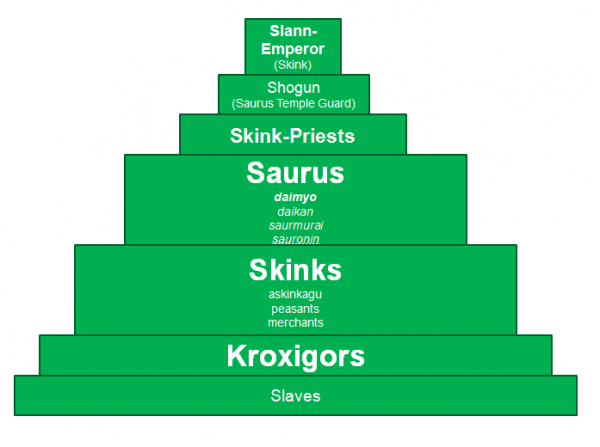
Dragon Isles Caste Structure
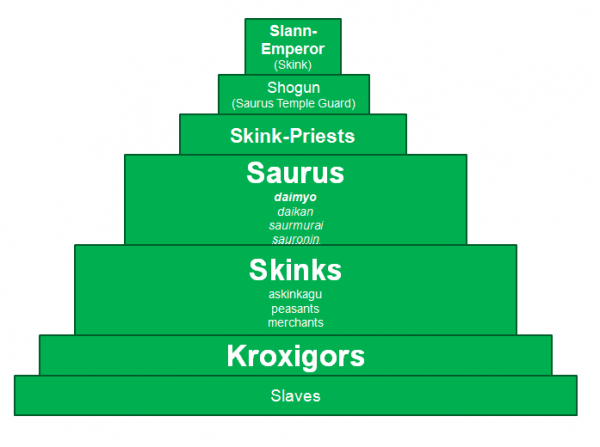
Slann-Emperor- the High Skink Priest of all the Dragon Isles. He and his spawn-children are considered the holiest living creatures on the entire Isles, and the rightful rulers of the Lizardmen. Despite this, the person of the Slann-Emperor has become increasingly distant and aloof from the problems of the Dragon Isles. The Slann-Emperor is always secluded away by the priest-caste and the shogun in the Capitol City at Koa.
Shogun- the shogun is the military representation of the Slann-Emperor, and is therefore the second most important figure in all of the Dragon Isles. Though a saurus, the shogun is higher than any skink priest.
Priests- Including the skink priests and the great monastery-temples that are spread throughout the Dragon Isles. They maintain a host of private skink and saurus monk armies, known respectively as skinkhei and saurhei, but the monk-warriors themselves are of course considered inferior to the skink priests, the only users of magic on the Isles.
Saurus- consisting of the saurmurai. At the head of this caste are the daimyo, followed by the daikan deputies of the daimyo, and all saurus retainers. All saurus are considered superior to skinks, with the only exception being the skink priests. Note that the Temple Guard are in some cases considered more important than a regular saurus, but the daimyo would in most cases dispute or ignore this. At the bottom of the saurus caste are the sauronin, saurus warriors who have no liege lord either due to war, treachery, or exile. The sauronin have only grown in number as the warfare on the Dragon Isles continues, often roaming the countryside as nothing more than bandits and brigands, though some find employ in the households of desperate spawn-clans.
Skinks- the bulk of the population of the Dragon Isles, consisting of both the askinkagu footsoldiers of the spawn-clan armies, and the skink peasants. Also includes the skink merchants who trade amongst the spawn-clan strongholds and beyond the Isles themselves, but as a rule merchants are looked upon as lower than soldiers and artisans in the eyes of the saurus. Interestingly, most saurus would consider outsiders to the Dragon Isles, such as humans, dwarfs, or elves, on the same level or lower than skinks, but higher than kroxigors.
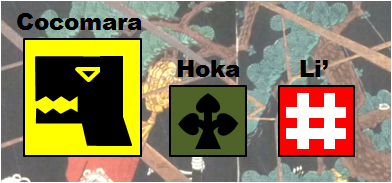
Kroxigors- while higher than slaves, the kroxigors are considered nothing more than beasts of burden to most of the saurus and skink populace of the Dragon Isles. This is due to no fault of their own, for they were in ancient times genetically engineered to have simple minds by the lost Old Ones and the Slann. There are some kroxigors who do manage to make something more of themselves and rise through the ranks of Lizardmen society, but these are rare and hard to find exemptions, the greatest example being Hoka Tepokatzu, the kroxigor ancient, powerful warrior, and loyal vassal in the employ of the Cocomara Clan.
Slaves- The slave trade, while technically outlawed by the edicts of the Slann-Emperor and the shogun, is alive and healthy across the Dragon Isles. Slaves are the lowest caste of Dragon Isles society, this class can be made up of the unfortunate soul of any species, whether saurus, skink, or non-Lizardmen. Slaves are used in all facets of Lizardmen society, rarely on the battlefield except to row the great wooden-and-stone ships of the spawn-clan fleets, and to work other unpleasant work such as the rice-fields or deep in the clan mines. Some become slaves because of debt, most became slaves due to capture in war or by pirates plying the coastlines.
I imagine Lizardmen society would remain somewhat stable without a Slann, just not progressive. Skinks have the most municipal responsibility and are relentlessly bureaucratic in the running of the temple-cities when the Slann aren't available for contact: and the cities surviving the cataclysm have been maintained even whilst the Slann remain distant or their numbers decrease.
The undoing may be the trend in Skinks turning to a more tribalistic worship of the Old Ones. I can't remember where, but I'm sure in the 8th edition it mentions how without direct leadership from the Slann the Skinks developed a religion about the Old Ones which favoured sacrifices, etc. A Lizardmen society without any influence from Slann leadership, either from within the city or other nearby cities, could devolve into a more base approach to worship which may dictate the direction of their civilisation.
I positioned the Saurus as the villains in "A Thousand Crimson Crosses" precisely because they're the stabalising element - they are paragons of order, and without a Slann to guide them they re-organise society to one which matches their militaristic ideal. If the balance of power favours Saurus rulership then I can see a Lizardmen society becoming akin to a military junta.
So I have to start this thread with an amazing quote from Lord @Slanputin from another fantastic thread on the Dragon Isles. This quote got me thinking about what really happened when Lizardmen society fell apart across the Old Ones empire when they disappeared. Odds are it was a gradual process, sped up by varying degrees of slann intervention and daemon invasions. It also got me thinking about the piece I did on pirates, and how it would be fun if I made up an altered warhammer timeline with the Dragon Isles based on Sengoku-period Japan!
This was back in june… so far I have a decent amount of backstory done, and I recently entered another test short story about one of the major characters. Hope you enjoy the lore!
Links
Lizardmen Version of the Lore of the Flies- concerning the lore of the Dragon Isles
Never Lie to a Samurai- my short story based on the saurus-samurai
Pirates of the Dragon isles- my earlier short-story entry on the contest thread, also on the Dragon isles. Not necessarily related to this continuity just yet, but I am trying to figure out a way to make it work.
History of the Dragon Isles
quick quote, pulled off Warhammer Lexicanum
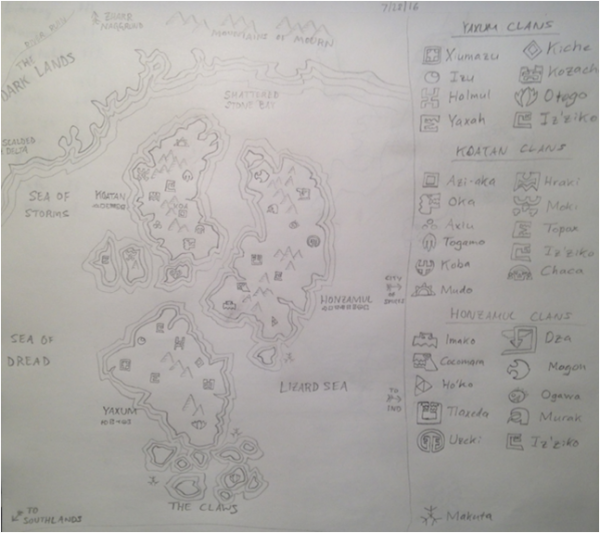
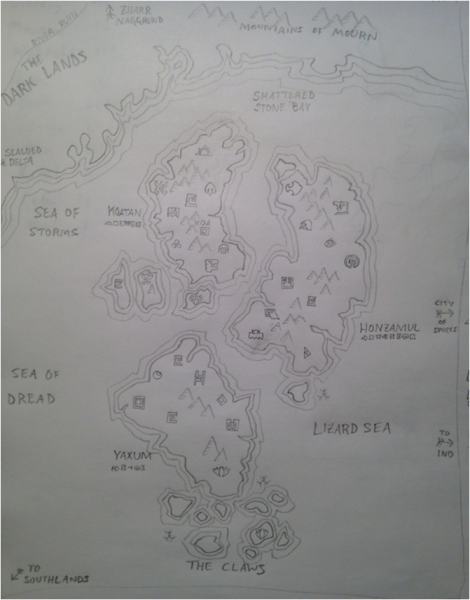
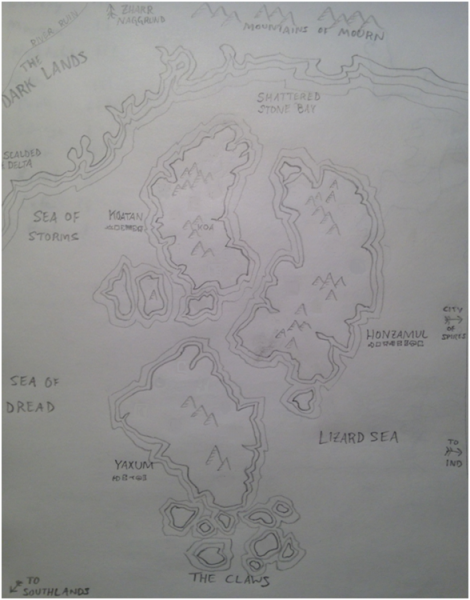
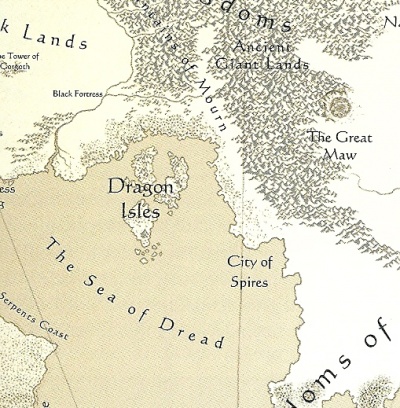
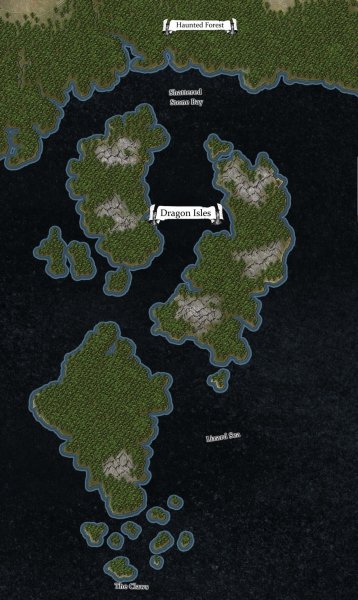
The Dragon Isles are a group of islands located in the Sea of Dread, east of the Southlands and south of the Mountains of Mourn. The Dragon Isles are inhabited by Lizardmen Saurus and Skinks, although never by Slann. Contact with their masters was cut off many centuries ago, and the Lizardmen on the islands have reverted to animalistic barbarism without the guidance of the Mage-Priests. It is unknown whether the Slann of Lustria have attempted to establish communications or left the Dragon Isles to their fate. However, as all attempts by explorers to establish colonies on the isles has failed, the fate of the Lizardmen living there has been accepted as part of the Old Ones Great Plan.
The Dragon Isles are a group of islands located in the Sea of Dread, east of the Southlands and south of the Mountains of Mourn. The Dragon Isles are inhabited by Lizardmen Saurus and Skinks, although never by Slann. Contact with their masters was cut off many centuries ago, and the Lizardmen on the islands have reverted to animalistic barbarism without the guidance of the Mage-Priests. It is unknown whether the Slann of Lustria have attempted to establish communications or left the Dragon Isles to their fate. However, as all attempts by explorers to establish colonies on the isles has failed, the fate of the Lizardmen living there has been accepted as part of the Old Ones Great Plan.
Early History
Eons prior to the Great Catastrophe, the skink priests had presided over their Lizardmen brethren through edicts from far Lustria, transmitted by the slann directly to the main communication node at the temple-city of Koa. These High Priest controlled the denizens of Koa and the outlying cities and territories of the Dragon Isles, as well as ancient (and now lost) minor temples and shrines as far away as Ind and Cathay.
Around -5600 IC (Imperial Calendar), the polar gates of the Old Ones collapsed. At the time, no Slann were present in the Dragon Isles, for the island was only ever inhabited by saurus, skinks, and kroxigors. With the loss of contact with the Old Ones and the Slann came incursions of orcs, goblins, ogres, beastmen, and chaos-daemons flooding over the dragon isles from the mainland.
Immediately following the Catastrophe, the skinks priests were able to maintain control over their fellow skinks and the powerful saurus legions thanks to the threat of a common enemy: vast hordes of enemies on their doorstep ready to tear down their temples and wipe them from existence. The saurus and skink legions of the Dragon Isles stood strong against the threat of extinction, and eventually triumphed and fought the hordes back across the ocean, or into the depths of the deepest and remotest jungles of the Isles.
After the Fall
When the revolts began, the Emperor’s shogun was unable to keep the armies together. The saurmurai commanders and the regional military powers had fragmented, and the Isles were plunged in even greater despair. Newly spawned saurus cohorts, lost to the world, reverted to their animal instincts and decimated the countryside and skink populations. Brigands ran rampant; the saurus daimyo governors were only able to maintain order by use of force in their isolated provinces. Skink fought skink; saurus fought saurus as the Old Ones were increasingly forgotten in the wake of the growing power of the warrior caste.
- Ake Zuhuanchi- excerpt from “Never Lie to a Samurai."
In the centuries following the Catastrophe, the memory of the Old Ones and a Slann were but a distant memory to the surviving inhabitants.
The High Priest of the skinks was still the undisputed ruler of the Dragon Isles, but had grown distant from the Lizardmen populace. The High Priest was given the title Emperor, to distinguish him over all other priests, later given the appellation Slann-Emperor, (or more formally, the Tzlan-Emperor) by his fellow priests. Considered on a higher plane than other skinks and saurus, for he is the one who communicates directly with the Old Ones on their behalf. The Slann-Emperor and his spawn-children are all considered direct descendants of the Slann and the Old Ones.
The skinks priests as a whole became increasingly fanatical and religious, ordering the construction of great temples and mountain shrines, in memory of the lost Slann and Old Ones. Many sacrifices were sent to the heavens wreathed in flames and incense, but no prayers were ever answered. Some skinks turned to the worship of the embalmed remains of past High Priests, enshrined in the Holy Temple at Koa. Still others turned to the worship of the ancient communications apparatus and engine portals where the ancient instructions used to come from.
Many worship wooden and golden idols made in the image of the Old Ones and the Slann. One of the most popular deities is the Fat Slann, golden idol of an immensely fat Slann, meant to be a representation of plenty, and an aspect of the Slann Emperor.
With the growing religious fervor of the skink populace and degeneration of their ancient and efficient bureaucracy, the skink priests unable to maintain order amongst the Saurus veterans, who begin to assert themselves for dominance.
Growth of the Saurus Class
Many small Lizardmen tribes on the outskirts of the Dragon Isles, cut off from the constant reminders of civilization, began to fall to barbarism. They rejected the rule of the skink temples and began to fight amongst each other in crazed bloodlust, and in some cases saurus and skinks were rumored to turn on each other in cannibalism.
The saurus legions themselves become disenchanted with the non-rule of the Slann-Emperor and the religious excesses of the skink priests.
The enclaves of saurus legions and veterans break into clans and tribes with various hunting grounds, doing little more than stealing what they need to survive. Some hunt for sport, others gather gold and riches. Few motivated by ideals other than personal freedom, and the time-honored tradition of the warrior class: might makes right.
Clans spring up along power lines formed from control of spawning pools, headed by the most powerful Oldbloods of each spawn-clan known as daimyo. No single clan held sway over the entire Isles, which led to competiton amongst the saurus clans. Fortresses and cities were built around the spawning-pools, becoming the focuses of the saurus power struggles. The saurus orchestrated constant moving patrols to hunt down trespassers in their lands, and fought skirmishes and eventual wars of conquests against their neighbors to gain more power to their realms.
A warrior code is developed amoungst the saurus clans, to stand as a replacement to the blind obedience of the past and the anarchy of the barbaric saurus clans. Loyalty and honor are most important in an age where self-interest and backstabbing are common.
The Slann-Emperor and the Shogun
“The Old Ones are departed. The Emperor Tenno-Jimmu slumbers, the rest of the tzlan are dead and gone. The priests lie to us and cast us aside. The shogun and his Temple Guard are weak and refuse to act as the Isles disintegrate in war.”
- Ake Zuhuanchi- excerpt from “Never Lie to a Samurai.”
The Temple Guard are a specific caste of the saurus who fanatically serve the Slann-Emperor and the skink priests as a whole. They are the personal body guards of the skink priests, elite and heavily armored saurus warriors whose devotion to the skinks are total.
In the centuries following the Great Catastrophe, the Slann-Emperor and the skink priests at large became distrustful of the saurus caste. As a response they appointed the head of his Temple Guard as a new title, the shogun, to bear the powers of not just the lead protector of the person of the Slann-Emperor but also supreme commander of all his armies, giving him supremacy over all the saurus legions. This worked for a time, but with the increasing religious focus of the skinks the Temple Guard too became aloof from the problems that plagued everyday Lizardmen society across the Isles as a whole. The shogun, like the Slann-Emperor himself, became a figurehead of failed government power, but at the same time became a coveted position by all the saurus caste, who longed to gain for themselves the powers of the shogun, and thereby unite the Dragon Isles under a strong ruler, and bring order to their trouble lands.
Also during this period of loss of central guidance causes some skinks to strike out on their own. Some skink merchants trade with cathayans and ind to the east for the goods coveted by the saurus warrior caste, or else with the ogres and chaos dwarves to the north for slaves.
Dragon Isles Caste Structure
Slann-Emperor- the High Skink Priest of all the Dragon Isles. He and his spawn-children are considered the holiest living creatures on the entire Isles, and the rightful rulers of the Lizardmen. Despite this, the person of the Slann-Emperor has become increasingly distant and aloof from the problems of the Dragon Isles. The Slann-Emperor is always secluded away by the priest-caste and the shogun in the Capitol City at Koa.
Shogun- the shogun is the military representation of the Slann-Emperor, and is therefore the second most important figure in all of the Dragon Isles. Though a saurus, the shogun is higher than any skink priest.
Priests- Including the skink priests and the great monastery-temples that are spread throughout the Dragon Isles. They maintain a host of private skink and saurus monk armies, known respectively as skinkhei and saurhei, but the monk-warriors themselves are of course considered inferior to the skink priests, the only users of magic on the Isles.
Saurus- consisting of the saurmurai. At the head of this caste are the daimyo, followed by the daikan deputies of the daimyo, and all saurus retainers. All saurus are considered superior to skinks, with the only exception being the skink priests. Note that the Temple Guard are in some cases considered more important than a regular saurus, but the daimyo would in most cases dispute or ignore this. At the bottom of the saurus caste are the sauronin, saurus warriors who have no liege lord either due to war, treachery, or exile. The sauronin have only grown in number as the warfare on the Dragon Isles continues, often roaming the countryside as nothing more than bandits and brigands, though some find employ in the households of desperate spawn-clans.
Skinks- the bulk of the population of the Dragon Isles, consisting of both the askinkagu footsoldiers of the spawn-clan armies, and the skink peasants. Also includes the skink merchants who trade amongst the spawn-clan strongholds and beyond the Isles themselves, but as a rule merchants are looked upon as lower than soldiers and artisans in the eyes of the saurus. Interestingly, most saurus would consider outsiders to the Dragon Isles, such as humans, dwarfs, or elves, on the same level or lower than skinks, but higher than kroxigors.
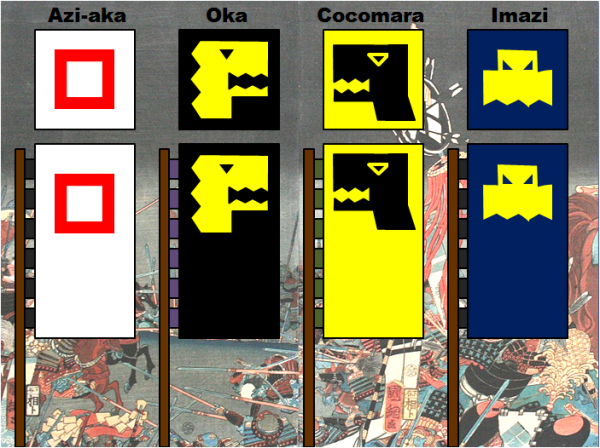
Kroxigors- while higher than slaves, the kroxigors are considered nothing more than beasts of burden to most of the saurus and skink populace of the Dragon Isles. This is due to no fault of their own, for they were in ancient times genetically engineered to have simple minds by the lost Old Ones and the Slann. There are some kroxigors who do manage to make something more of themselves and rise through the ranks of Lizardmen society, but these are rare and hard to find exemptions, the greatest example being Hoka Tepokatzu, the kroxigor ancient, powerful warrior, and loyal vassal in the employ of the Cocomara Clan.
Slaves- The slave trade, while technically outlawed by the edicts of the Slann-Emperor and the shogun, is alive and healthy across the Dragon Isles. Slaves are the lowest caste of Dragon Isles society, this class can be made up of the unfortunate soul of any species, whether saurus, skink, or non-Lizardmen. Slaves are used in all facets of Lizardmen society, rarely on the battlefield except to row the great wooden-and-stone ships of the spawn-clan fleets, and to work other unpleasant work such as the rice-fields or deep in the clan mines. Some become slaves because of debt, most became slaves due to capture in war or by pirates plying the coastlines.
Last edited: