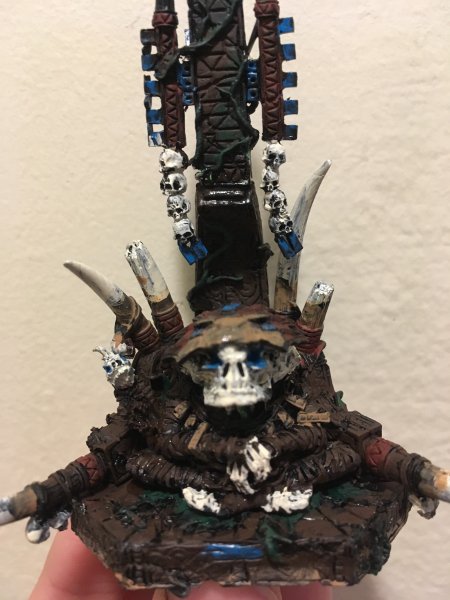
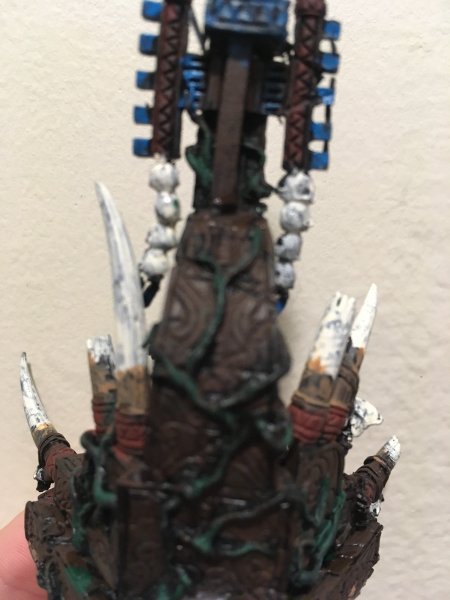
I also think it is a good start. You got paint onto a model. That's more than many people do.
There are a few things you can do that will massively improve your painting:
- Buy better paint. I know the paints are kinda expensive, but GW, Army Painter, Vallejo, and P3 all have a wide variety of pretty good colors. It may take a while to get a good amount of them, but they are worth it.
The problem with your colors is that they do not cover very well. Good acryllic colors cover well depsite being thin. That helps with crisp details.
- For each material use four techniques of painting to make the structure show:
1. prime. That usually means spraying the whole model black, grey, or white. Black is probably the best for starters, but you can also use the base color for a model. I prime my Skinks blue for example.
2. basecoat. That's basically what you did. Just cover the part with a color that is close to what it should have. Aim for a color that is a tad too bright.
3. shade. Use a thin color that runs into all the recesses. That gives the structures depth. Pick one that is similar to the basecoat paint, just darker. In a pinch just use strongly thinned-down regular brown or black color. That will still look better than no shade at all.
4. drybrushing. Put a brush with stiff bristles into the color, wipe it off on a paper towel until it only leaves very little color on your skin when you brush over the back of your hand. Pick a color that is slightly brighter than your base color, and carefully brush over the parts. That will leave colors only on raised surfaces.
- Practice. Buy a very thin brush from a hobby store or craft store (no need to buy overpriced GW brushes). Try to precisely follow the lines of your model and neaten up the parts where you fail to do so (which is normal). This is done in the basecoat step.