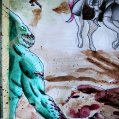
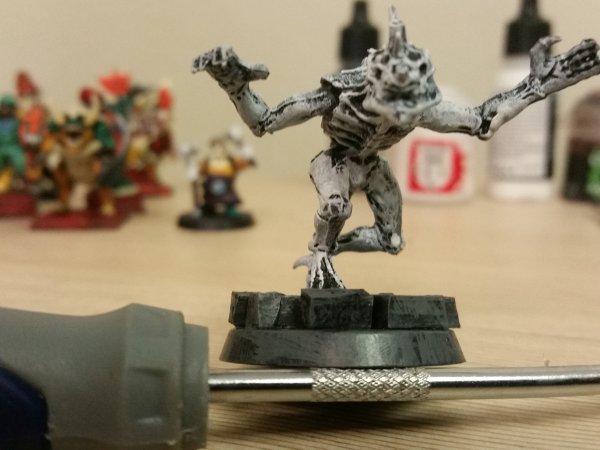
I am not one of L-O's best painters, but I do have lots of related experience. I haven't added much to my
plog because I didn't do much painting or modeling for the entire year of 2016, and what little I've done, I rarely photo graphed, but I do have a lot of Skink zombies and a few Saurus zombies. Allow me to spew my about Lizardmen zombies.
Any model can become a zombie with the right postmortem damage. My favorite tools are a candle, a nail, and a pair of pliers. I use the pliers to hold the tip of the nail over the open flame, so it's super hot for a few seconds, then I melt holes and gauges in my zombie conversions. I usually start with the eyes. One, realistically eyes are one of the first things to decompose. Two, it's easy to paint. I just make the hole black and leave it at that. Maybe I'll try glowing eyes, or alien eyes or something in the future but because I am already a slow and easily distracted painter, I aim for simplicity.
A few holes in the body are good. When painted, I tend to paint them purple and brown to represent scabs A few dark painted holes aren't amiss. I have enough red in my living models that I opted to establish the rule that in Scalenex-verse, Lizardmen bleed purple. I have no scientific basis for this. I just wanted to distinguish Lizardmen blood from Sotek Red colored scales. I'm getting a little tired of purple clotted blood. I might have some holes oozing slime or pus in the future for variety.
When mutilating a Lizardmen zombie, I often target the scales. I might peel some off with a sharp knife or mush some scales together with a hot nail (the flat end not the point this time). I don't go super gung ho on this, because this descaling
removes details that are sculpted on to the model rather than adding details.
I borrowed a friend's heat gun and blasted a few models. This melts a hole section of a model, which could look nice, but it is easy to overdue it cause it really obscures the details on a model. Cold Ones are big and thick enough to withstand this, but I Skinks and Saurus models are a little iffy. I only have a few infantry models with literally melted faces.
Speaking of adding details. Green stuff can make boils, scabs, or sliding flesh. I have painted and converted parts of my zombies to have bits of skull showing in their head or a visible bone in the arm, but I have yet to swap a zombie arm or leg for a skeleton leg or arm. I have the bits, but it's challenging to get human minis bones the right dimension.
For zombies it never hurts to have an arm or leg missing. Most of the time, my zombie amputees have a prosthetic replacement for their missing limbs. Usually the prosthetic is a broken weapon.
Color scheme, Most of my zombies use the same color scheme of my living Lizardmen as the base. Saurus are light blue with dark scales and yellow spots or jade green with dark green scales. Skinks I have light green with bright red crests, light blue with off white crests, and dark green with dark red crests. To zombify them I take my usual color palates then mix it with a lot of graveyard earth. The intent is to make the zombies look like they rose from a muddy swamp. A minority of my zombies, I take my usual color palate and mix them with black and/or grey. The intent is to make these zombies look like they rotted in a relatively dry area and faded and discolored rather than became waterlogged and suffused with mud. After the models are all painted, my last step (besides basing which I'm not super skilled at) is to apply a wash. I pick a wash that's either sickly green, muddy brown, or black (which washes out grey) or some mix of them, and I deliberately apply the wash unevenly. Walking corpses shouldn't have uniform skin tone or uniform filth covering.




 Loved your writing here as always.

 . Also, does anyone know of any models that could be converted into an undead Saurus? I'm planning an Ankhachic'qo conversion, and I'd like to make his nemesis. I wouldn't want either of them getting bored.