
• The forum software have been upgraded to the latest version.

    If you notice anything that looks off, or does not work, please let us know.

    For more information, click here.

Medieval facts

Slann

Aginor

Fifth Spawning
Messages
12,256
Likes Received
20,177
Trophy Points
113
Hey y'all

Since it is brought up now and then when discussing Warhammer rules or similar stuff I'd like to have this thread going to discuss medieval facts.
This is the place for questions, discussions, and theories about real world historical facts.

EDIT: it is not in the title but this thread is also meant to discuss other historical periods like ancient Greece and the Renaissance.

In here we can discuss things like:

- were medieval castles bare stone?
- was medieval armor heavy?
- is a Katana a better cutting weapon than a Longsword?
- could a Rapier cut?
- was a Greatsword a heavy and unwieldy weapon?
- could a Warbow shoot arrows over half a mile?
- were sail ships faster than ox carts?
- were medieval horses small?
- were Berserkers crazy?
- were Knights rich?
- is 300 an accurate representation of the battle of Thermopylae? (Ok not medieval but related)
- did medieval people wear a lot of black or brown clothes, and why (or why not)?

....and similar stuff

 
I'll quote a few posts from another thread, discussing Knights and their armor:

I mean it does make sense, as knights are possibly one of the dumbest types of soldiers ever. There have been numerous cases where club armed peasants beat them, and a knight, once knocked off the horse could not get up. Kinda fitting our worst unit is named after them

In fairness the original meaning of knight, or well the original meaning of chevalier from which it was derived was indeed basicly just "mounted warrior" or "mounted horsemen" or some such. The connotations with nobility and codes of honour came much much later. So in a roundabout way he'd be sorta right I guess.

(referring to the first post) Except that is a myth.
A Knight was the elite warrior of his time. They were trained and perfectly able to fight on foot, and many of them did.
Also plate armor (except some types for tournaments) was not that heavy. It does not prevent you from getting up, running, jumping, fighting, doing somersaults etc. That's just wrong.

Knights were used because they worked. People in medieval times were not that dumb.

I still love that picture in some old childerens book I had where knights had to be lifted onto their horse with a freaking crane. Not once did I consider that if the knight was that immensly heavy it'd break the poor animals back immeadiatly.

Also to put it into perspective, a video of some guy in plate messing around from about 0:44 he shows off mobility related stuff. If I remember correclty the weight of a medieval knight's equipment is surprisingly similar to what a modern soldier wears.

In defense of the crane picture:
There were indeed such cranes, and there was indeed armor that was so heavy that it was very hard to move while wearing it.

But that was jousting armor, designed for maximum protection during a tournament. Since you only had to use it for a few minutes and for a very limited activity (not a lot of movement necessary for jousting) you could afford to make it like that.

Armor for the battlefield was never that bad. In fact a good plate harness of the 15th century or later (we know because we have original parts) was typically less than 30 kg heavy. A trained soldier (we have documents describing how they trained and fought) could easily wear it the whole day.

Chainmail with proper under armor and padding was effective against nearly all piercing and slashing weapons. It even was quite effective against arrows. The rise of platted armor came about because of how effective mounted lancers proves to be against what had been an extremely success form of protection for over 400 years.

The full plate armor suits that are generally on display is muesems and estates were not actually used that often or were jousting suits. Standard plate armor was a set of pauldrons, lorica, brevor, and helm that was places over top of mail armor. All of which was shocking light. Their purpose was just to redirect the force of impact from heavy weapons such as lances, halbers, and hammers.
 
So, about those Knights, or more precisely: People fighting in heavy armor, which might have been Knights, or "Men-at-arms".

Of course it heavily depends on the context, which means the time and place we are talking about.
Armor developed based on the weapons used, and vice versa.

A decent example for that is swords vs armor:

Using a one-handed viking-age sword against someone wearing a 15th century full plate armor is basically suicide. There is no realistic chance to significantly hurt the armored fighter before he just kills you with whatever weapon he is carrying.
In fact even mail armor with a padding (such as a gambeson) underneath is pretty effective against cutting or even thrusting with such a sword.
That's why swords in the late medieval period evolved to be thin at the tip. The idea was that you could thrust between the rings of mail, through a gambeson, or even into the gaps of plate armor. Still risky, but possible.

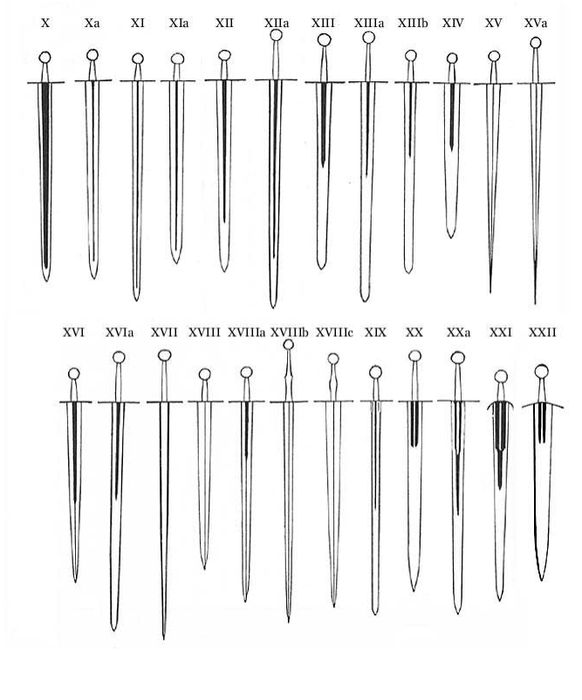
Here is a great explanation of the Oakeshott Typology that defines categories for swords:
https://www.albion-swords.com/articles/oakeshott-typology.htm

And here is a picture that shows the types as well:
5e640284-9480-11e6-9c53-3873da25d88f.jpg


Better materials, different styles of fighting, and different ways of protection, sometimes even different laws allowed different sorts of swords.

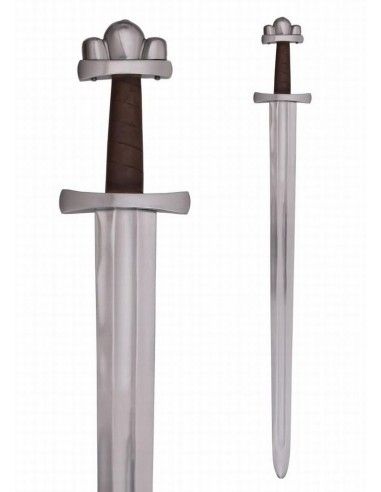
For example you might wonder why 10th century swords like this one (and also many many earlier swords like the roman Gladius) have such a small cross bar. Why weren't basket hilts (like on many 16th century swords) developed 1000 years earlier? They offer significantly better hand protection. Were 10th century people too dumb to protect their hands properly?

FUNCTIONAL-VIKING-SWORD-10TH-CENTURY.jpg


Well... no. They just usually carried a shield. That's what they protected their hands with.


Anyway, back to Knights:
If swords are such bad weapons against heavy armor.... what did people use to fight such enemies then?

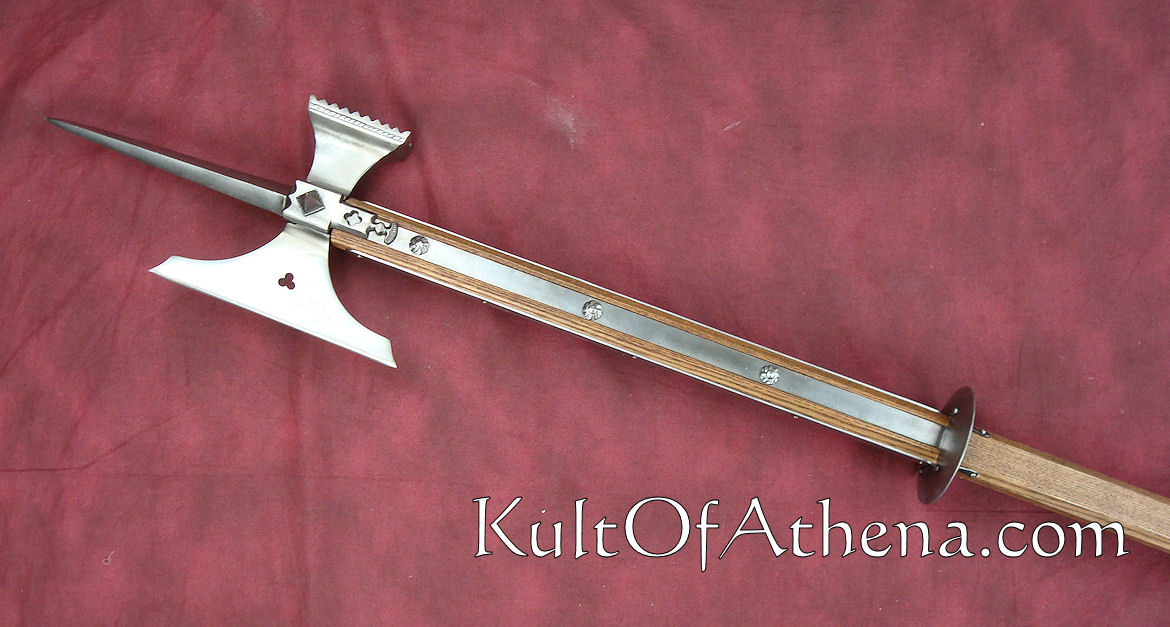
Poleaxes for example:
AA010_1_l.jpg


Those hit so hard that even when they are made of wood or plastic, fighting someone, even wearing modern HEMA armor, is pretty dangerous due to the amount of percussive force you have when swinging them. That's the reason why many HEMA clubs don't sparr with poleaxes.
 
Hi, Modern soldier here lol, and can confirm. We got to do a historical weapons training day because sometimes when you are in war zones with people that live in mud huts you come across tactics and equipment that are outdated but could be surprisingly effective, and we actually had an insurgent bum rush a check point in real plate armor. It stopped several rounds from rifles and he had to be stopped with the M240 mounted in a tower. I got to run around in plate armor for half a day and it was actually LIGHTER than a full load out for a machine gunner or grenadier. the rifleman load out was lighter by a smidge.

fun fact blunt force trauma in plate armor still leaves nasty bruises lol


Yep. And that leads to an important point about armor and its effectiveness. I'll get to that in a minute.
 
So, about that armor.

Can a medieval cuirass stop a rifle bullet?

There are LOADS of videos on Youtube about that. And most of them hurt because they ignore some of the most important aspects.

The answer is: "It depends."
But what does it depend on?
Well, things like:
- the rifle used
- the ammunition used
- the range
- the angle of impact
- the material the armor is made of
- the shape of the armor


Generally speaking: Yes, the bullet can go through. Firearms are one of the reasons why heavy armor disappeared from battlefields at some point.
However there is a certain chance that it works in some situations, like in @ILKAIN 's example.

Little tangent on that:
Here is a (non-scientific but interesting) video of a guy who tries shooting through a tree. Many people would probably agree that a tree should offer less protection than armor. But this video illustrates that things aren't that simple:
 
So, about that armor.

Can a medieval cuirass stop a rifle bullet?

There are LOADS of videos on Youtube about that. And most of them hurt because they ignore some of the most important aspects.

The answer is: "It depends."
But what does it depend on?
Well, things like:
- the rifle used
- the ammunition used
- the range
- the angle of impact
- the material the armor is made of
- the shape of the armor


Generally speaking: Yes, the bullet can go through. Firearms are one of the reasons why heavy armor disappeared from battlefields at some point.
However there is a certain chance that it works in some situations, like in @ILKAIN 's example.

Little tangent on that:
Here is a (non-scientific but interesting) video of a guy who tries shooting through a tree. Many people would probably agree that a tree should offer less protection than armor. But this video illustrates that things aren't that simple:
An important part aspect of a cuirass stopping bullets is also what other armor you're wearing. People often forget that a knight wouldn't just be wearing metal plate and then do these tests against just a cuirass. But there'd be layers of armor beneath it as well. Both for the Knight's comfort (metal plate kinda chafes) and for protection against various types of attacks. For example, plate armor protects quite wonderfully against sharp weapons, but it doesn't do much against blunt trauma. On the other hand the padded layers beneath the armor would help absorb blows from blunt trauma much better. Then there could also be things like an additional chainvest underneath the plate. All that added together gives a surprisingly decent chance of surviving gunshots, especially smaller caliber stuffs.
 
My favourite medieval history story is by far that of a castle in a marsh that was being laid to siege. It is believed that this castle was constructed with limestone (which stands to reason, as it was rather prevalent in the area), and had been in the area for a bit over a century. The castle was also being laid to siege around the time that metal arrowheads had come into fashion. A common practice for archers at the time was to loose one arrow before the others, as a way to test if the walls were short enough to effectively loose over, and as one archer did such, his arrow struck the parapet near the top of the wall. Then the castle exploded. Yes. Exploded. Boom. Kablooey. NOW FOR THE SCIENCE! Limestone is a rather porous stone, and this particular castle had been around for a bit longer than century, in a swamp. This massive limestone structure had been absorbing SWAMP GAS for over one hundred years, swamp gas being primarily METHANE which is extremely volatile and combustible. When the metal arrowhead hit the top of the rampart, it struck a spark against the stone, lighting up the century's worth of explosive gas stored within, and, as such, went BOOM.
 
My favourite medieval history story is by far that of a castle in a marsh that was being laid to siege. It is believed that this castle was constructed with limestone (which stands to reason, as it was rather prevalent in the area), and had been in the area for a bit over a century. The castle was also being laid to siege around the time that metal arrowheads had come into fashion. A common practice for archers at the time was to loose one arrow before the others, as a way to test if the walls were short enough to effectively loose over, and as one archer did such, his arrow struck the parapet near the top of the wall. Then the castle exploded. Yes. Exploded. Boom. Kablooey. NOW FOR THE SCIENCE! Limestone is a rather porous stone, and this particular castle had been around for a bit longer than century, in a swamp. This massive limestone structure had been absorbing SWAMP GAS for over one hundred years, swamp gas being primarily METHANE which is extremely volatile and combustible. When the metal arrowhead hit the top of the rampart, it struck a spark against the stone, lighting up the century's worth of explosive gas stored within, and, as such, went BOOM.

I hope this did happen.
 
My favourite medieval history story is by far that of a castle in a marsh that was being laid to siege. It is believed that this castle was constructed with limestone (which stands to reason, as it was rather prevalent in the area), and had been in the area for a bit over a century. The castle was also being laid to siege around the time that metal arrowheads had come into fashion. A common practice for archers at the time was to loose one arrow before the others, as a way to test if the walls were short enough to effectively loose over, and as one archer did such, his arrow struck the parapet near the top of the wall. Then the castle exploded. Yes. Exploded. Boom. Kablooey. NOW FOR THE SCIENCE! Limestone is a rather porous stone, and this particular castle had been around for a bit longer than century, in a swamp. This massive limestone structure had been absorbing SWAMP GAS for over one hundred years, swamp gas being primarily METHANE which is extremely volatile and combustible. When the metal arrowhead hit the top of the rampart, it struck a spark against the stone, lighting up the century's worth of explosive gas stored within, and, as such, went BOOM.
I never heard of that story before, and if it really happened (reports from medieval times are often not perfectly accurate) it is a very cool thing to happen! (Except for the people in the castle that is).

I'll see if I can find more about that somewhere...
 
I never heard of that story before, and if it really happened (reports from medieval times are often not perfectly accurate) it is a very cool thing to happen! (Except for the people in the castle that is).

I'll see if I can find more about that somewhere...
Honestly, even if it's false, it's still pretty compelling. I'm relatively certain it's true. Or at least, that the person that told me also thought it was true.
 
Also, swords (especially those kept by general soldiery) were not kept particularly sharp, as they would be dulled again anyway being battered against chainmail for and hour or two, but were more used as a weighted club with a rather thin point of contact, which could still slash through lighter armours and, of course, flesh.
 
The spear was the main weapon for most of human history and for a good reason. Swords are just better daggers to use after the spear is broken or once you have breached a fortification and are fighting in confined spaces.
 
Also, swords (especially those kept by general soldiery) were not kept particularly sharp, as they would be dulled again anyway being battered against chainmail for and hour or two, but were more used as a weighted club with a rather thin point of contact, which could still slash through lighter armours and, of course, flesh.
There seem to be examples for that, but also examples that seem to prove the opposite.

Most likely both existed.
We know that especially late medieval swords (of which we have way more examples that still exist) were sometimes very sharp. But the sharpness of a blade - and especially whether a sword could stay sharp even though it was used- depends on several factors.

Here is Matt Easton (a real expert on swords) talking about the topic. I hope that's the right video, I cannot check right now because I am not at home.
 
The spear was the main weapon for most of human history and for a good reason. Swords are just better daggers to use after the spear is broken or once you have breached a fortification and are fighting in confined spaces.
Yeah, spears are great! The Romans get a ton of praise for the phalanx, but after that they were so tactically inflexible as to be laughable. When romans hit the dense-ass forests in Bavaria they practically came to a halt, trying to maintain formation while moving through the trees. The local residents, who were usually a good bit taller than the average roman citizen, would just charge up to the phalanx formation, with all its bristling spears, and use their zweihandersupload_2019-3-14_11-49-40.png to just hack off the ends of all the spears, terrifying the roman soldiers and crash into the formation and start hackin' away.
 
- is 300 an accurate representation of the battle of Thermopylae? (Ok not medieval but related)

Fuck no:

1. The original Greek army that showed up at Thermopylae numbered in the thousands, and that number included Spartans, Thebans, Corinthians, and many others. The idea that it was just 300 Spartans and a handful of puny-looking other Greeks who happened to tag along is nonsense. Only when the force was at risk of being outflanked did Leonidas order a retreat whilst he did his famous sacrificial rearguard.

2. The Persian army most definitely did not count giant rhinos, monster-men-dudes, and other such shit amongst its ranks. Xerxes was also not some crazy-ass massive bald dude who looks like he just spent a few grand at Hammurabi's Wacky World of Piercings. He likely looked a bit more like this:

antique-relief-of-the-third-king-of-the-achaemenid-empire-darius-the-great-550486-bce-d2564d35-6f8d-4ba9-be78-f78e7a8289ac.jpg

3.The Persian army had uniforms, some semblance of how to march in a straight line, and was reasonably well-equipped and disciplined as far as we know. Conversely the Spartans most likely did not run into battle shirtless, and would definitely not have done something like break the phalanx midway through combat, even for some epic slow-motion action shots.

4. There's something to be said for the Spartan military doctrine, but the other Greek cities were far from pussies - Spartan dominance post the Peloponnesian war was shattered by Thebes at the battle of Leuctra, where not even Gerard Butler could withstand the overwhelming force of a 50-rank-deep Theban hoplite phalanx.

No expert on the subject by any means, but there's my ramble.
 
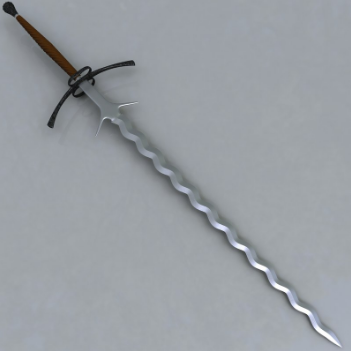
Flamberge are fantastic weapons. The one pictured is particularly attractive.

In the middle ages spears evolved into pole arms. Pole-axes, halberds, bills, and pikes were most soldiers primary weapon even into the Renaissance.

here is just a fun video of some people playing with spears and swords.
 
Fuck no:

1. The original Greek army that showed up at Thermopylae numbered in the thousands, and that number included Spartans, Thebans, Corinthians, and many others. The idea that it was just 300 Spartans and a handful of puny-looking other Greeks who happened to tag along is nonsense. Only when the force was at risk of being outflanked did Leonidas order a retreat whilst he did his famous sacrificial rearguard.

2. The Persian army most definitely did not count giant rhinos, monster-men-dudes, and other such shit amongst its ranks. Xerxes was also not some crazy-ass massive bald dude who looks like he just spent a few grand at Hammurabi's Wacky World of Piercings. He likely looked a bit more like this:

antique-relief-of-the-third-king-of-the-achaemenid-empire-darius-the-great-550486-bce-d2564d35-6f8d-4ba9-be78-f78e7a8289ac.jpg

3.The Persian army had uniforms, some semblance of how to march in a straight line, and was reasonably well-equipped and disciplined as far as we know. Conversely the Spartans most likely did not run into battle shirtless, and would definitely not have done something like break the phalanx midway through combat, even for some epic slow-motion action shots.

4. There's something to be said for the Spartan military doctrine, but the other Greek cities were far from pussies - Spartan dominance post the Peloponnesian war was shattered by Thebes at the battle of Leuctra, where not even Gerard Butler could withstand the overwhelming force of a 50-rank-deep Theban hoplite phalanx.

No expert on the subject by any means, but there's my ramble.
But the massive piercing-laden Xerxes is so much more MARKETABLE! I mean INTERESTING! Yeah....
 
Fuck no:

1. The original Greek army that showed up at Thermopylae numbered in the thousands, and that number included Spartans, Thebans, Corinthians, and many others. The idea that it was just 300 Spartans and a handful of puny-looking other Greeks who happened to tag along is nonsense. Only when the force was at risk of being outflanked did Leonidas order a retreat whilst he did his famous sacrificial rearguard.

2. The Persian army most definitely did not count giant rhinos, monster-men-dudes, and other such shit amongst its ranks. Xerxes was also not some crazy-ass massive bald dude who looks like he just spent a few grand at Hammurabi's Wacky World of Piercings. He likely looked a bit more like this:

antique-relief-of-the-third-king-of-the-achaemenid-empire-darius-the-great-550486-bce-d2564d35-6f8d-4ba9-be78-f78e7a8289ac.jpg

3.The Persian army had uniforms, some semblance of how to march in a straight line, and was reasonably well-equipped and disciplined as far as we know. Conversely the Spartans most likely did not run into battle shirtless, and would definitely not have done something like break the phalanx midway through combat, even for some epic slow-motion action shots.

4. There's something to be said for the Spartan military doctrine, but the other Greek cities were far from pussies - Spartan dominance post the Peloponnesian war was shattered by Thebes at the battle of Leuctra, where not even Gerard Butler could withstand the overwhelming force of a 50-rank-deep Theban hoplite phalanx.

No expert on the subject by any means, but there's my ramble.

Not to mention they swing their xiphos like they weren't iron ages swords that would become horribly malformed if used for hacking. Swords were mostly for poking until the middle ages.
 
My favourite medieval history story is by far that of a castle in a marsh that was being laid to siege. It is believed that this castle was constructed with limestone (which stands to reason, as it was rather prevalent in the area), and had been in the area for a bit over a century. The castle was also being laid to siege around the time that metal arrowheads had come into fashion. A common practice for archers at the time was to loose one arrow before the others, as a way to test if the walls were short enough to effectively loose over, and as one archer did such, his arrow struck the parapet near the top of the wall. Then the castle exploded. Yes. Exploded. Boom. Kablooey. NOW FOR THE SCIENCE! Limestone is a rather porous stone, and this particular castle had been around for a bit longer than century, in a swamp. This massive limestone structure had been absorbing SWAMP GAS for over one hundred years, swamp gas being primarily METHANE which is extremely volatile and combustible. When the metal arrowhead hit the top of the rampart, it struck a spark against the stone, lighting up the century's worth of explosive gas stored within, and, as such, went BOOM.
I've never heard this one either. I have my doubts it's true, actually. First question is where the oxygen for the combustion/ explosion came from. The release would probably too slow to produce a true explosion. And it assumes that the inhabitants of the castle hadn't had any fire near the walls for the previous hundred years, which with torches existing doesn't sound right to me.
 
Back
Top