Now this I like! Though whereas with the previous category it was difficult to think of 10, with this one the difficulty is choosing 10 from so many great films! Though as trilogies (and I are allowed to be classed as one entry in this list (makes sense as otherwise our lists would be cluttered with all different individual Star Wars films

), that makes things a bit easier.
- Star Wars (Episodes I-III): Let's face it, you all knew that where you all would put the Original Trilogy at the top, I would put the Prequels in the same place! I've always preferred the more grounded feel of the Prequel Trilogy, with the midichlorian concept rooting the notion of the Force in sci-fi proper, and the 'War' finally being brought to the franchise, with the Clone Wars becoming a galaxy-wide conflict in a league that isn't seen elsewhere (apart from the spin-off series of course). The Prequels also entered darker territory than their Original counterparts, with the Jedi no longer being the unkillable wizards of folklore, but people with flaws of their own, despite their best attempts to control them (Anakin is the most obvious contender, but also Yoda's complacence, even arrogance, in the belief that the Sith were no threat, Dooku joining the Separatists in his desire to topple and reinvent the Republic and Mace being equally willing as Palpatine to use Anakin as a pawn). True, there are goofy moments and characters too, but let's face it, they're needed to offset scenes like Anakin burning alive, Jedi being killed left, right and centre and Padme suffering in childbirth. The concept of Palpatine being the cause of the whole conflict and manipulating both sides to wipe out the enemies of the Sith and the Republic is excellent, as is the way he plays Anakin against the Jedi Council, with both sides ultimately using him to spy on the other. The Lightsaber fights are still generally agreed to be the best in the franchise. The world-building is particularly detailed here, with whole planets, ecosystems and native species grown organically as they would actually do (though to its credit the Original Trilogy also has some of this). The gradual transformation of the democratic, peaceful Republic into the ruthless, dictatorial Empire has the feeling of a grandiose Shakesperean tragedy. All in all, where many others here prefer the simpler, Flash Gordon-style hero's journey of the Originals, the Prequels defined what Star Wars is for me.
- Rogue One: A Star Wars Story: You thought Revenge of the Sith was dark? "Hold my beer," says Rogue One. After an attempt by the Despoiler of Trek to wipe everyone's memory of the Prequel Trilogy in the sham that is the Farce Awakens, out of the blue came the standalone story that set out to simply fix a plot hole in Episode IV, but in the process rose to become what is generally agreed to be the best effort by Disney Star Wars to date. Pretty much devoid of even the light-hearted comic moments of the Prequels, Rogue One is the most mature of the Star Wars films, that took the War aspect of the franchise up to 11 and had the guts to kill off all its main characters. Unlike Episode VII which regurgitated a beloved film unnecessarily, Rogue One added to it, supplemented it, with familiar locations and characters from both the Original and Prequel trilogies bridging them together. There are some which claim it should have been one of a trilogy of its own, and certainly I can see how making a trilogy that could have started with the story that's currently being made in Andor (which seems to be showing a lot of potential right now in the eyes of fans) and culminated in this film would have fixed its Achilles heel of having too many new characters for one film to have enough time to develop and explain. As per the Prequels characters are portrayed as more morally ambiguous, with the Rebel Alliance having a terrorist sect that it wants to disassociate itself with, Cassian having no qualms about killing a fellow operative and almost killing an unarmed (and as things would turn out, Rebel-sympathising) man and even officers in the vanilla Rebellion itself showing a more ruthless streak than you see in the OT. A much-needed return to my perceived view of what Star Wars is all about, and though Episode IV is not among my favourite Star Wars films, Gareth Edwards stated that he intended Rogue One to be his tribute toward it, and I personally believe he did a grand job of doing so.
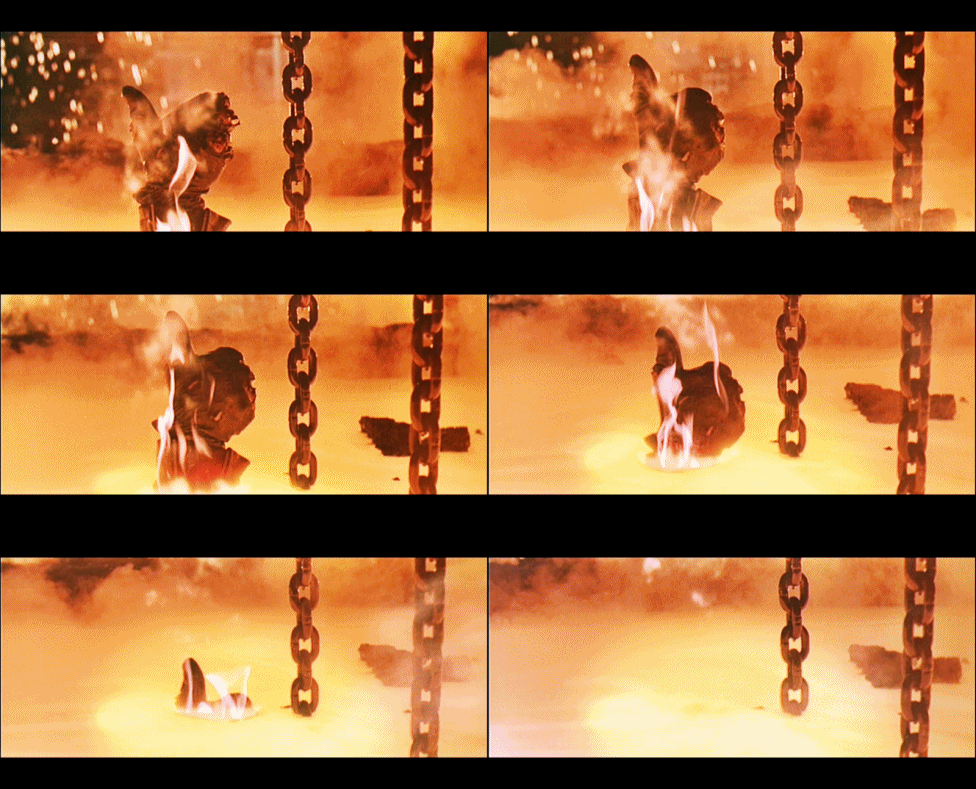
- Terminator (1, 2, 3 and Salvation): I've just rewatched these four. Terminator 1 and 2 are of course classics, though the one flaw with 2 is, funnily enough agreeing with @NIGHTBRINGER, they could easily have made John a more likeable character - I personally think more of a computer whizz, like Mr. Dyson in the film, would have been a good archetype as it would have better conveyed the origins of the skills he would later use to reprogram Terminators - but no, they had to make him a 'glamorous' but ultimately contemptible bad boy beta, with hardly any potential for leader material. I get the point a lot say about 3 undoing the conclusion of 2, but there are still a couple of points that stand which could have caused 3 to happen, and I personally like Salvation as a continuation of the future battle after Judgement Day. It turns Terminator into a war film as a welcome break from the defender-and-oppressor-time-travelling theme, which, while fine in the first three, would have got tired if it had been done anymore. It was originally planned for two more films to be made after Salvation which would have tied the story up, but the company that made Salvation went bankrupt before it could see those plans come to fruition - what a shame, because then we could have had a decent end to the story, where Skynet finally falls and humanity emerges triumphant, instead of the largely pointless reboot that was Genisys and the wokefest that was Dark Fate.
- Alien (Alien, Aliens, Alien3, Alien: Resurrection and Alien vs Predator): This is why it didn't feature in my Horror list - true, these definitely come under the horror genre, but they are sci-fi first and foremost. The original four are all classics in my book (though I would classify Alien3 as the weakest due to killing Newt and the last surviving Marine off without even giving them the chance to have some lines, making everything they achieved in Aliens pointless). Prometheus was a mostly solid prequel that I thought would tie everything in with Alien there and then but left some loose ends, and Covenant is OK, but Mr. Scott really needs to come up with a third prequel film to tie those three in with Alien. It could definitely be done, but I don't envy his job

- Predator (1, 2, Alien vs Predator and Predators): The third of the sci-fi horror franchises had to have a place alongside the others. Again, the original was a milestone, principally because while in so many other action/sci-fi films (Terminator being one of them, alongside Conan the Barbarian, Commando e.t.c), Arnie, as one of the strongest men in the world at the time, was the merciless, unstoppable killer, wiping the floor with lesser men and generally kicking arse, as he does in the first half hour or so of Predator. However, when the eponymous alien comes to play, Arnie becomes the prey, being unable to see the creature, let alone fight it, through much of the film, and even when he can see it, it's far stronger than even he could ever be. He's beaten at his own game, and is forced to resort to ingenuity to ultimately beat his foe - pretty much a darker, grittier version of Captain Kirk vs the Gorn. I also like 2 as the Predator's environment changes from the rainforests of the Amazon to the urban jungle of Los Angeles (though it's a shame Arnie's Dutch didn't return) and Predators took more of an in-depth look into the culture of the Yautja and the civil war between the larger and smaller subspecies. Note: I've included the first Alien vs Predator as a top film for both of the Alien and Predator franchises. This one I thought was excellent, with the three-way fight between the three species resulting in chaos, an interesting mythos as to how the Yautja first recognised the Xenomorphs as prey, and a satisfying feeling to see the surviving humans team up with the last remaining Predator to take down the bigger bad of the Alien Queen. A shame though that the ending is an anticlimax developed to continue the story into the weaker sequel.
- Star Trek: The Next Generation films: I got into Trek through the Next Generation, like many others, and I do prefer the Next Generation films over the Original Series ones. First Contact is excellent as others have said, but I would also advocate Generations (Captain Kirk and Captain Picard working together to defeat Soran is a piece of Trek history) and Nemesis (Data finally meeting his maker to help save Captain Picard from Shinzon was a nice bit of hero mortality) as being solid. No Wesley also helps a bundle in making these more enjoyable.
- Planet of the Apes (1968): The original is a classic, without a doubt (though with probably one of the worst scores of any film I've seen ). The costumes still look pretty darn good even today, and it's interesting to see how the Ape civilisation sought to become better than man, but ended up following the same pattern, with parodies of game hunting, zoos and museums and their own deluded religion blinding the majority to the truth. Haven't seen any of the old sequels, but have seen the remake and the reboot trilogy. The remake was OK but nothing fantastic, and the reboot trilogy started off pretty well with the first two, though the third one I think, like Prometheus, left some loose ends.
- Paul: Though not part of the Three Flavours Cornetto trilogy, this Pegg-Frost comedy is as funny, if not funnier. It has me in stitches. If you don't laugh at this, you surely must have a heart of stone. Pegg and Frost travel to America to attend Comic Con and geek out on Star Wars, Star Trek and the like, when they end up meeting an actual alien called, funnily enough, Paul (hilariously voiced by Seth Rogen), who's settled on Earth and picked up all the lingo and knowledge of a modern-day American. Basically, if you're a sci-fi fan, watch it and enjoy the ride.
- Galaxy Quest: Watched this spoof not long ago and have become a fan. My stand-out favourite character is Alan Rickman's British actor character forced to endure the continual popularity of his cheesy alien character ("By Grabthar's Hammer, what a savings!") but Tim Allen and Sigourney Weaver were also very good, as is the whole notion of their TV series being perceived as real by a harmless civilisation seeking help against invaders.
- The World's End: The third of the Three Flavours Cornetto Trilogy and my second Pegg-Frost film on this list. Hot Fuzz I would say is the most quotable of the three, but I think overdid things a fair bit on the comic gore. This one on the other hand avoided this, and is equally as funny I would say. Pegg and Frost go on a pub crawl with some of their old school friends, only to discover that most of the population of their home town have been replaced with Androids controlled by a disembodied alien entity. No references to famous sci-fi franchises in this one, unlike Paul, but makes up for it by being an intriguing yet comical sci-fi in its own right.
Honourable Mentions: Back to the Future, Oblivion, Mortal Engines, Stargate, Star Trek: The Original Series films (except the Motion Picture, which is too much of a long haul to be considered an Honourable Mention)
, Cowboys and Aliens, Outlander (the 2008 film, not the later neo-Braveheart series)
, Pacific Rim
Space Fantasy as a whole has a campy feel a lot of the time, the main reason why I have no interest in Flash Gordon and I look down on the Star Wars Original Trilogy compared to the more serious (most of the time) Prequels. I think modern audiences are gradually waking up to this notion as well, seeing said campness as 'Retro', which is likely one of the reasons why more recent space fantasy developments like the Star Wars Sequel Trilogy and the current series of Doctor Who are losing ground (though the corruption of those two by The Message is the biggest culprit). Dune, though, allegedly did pretty well, and I would also consider that space fantasy, so there are usually exceptions to the rule (alongside the continued nostalgia for older space fantasies like the OT).
I would definitely say Mortal Engines is more of a dystopia, with an infusion of Steampunk, than a space fantasy, given that it is set in a post-apocalyptic Earth after the USA and China have pretty much destroyed each other in nuclear war (China survives, but if the CCP existed in the Mortal Engines equivalent of the 21st Century, everything to do with it was destroyed - the Chinese and other Asians in the Mortal Engines universe are peaceful inhabitants of one of the last regions of Eurasia inhabited by humans living in static settlements). Of course the books provide a much more in-depth explanation and understanding of it all - I saw the film and thought it was decent, but it did miss out a significant proportion of the first novel and changed some of the main characters.
No shame in that! I also have a DVD library, for I do not serve the Streaming Services that threaten to change everyday life for the worse.






 )
)