More or less.
More to the point, the ruler has a lot of issues when it comes to trying to eyeball the range bands, which is where the headaches come into play.
Ideally, the circle at the one end of the ruler must remain centered on the throwing player's square, and the middle line of the ruler must cross over the center of the receiving player's square. Additionally, If at any point the receiving target's square is partially between two range bands on the ruler, it is always considered to be in the further range band. This also means that you can only target squares that are entirely underneath the maximum range of the ruler.
Again, problems arise because of how imprecise using the ruler can be. Between the increments you're trying to use being as thick as they are, and any inaccurate judgment on part of the players as to where the center of the squares are, you're liable to have instances where you think the receiving player is in one range band when in fact they're either not in a further range band, or aren't even in range to be an eligible target.
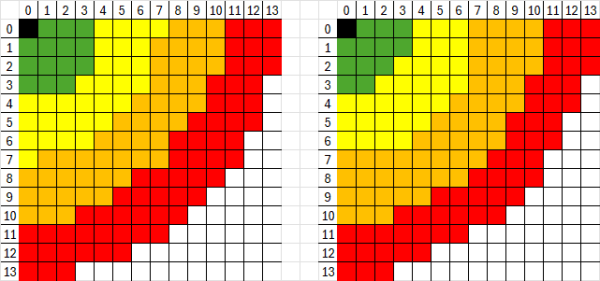
Here's a side-by-side comparison, with the left chart being me trying to eyeball the range and the right chart being the one found on page 71 in the 3rd ed rulebook:
View attachment 170853
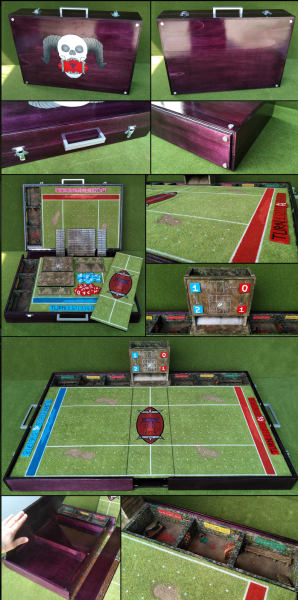
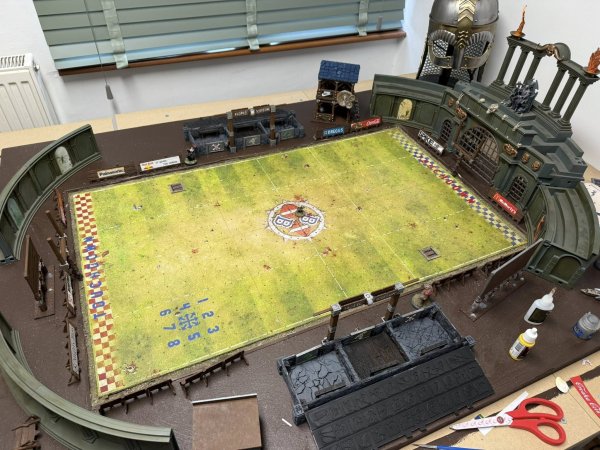
For sake of expediency, my gaming group has taken to using a third party Blood Bowl pitch mat that includes most peripheral things you need for Blood Bowl: a passing range chart, a kick-off table, a weather table, dug-outs, and paired random direction templates. The range ruler only ever comes out when it's a matter of interference.