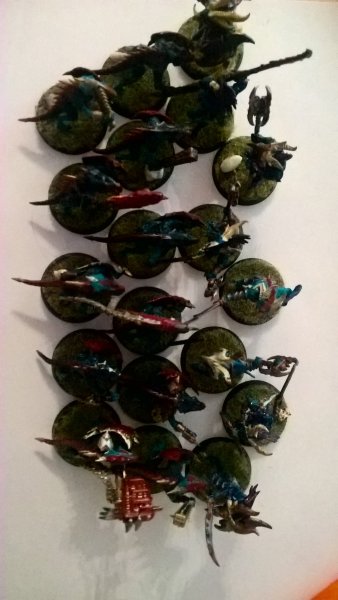
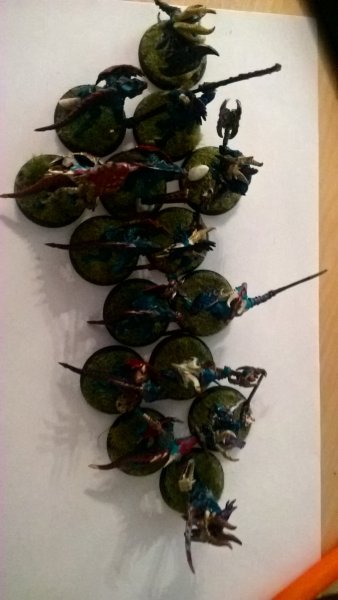
@Putzfrau: I give you my amazing microsoft paint skills. Minor caveat, my amazing paint skills only show the general outline of the formation, I cannot draw the distances properly like this but it should hold up unless I'm making some weird mistakes somewhere.
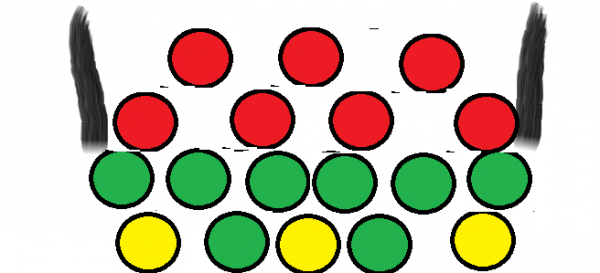
Assume that the black things are obstacles so we can't simply surround red to keep the example simple. The theory holds up regardless but I don't want too put too much effort into this

The idea is now as follows. Red takes this formation.
The space in between 2 reds is too small to slid the green one's neatly.
Now the yellow ones consistantly face an empty space in his formation even when honeycombing. Thus the yellow ones can't attack
Alternativly you could try to slot your the greens on as much into the empty space as possible resulting in the following (ignore the even more amazing paint skills)
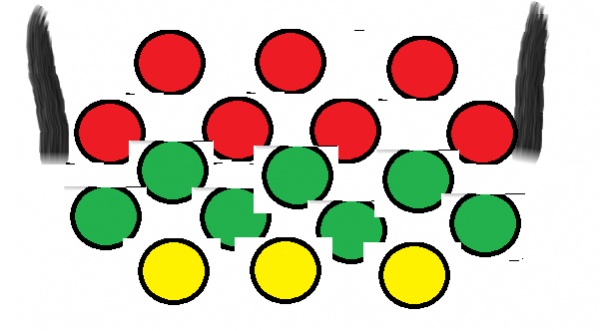
This'd perform worse as you can see even less green ones.
Given by the example I'd say it's possible to deny about half of the second line when honeycombing. This puts clubs at roughly the same effectiveness as spears. However, spears retain a higher maximum. E.g. with 2 lines of 10 for a total of 20. Both spears would now have 20 attacks, clubs 15, both average 6.66 wounds, but spears have the possibility of going over the maximum number of wounds the clubs can cause. Also, this means spears benefit far more from any buffs you might have laying around as it simply affects more attacks. Overal this still gives a slight advantage to spears in large groups, becoming more significant if your opponent tries to actually counter it (even without countering spears will be easier to get into position.)
That was what I was on about. I hope my amazing drawings don't cause even more confusion