Terradon
Christopher
Well-Known Member
- Messages
- 530
- Likes Received
- 851
- Trophy Points
- 93
My local Games Workshop location is hosting a four-week Age of Sigmar Escalation League starting tomorrow and my outsized goal is to have a fully painted army for each week. So far, so good, in that I completed my 500 point list last night (Week One is 500 points using the Vanguard Pitched Battle rules, Week Two is 1000 points, Week Three is 1500 points using the Battlehost Pitched Battle rules, and Week Four is 2000 points).
The two big house rules are that measurements are taken base to base and that there are no double turns—whoever wins the initiative roll in the first round has the first turn in each subsequent round.
All games in the League will be played using the same draws from an Open War card deck. Each Thursday, the shop manager will draw one Deployment, one Objectives, and one Twist card, making a video of the draws which she’ll then post to the shop’s Facebook page. She hasn’t done it yet for Week One, so I don’t know the exact details of the Week One games.
We can play twice a week, taking our better result to be recorded in a just-for-fun points accumulation.
Now, as the title of this post suggests, I have my 500 point list ready to go. Thing is, I’ve still only got maybe a half dozen AoS games under my belt and will be playing against skilled and experienced players. Most likely, I’ll end up playing a lot against the Death player who’s smashed me in every previous contest (more on that below).
Here’s my list.
Battle Trait—Lords of Space and Time
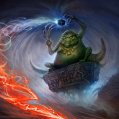
Saurus Eternity Warden (General)
--Leader
--Thickly Scaled Hide Command Trait
--Coronal Shield Artefact
--Inspiring Presence Command Ability
5 Saurus Guard
--Battleline
--1 model built as a drummer
--1 model built as a Stardrake Icon bearer
30 Skinks
--Battleline
--Boltspitters and Star-bucklers
1 Salamander
--Artillery
1 Razordon
--Artillery
That’s exactly 500 points.
My general question for this post is this: what tactics, both broadly and specifically speaking, are most likely to be effective with this list in most situations?
Here are tactical notes I wrote for myself for the test game I played against that Death player last week.
In every Hero Phase, use Inspiring Presence and consider using Lords of Space and Time (possibly on the same unit).
Consider using Lords of Space and Time to teleport the Skinks to a distant objective as soon as possible.
Keep the Saurus Guard with 5” of the general. Give their lack of mobility, consider setting them up on a unit in friendly territory.
Use the Salamander and the Razordon as assassins targeting enemy Heroes.
And that might have worked against that Death army had I actually followed my own advice (and rolled better). We played using those cards and drew a fairly simply two-objective scenario with a Twist of no Battleshock tests to be taken. I teleported my Skinks to close to the objective in my opponent’s territory on my first turn, set up my Eternity Warden and Guard on the objective in my own territory, and set the Salamander and Razordon up flanking the middle of the board—where he’d concentrated most of his forces, which consisted of two undead Heroes of some kind and Battlelines of ten zombies and twenty skeletons (to the best of my recollection).
The three major factors in my defeat were two mistakes I made and the simple nature of his Battlelines. Mistake Number One: I immediately took the bait when he sent his zombies up the middle and sent out my Saurus Guard to engage with them. Mistake Number Two: I realized this days later—I didn’t give myself the Celestial Cohort bonus on my shooting with the Skinks! This led to them being tied up in an all-battle scrum around the objective marker in his territory. Simple Fact: His skeletons and zombies Just. Kept. Coming. Back.
Minor factors included not taking the save for cover in the first round and frankly, the fast and loose nature of my opponent’s play. As just one example, I’m pretty sure he was taking an extra save for his skeletons dependent on them being in proximity to one of his heroes, but they were more than 9” away, which I think is the minimum.
The only thing that worked out fairly well was that I tied up his two heroes with my artillery for most of the game.
Sidebar Question: His skeletons were armed with a mixture of Blades and Spears, giving him incredible ranked reach in melee (lining up the 2” Spearmen behind the 1” Bladesmen). It had been my understanding, based on a FAQ I read, that in most cases any given unit has to be armed identically across all models. In this case, that would be all Spears or all Blades. The exceptions are dependent on the language of the Warscroll, but the Warscroll for Skeleton Warriors specifically says “some units are equipped with Ancient Blades, whilst others go to war with Ancient Spears.” Also, he made a practice of using his Icon Bearer among the skeletons to bring back D6 slain models, as you do, but he did so at the end of the Combat Phase instead of during his Hero Phase, explaining that since we weren’t taking Battleshock tests it wouldn’t make a difference when he did it. At the time, I let that pass, but now that I’m thinking about it, it seems a little off.
The question in all that is, am I right about the identical arming of units being required?
Okay, that’s enough of a wall o’ text.
The two big house rules are that measurements are taken base to base and that there are no double turns—whoever wins the initiative roll in the first round has the first turn in each subsequent round.
All games in the League will be played using the same draws from an Open War card deck. Each Thursday, the shop manager will draw one Deployment, one Objectives, and one Twist card, making a video of the draws which she’ll then post to the shop’s Facebook page. She hasn’t done it yet for Week One, so I don’t know the exact details of the Week One games.
We can play twice a week, taking our better result to be recorded in a just-for-fun points accumulation.
Now, as the title of this post suggests, I have my 500 point list ready to go. Thing is, I’ve still only got maybe a half dozen AoS games under my belt and will be playing against skilled and experienced players. Most likely, I’ll end up playing a lot against the Death player who’s smashed me in every previous contest (more on that below).
Here’s my list.
Battle Trait—Lords of Space and Time
Saurus Eternity Warden (General)
--Leader
--Thickly Scaled Hide Command Trait
--Coronal Shield Artefact
--Inspiring Presence Command Ability
5 Saurus Guard
--Battleline
--1 model built as a drummer
--1 model built as a Stardrake Icon bearer
30 Skinks
--Battleline
--Boltspitters and Star-bucklers
1 Salamander
--Artillery
1 Razordon
--Artillery
That’s exactly 500 points.
My general question for this post is this: what tactics, both broadly and specifically speaking, are most likely to be effective with this list in most situations?
Here are tactical notes I wrote for myself for the test game I played against that Death player last week.
In every Hero Phase, use Inspiring Presence and consider using Lords of Space and Time (possibly on the same unit).
Consider using Lords of Space and Time to teleport the Skinks to a distant objective as soon as possible.
Keep the Saurus Guard with 5” of the general. Give their lack of mobility, consider setting them up on a unit in friendly territory.
Use the Salamander and the Razordon as assassins targeting enemy Heroes.
And that might have worked against that Death army had I actually followed my own advice (and rolled better). We played using those cards and drew a fairly simply two-objective scenario with a Twist of no Battleshock tests to be taken. I teleported my Skinks to close to the objective in my opponent’s territory on my first turn, set up my Eternity Warden and Guard on the objective in my own territory, and set the Salamander and Razordon up flanking the middle of the board—where he’d concentrated most of his forces, which consisted of two undead Heroes of some kind and Battlelines of ten zombies and twenty skeletons (to the best of my recollection).
The three major factors in my defeat were two mistakes I made and the simple nature of his Battlelines. Mistake Number One: I immediately took the bait when he sent his zombies up the middle and sent out my Saurus Guard to engage with them. Mistake Number Two: I realized this days later—I didn’t give myself the Celestial Cohort bonus on my shooting with the Skinks! This led to them being tied up in an all-battle scrum around the objective marker in his territory. Simple Fact: His skeletons and zombies Just. Kept. Coming. Back.
Minor factors included not taking the save for cover in the first round and frankly, the fast and loose nature of my opponent’s play. As just one example, I’m pretty sure he was taking an extra save for his skeletons dependent on them being in proximity to one of his heroes, but they were more than 9” away, which I think is the minimum.
The only thing that worked out fairly well was that I tied up his two heroes with my artillery for most of the game.
Sidebar Question: His skeletons were armed with a mixture of Blades and Spears, giving him incredible ranked reach in melee (lining up the 2” Spearmen behind the 1” Bladesmen). It had been my understanding, based on a FAQ I read, that in most cases any given unit has to be armed identically across all models. In this case, that would be all Spears or all Blades. The exceptions are dependent on the language of the Warscroll, but the Warscroll for Skeleton Warriors specifically says “some units are equipped with Ancient Blades, whilst others go to war with Ancient Spears.” Also, he made a practice of using his Icon Bearer among the skeletons to bring back D6 slain models, as you do, but he did so at the end of the Combat Phase instead of during his Hero Phase, explaining that since we weren’t taking Battleshock tests it wouldn’t make a difference when he did it. At the time, I let that pass, but now that I’m thinking about it, it seems a little off.
The question in all that is, am I right about the identical arming of units being required?
Okay, that’s enough of a wall o’ text.