Shad recently released a world building video that really got my brain cells firing though mostly on off-topic tangents.
I recommend you skip the first four minutes of the video.
Shad has a silly comedy sketch that is not very good then shills his sponsors and then shills his other channel for the first four minutes.
Inns in fantasy are commonly based on the Prancing Pony in Bree in the Lord of the Rings, and these are not very historically accurate but they are prevailent in many fantasy worlds, including Scarterra.
Despite this, the player characters in my RPG rarely stay in inns despite it being an adventurer staple in most of our previous games. Neshik and Kormatin are both deeply entrenched in the priesthood of Khemra. That means, more often than not, they can get free food and lodging from a Khemra temple or allied temple. Neshik is a a highly charismatic folk hero beloved by the peasants and Neshik really likes to talk up the people around him. After Neshik stayed in Duke Zimoz castle, Neshik spread the word among the peasants how wise and just Duke Zimoz is. The other nobles noticed this. Now every noble is delighted to host Neshik.
So far Neshik and company, and Kormatin and company only stayed in inns once, and they did this while traveling incognito as part of an espionage ploy.
4:00 Inns were not as common as most fantasy worlds assume. I knew this already, but it’s was easy to forget.
5:35 Pilgrimages were pretty common, not just for nobles and rich people but it’s something peasants did. Not just for the religious aspect but for the tourism aspect. Not mentioned in the video, but medieval pilgrimage sites had elements of modern tourist traps with people who made their living selling food, accommodations, and cheap souvenirs to pilgrims.
I sort of worked this into the Great Stone of Meckelorn being
the pilgrimage site for dwarves. The Border Barony of Prophet Pass could have people make a pilgrimage to visit the oracle.
During my December writing binge I wrote a short article on the
Temple of the Mountain Winds located in the Barony of Prophet’s Pass.
This would be an important pilgrimage site for Nami’s faithful in West Colassia and ignored by everyone else. I guess it’s also useful for anyone who wants to consult an Oracle which would be many people.
It occurred to me that with Nine deities, Scarterra is probably overflowing with pilgrimage sites though most of them only appeal to a small demographic. I’ve been procrastinating making a detailed map of Fumaya and Swynfaredia but I need to get around to this eventually.
It occurred to me that instead of populating the land with Generic Small town Number One and Generic Small Town Number Two, I can add a local pilgrimage site to give the town some local color and possibly name the town after it.
I clearly need to come up with many pilgrimage sites in the near future. I figure in Swynfaredia, a lot of pilgrimage sites would be the tombs of famous dragon bloods.
5:57, Despite the lack of inns, travelers were fairly common, so they had to stay somewhere.
Not much to add here.
6:55, Staying in Strangers Homes used to be more common than it is now. Air BNB, medieval style. Not much to add here. Scarterran standards for hospitality and being a good host/good guest were probably similar to the real world antiquity.
7:40 Kings and queens visited their vassals often, as noted in the comment section below the video, a king that disliked a vassal might choose to visit a vassal and stay a longer than usual time to eat his resources as a sort of de facto tax. Sure, the king gets the best lodging and that is not that big of a deal, but feeding the king’s entourage is no small feat.
8:10 Merchants liked to host traveling merchants. You get news this ways, and you can shop talk with your peers. Now that I think about it, without phones or the internet, almost any member of a skilled trade would relish the chance to converse with a peer over their shared trade. Shad covers this a bit too.
8:59 One of the expectations of travelers being good guests was that they share news. This actually is what the Order of Delas is based on and without watching this video I came to the logical conclusion that a disproportionately high number of the
Order of Delas members would be merchants.
I also figured tengku would be unusually well informed of comings and goings relative to other Scarterrans though they don’t have a formal order for gossip sharing. Gossip sharing is just something that is part of their culture.
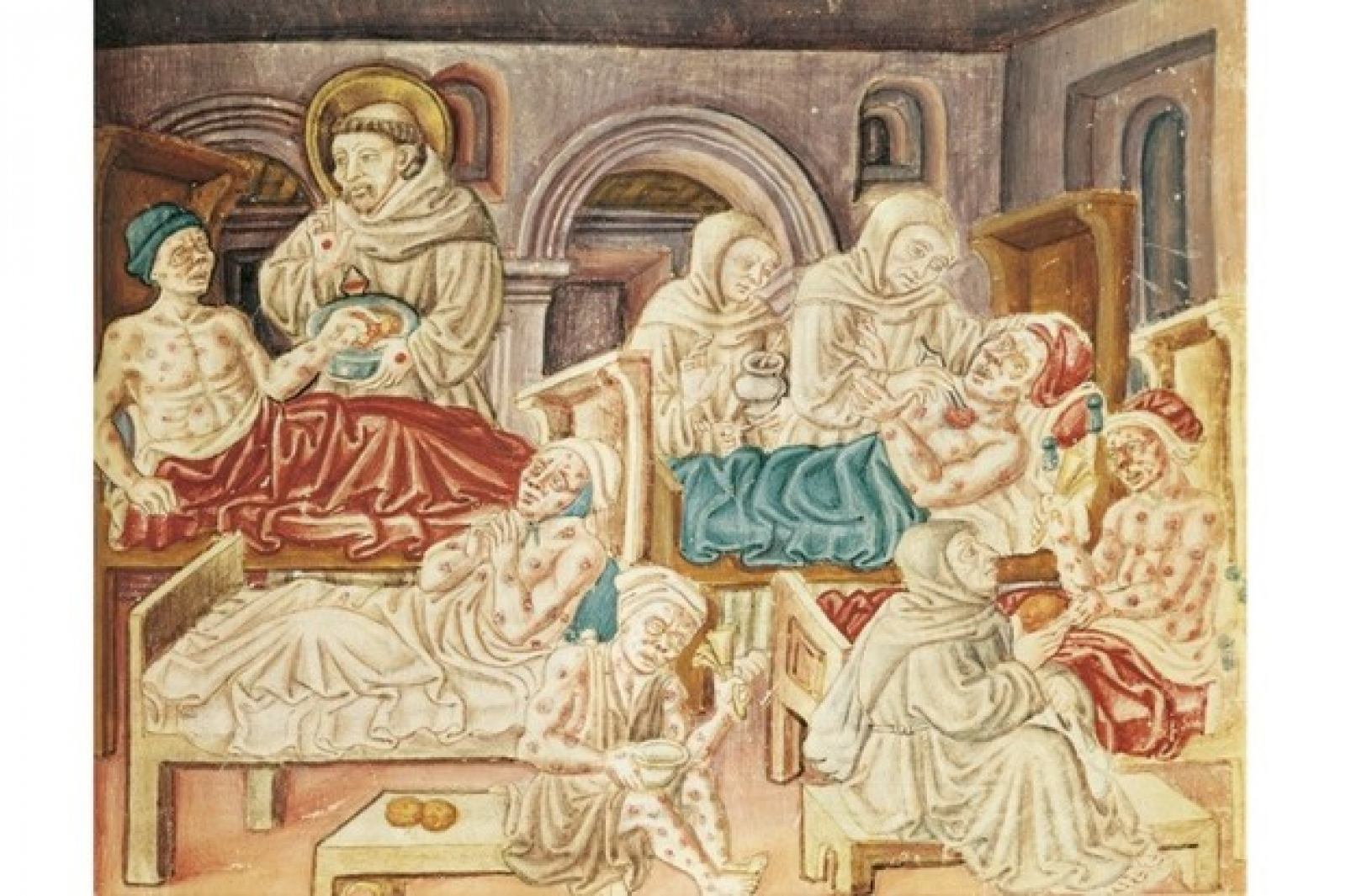
9:15 People who are sick have a harder time finding shelter, as do the bottom rung of society. Originally hospitals provided shelter to
everyone. They were not originally places of healing but places of hospitality. But if you were a healer and you were looking for sick people to heal, you go to the hospital. Hence the modern evolution of the institution.
Mera is a big softy who cares about the outcasts
and Mera’s theurgists and clergy are frequently gifted healers. Zarthus might get in on the action too. Also, Hallisan might get in on the action too, if only to make sure Zarthus doesn’t win too much of Mera’s favor. Okay, so most Scarterran hospitals are run by Mera’s Tenders and they receive support from Zarthus’ Lanterns and Hallisan’s Guardians.
I must make a note to write an article about Scarterran hospials in the near future.
13:57 Medieval European monasteries frequently accommodated those seeking shelter. I covered bishoprics in
this article.
I probably need to figure out how common they would be. Bishoprics and monasteries go hand-in-hand. It’s rare to see one without the other. Because Scarterra has nine deities rather than one, a case could be made that Scarterra would have
more bishoprics than real world medieval Europe but because no priesthood in Scarterra wields political power akin to the Medieval Catholic Church, a case could be made that there would be fewer such places.
The only bishopric that I created thus far is the
Island of the Stewards. Note, the Island of the Stewards does not lay out a welcome mat for random travelers. It's an island that is protected by a small army of sentient plants.
17:30 He finally gets around to addressing inns.
18:30 The concept of sleeping in your own bed and especially your own room is a very modern concept. It was not unusual to have strangers share a bed in an inn. It was certainly not uncommon to have a stranger in the same room. It was pretty common to have a single large room with lots of beds.
This clashes so much with modern sensibilities I might prefer to hand wave this historical realism away because it would distracting to modern audiences.
It was noted in the comment section that adventurers in a fantasy setting qualify as a separate social class and they are fairly rich. Rich enough that whole industries would pop up to accommodate them. They could afford private beds and private rooms. Also, adventurers are often trouble makers and common people would not want to share rooms with them.
24:20 Medieval inns were not commonly also public taverns or ale houses. This conception arises almost entirely from the Prancing Pony in Lord of the Rings. It’s logical that Tolkien came up with this because in the modern world, hotels frequently have attached bars and restaurants open to the public. Real world historical inns did provide food and drink to their patrons but they didn’t normally attract public clientele who were not staying at the inn.
I don’t see a problem with this. Maybe it’s not historically accurate, but it’s not that crazy of an idea that an inn could also be a pub.
As of yet, no article I have written on my World Anvil account has accrued more positive feedback than the
Drunken Bat Inn and Brewery.
To be fair, I would not want to live in Scarterra (unless I retained my power to change Scarterra with my mind while visiting). Scarterra has too many things that could kill me. Also, I like indoor plumbing and toilet paper. But if I could visit Scarterra for one day, I would want to visit the Drunken Bat and chill with my bat homies.
If this style of inn is what people like to read about, why would I not include it? Historical accuracy be damned. Historical Europe didn’t have many combination inn/tavern/breweries, but they didn’t have many kalazotz either.
I will point out that Nami is the patroness of travelers
and is the patroness of wineries, distilleries, and breweries. So Nami monasteries would probably include inns
and a winehouse or alehouse. If this became popular enough, secular people could adopt this practice. In fact, the aforementioned Drunken Bat Inn and Brewery has a symbol of Nami near the entrance out of respect.
I probably need to write an article about Scarterran inn traditions to help clarify this.
27:37 When a city had weapon restrictions, inn’s served as an official place to check your weapons. That could work in Scarterra, but as we covered many pages ago on this thread and summed up in t
his World Anvil article, I think Scarterran lords would be laxer on weapon control than real world medieval lords.