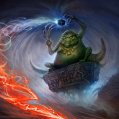
Okay so I just talked about eternal souls but I didn’t cover where these souls actually go...
There are over 20 pages of posts on this thread. Among these, I mentioned three possible fates for a soul in passing.
1-Mortals who were especially devout towards
one god or goddess spend their afterlife in the realm of that god or goddess. A lucky few of these get sent back to the mortal plane to act as their deity’s agent.
2-Mortals who die with Void taint, usually find their soul getting sucked into the Void. Barring divine intervention or epic heroism, a soul in the Void faces utter oblivion.
3-Mortals who die with mild Void taint, who also have very strong passions and unresolved issues become ghosts.
Throw all three of these categories together and 60-90% of Scaterrans do not qualify for any of these ultimate fates. It's time to address where "normal" Scarterran souls go after death.
The Afterlife in Dungeons and Dragons
Originally, I created Scarterra as a Dungeons and Dragons 3.5 edition setting (that could easily be adapted to 2nd or 5th edition with a minimum of fuss), but not every D&D game is required to use the same afterlife model. The afterlife model in a “typical’ D&D setting goes like this:
A mortal normally passes to the afterlife of his or her god. If the mortal was not especially pious the mortal passes on to the outer plane associated with his alignment. In D&D, the outer planes and the gods are largely the same thing. The gods shape the planes and they are shaped by the planes.
Usually mortal souls generally look and act like they did in life. Eventually, maybe over months, maybe over decades, maybe over thousands of years, the mortal soul gets absorbed into the plane they reside in. In general in the Good planes mortal souls peacefully merge with the realm and in the Evil planes mortal souls are often literally eaten by an evil god or demon. Either way the mortal soul merges with the plane and continues to exist but they cease to be an autonomous individual. They maybe reincarnated as archons or devils or demons or whatever, but it's near impossible to trace an extraplanar creature in D&D to the mortal it used to be.
Going back to the parts of the soul in my previous post, if a Scarterran merges with his or her own god in the same fashion as D&D souls merge with their gods, this means the Psyche fades away but the Mortis lives on eternally in a knew and unrecognizeable form.
I have no problem with devout worshippers of one of the Nine getting a VIP pass to their favorite god’s or goddesses’ private palace in the sky, but the vast majority of Scarterrans and Scaraquans are polytheists, so that system does not work for everyone.
I’m not comfortable shunting polytheists off to the godly realm that matches their alignment. Characters in my setting have alignments but alignments are just a tool for categorization. Alignments are not cosmological forces in my world. Players write an alignment on their character sheet, but I don’t punish or yell out players who “play their alignment wrong.” It seems weird to me to dump all the Chaotic Good people in one place when alignment is so subjective and fluid. Complex characters are much more than their alignment.
Greek, Egyptian, Norse, Chinese mythology and many others, the gods disagree a lot but they generally agree on the basics of what constitutes a good life or a life of sin. I like the idea of dead people having their hearts weighed against a feather like in Egyptian mythology, but that doesn’t work very well in Scarterra. Nami and Khemra have very different views on what is sinful. Same with Maylar and Mera. None of the gods see to eye-to-eye on everything. Hallisan and Maylar may both celebrate people who die a warrior’s death, but they disagree strenuously on what warriors should be fighting
for.
The Meta-sky
Back when Scarterra was a D&D setting I created an outer plane that I call the Meta-sky, or if I want to be more fancy, the Ethereal Realm. Scarterra's Meta-sky Version 1.0 is very similar to the D&D realm called the Outlands. The Meta-sky was a giant round field punctuated with forests, hills, valleys, seas etc. All the landmarks glow liked stars. In the center was sort of a neutral city/switching point.
The Meta-sky is to be divided into roughly nine pizza slices. At the "crust" of the metaphorical pizza slices was where each of the Nine has
their own private Idaho. The closer you get to Mera’s private Idaho, the more the terrain looks like Mera’s realm, the more the values resemble Mera’s values. So on and so forth for all the Nine and
their own private Idaho.
I haven't fleshed out each deity's private realm but Mera might provide her dead worshippers with a warm white sandy beach to lounge around and drink pina coladas. Maylar probably lets the souls of worshippers fight each other like a big MMO. Don't worry, if a soul dies in Maylar's realm, it'll heal in a few hours, like a video game with infinite "lives." Zarthus probably has daily rock concerts in his moon palace.
Alternatively rather than have the Meta-sky be a giant pizza with nine even slices the other thought I could make the Meta-sky non-Euclidean where nothing has a fixed location. Landmarks, people, and creatures float around the Meta-sky. Even the palaces/private Idahos of the Nine move around, mirroring the movement of their constellations in the night sky on Scarterras below. The downside of this approach is it makes it harder to narrate plane traveling adventurers visiting the Meta-sky. “So you guys float. Then you float some more. A week later, you're still floating.” In short, if the Meta-sky is a location where heroes can go questing in, it needs to be at least somewhat comprehensible to we earthbound humans who are playing RPGs or reading stories.
In theory, polythesists could wander around the neutral areas of the Meta-sky though I have no idea what they would do. Maybe they are wandering around bored like the spirits of the Asphodel Fields (the neutral zone of Hades in Greek mythology). Maybe they build cities and farms. Maybe they wander a circuit route through the Nine's various Idahos eventually getting bored and moving on. Rinse and repeat. That's a little unsatifying to me. If anyone has a better idea, I'm open to suggestions.
I also don’t know what life is like in the areas that are in neutral zones that are not under the direct purview of one of the Nine. It also doesn’t answer how secure the Meta-sky is. The Nine’s private sub-realms are almost certainly well-protected from Void Demons, but it’s an open question on whether or not Void Demons (or anyone else) can poach souls out of the Meta-sky or not. They certainly would
want to poach souls here.
I also don’t know if the post-mortem residents of the Meta-sky look and act like living mortals or if they look and live radically different lives. It’s also an open question whether the post-mortem residents here have crystal clear memories of their former lives, hazy memories of their former lives, or no memories of their mortal lives.
Star Animals
Originally when Scarterra was going to be a D&D setting, I opted to fill the Meta-sky with Star animals. Star Tigers, Star Dogs, Star Elephants, Star Giant Squids, and Star Pandas...the greatest of all. The basic idea was that since Fiendish and Celestial versions of animals didn’t fit well in my setting that I needed
something to show up when people cast
Summon Monster, so if the Player’s Handbook says you summon a Fiendish Dire Weasel instead you summon a Star Dire Weasel.
Star Animals are a little bit smarter and a little bit stronger and tougher than their mundane counterparts. I place of the
Smite Good attack Fiendish animals get or the
Smite Evil attack Celestial animals get 1-4 times a day, Star Animals get a burst of speed they can access 1-4 times a day. Star animals have black or dark blue scales, skin, or fur dappled with silvery star patterns. Their eyes glow like especially bright stars.
I guess I can still use Star Animals in my homebrew system of D&D10 but as of now, spell-casters summon creatures directly from one of the Nine’s realms and not from the Meta-sky. I suppose I could always have divine spell-casters summon creatures from the Nine’s private realms and arcane casters summon unaffiliated Star Animals from the Meta-sky. It doesn’t make a difference for game stats, just for aesthetics.
I don't have to use the Meta-Sky or Star Animals at all. This is just the rough draft of an afterlife I dreamed up a couple years ago for a slightly different gaming system.
Whatever system I come up with ultimately needs to answer the following questions, plus any pertinent questions you guys come up with.
In general, is the afterlife fair or unfair?
In general, is the afterlife pleasant or unpleasant?
I honestly don’t know either way.
I like the idea of the afterlife being in the sky, but being in the sky doesn’t make something pleasant or fair.
Do the Nine get stronger the more souls they collect in the afterlife or are they burdened by the taking care of mortal souls?
Do mortal souls naturally make their way to their proper afterlife or do soul collectors have to guide them to their afterlife?
These two questions are linked. If the Nine get stronger from collecting souls they are going to put much more effort into collecting the souls of the dead and empower many soul collectors. If the Nine don’t get stronger from collecting souls, they are only going to bother collecting their favorites and employ relatively few soul collectors. In the latter case, Mera, Zarthus, and Hallisan are probably going to collect souls either way. They are generally altruistic and wouldn’t want to leave any souls to twist in the wind. If any uncollected souls ultimately go to the Void, even the evil deities will chip in to help save souls if only to keep the Void from getting stronger.
Is the afterlife really eternal or is some ultimate fate cutting eternity short (becoming one with the gods or some kind of doomsday like the Norse Fimblewinter)?
This ties into the question of if souls make the gods stronger or not. This ties directly into the earlier question of how much Fairness in Death there is, if any.
This impacts a later question as to under what circumstances can the honored dead talk to and interact with the living. If souls eventually fade away or pass on to a higher state of consciousness, it would be much harder to find a two thousand year old dead person than a two hundred year old dead person.
In theory if the Void Demons every wiped out Scarterra, the Nine would die shortly before or after and all existence would end. I guess that's my equivalent to Fimblewinter, but unlike Norse Mythology, my mythology doesn't make Armagedden inevitable. The Void Demons certainly tried to wipe out all of Creations, but they arguably barely put a dent in Creation. Sure, millions of people and animals died but the basic functionality of the universe was undamaged.
How well do dead people retain their memories from life?
This gets to the strength of the psyche. I should note that in both real world historical myths and modern fantasy stories, sometimes memory loss is viewed as a gracious gift and sometimes it’s viewed as a horrible violation.
I suppose it’s also possible to selectively scrub out only good or only bad memories depending on whether or not a soul is being punished or rewarded.
Going back to Coco. Does it matter to a deceased soul whether living people remember them or not.
If it does matter, is being remembered a luxury (those who are remembered can visit the land of the living) or a necessity (being remembered is required to keep one’s Psyche intact).
Does a proper burial help speed mortal souls to a better afterlife than an improper one?
My current notion is that proper funerary rites helping prevent a soul from being sucked into the Void or twisted into an undead mockery, but it doesn’t buy a dead person a free VIP pass to paradise.
My current notion is that each culture has different funerary practices and they believe their practices are the correct ones. However, the actual funerary rituals do not matter to the Nine and they do not matter to the Meta-sky. It’s the thought and sentiment that matters, not the procedures.
What about grave goods? Can a deceased person take it with them? If yes, do they lose their benefit if a graverobber takes their goods much later?
I don’t have any preconceived notions, but this important because fantasy adventurers dive into old tombs a lot.
I really have no preconceived notions or ideas for this part.
Besides ghosts, can deceased souls interact with the living in any way?
The answer is yes. I like the idea of heroes communing with the honored dead. It’s just too cool to not use. My only issue is how often does this event occur and how easy is it to do?
I really like the idea of filial piety (aka ancestor worship) having real world effects. I don’t know if I want something like the Dia Los Meurtes where the dead are close to the living on a special day or if the calendar day doesn’t really matter.
Besides special days, a lot of ancient cultures had special temples or holy sites where people could talk to the undead. Greek Mythology had a lot of cases where Greek heroes had to consult the dead for advice on their quests.
If Scarterra has temples or magic nodes where the living can contact the dead it is not going to be a casual thing. Living supplicants who want to talk to dead people will need to bring offerings, pass tests of willpower and endurance and otherwise prove their worthiness. Then there is the old fantasy/mythology chess nut that dead people tend to be cryptic and confusing, assuming they aren’t deliberately lying. Ignorant of what the living person wants to know, or driven crazy by being dead.
Barring a Dia Los Meurtes situation, I think living people need to go on some kind of personal quest to talk to the dead people, especially if they want to talk to a specific dead person. If a séance participant is not picky, it’s not hard to issue a call to a random dead person. The danger of that approach is most of the dead people waiting on deck to respond to a random séance are jerks.
I also like the idea of Spirit Loas and I don’t have to limit Loas to using ghosts. They could have a means to talk to dead people in the afterlife. At least dead people they have a personal connection to or dead people who are especially interested in meddling with the living.
For a recap, Spirit Loas means spirit horse. A metaphorical horse can let dead people ride him. When this happens the Loa can access skills and knowledge form the spirit riding him, and the spirit can vicariously enjoy the sensation of being alive.
Most Spirit Loas are born with the innate talent to invite dead people in. A few wizards can cast spells to mimic the natural talent of a Spirit Loa, but it’s not a common trick most wizards bother with because of how inherently risk being a Loa is. There are less dangerous ways to contact the dead.
The point is, I think it’s a good thing for a fantasy setting if exceptional individuals can talk to the dead under specific circumstances. So I guess whatever form the general afterlife takes, I want the living and the dead to be able to communicate with the living.
Can living creatures visit the afterlife to go on Orpheus like quests? How common is this?
In Greek mythology, Hercules, Psyche, and Orpheus all traveled to the underworld and lived to tell about it. Maybe Odysseus pulled this off when he talked to the shade that was Tiresias. Some versions of the story, Odysseus traveled to Hades to talk to him, other versions of the story he summoned the dead to the land of the living. That was it. Underworld journeys were not routine.
In other mythologies, especially high fantasy, underworld journeys are something that, while not routine, is something that at least one hero does per generation.
Since plane hopping magic is part and parcel to most D&D games, if Scarterra is used in a D&D game, I figured I’d let D&D magic that allows planar travel to let characters travel to the Nine’s realms. High level characters can travel to other planes almost routinely.
In my homebrew system, ●●●●● magic plus a lot of time and additional investment would be required to visit another plane as a bare minimum. I prefer the notion that to travel to another plane, a mortal has to undertake a quest or complex ritual. This gives non magic users an equal chance.
Either way, it’s a good idea to be on at least neutral terms with the Lord or Lady of the realm you want to visit. I figure most deities have three “welcome centers” in their private realms/palaces. One center is for valued friends, one center is for questing and testing champions and the third center is a dungeon or torture chamber for enemies. The god or goddess gets to decide where any would-be visitor goes.
There would be a backdoor way into the Nine’s private Idahos. A person could theoretically enter the Meta-sky, walk towards a deity’s private Idaho and sneak in a proverbial side door. If a hero or villain wants to invade a deity’s home turf, steal something or do some damage and live to tell about it, this is the only way to do it with any chance of success.




 )
)