
-
The forum software have been upgraded to the latest version.
If you notice anything that looks off, or does not work, please let us know.
For more information, click here.
You are using an out of date browser. It may not display this or other websites correctly.
You should upgrade or use an alternative browser.
You should upgrade or use an alternative browser.
Tutorial High Saurian
- Thread starter n810
- Start date
Slann
n810
First Spawning
- Messages
- 8,103
- Likes Received
- 6,527
- Trophy Points
- 113
GRAMMATICAL RULES, HIGH SAURIAN
Submitted by TzaTza
Adjectives: There are two ways of creating adjectives in Saurian. Almost all nouns can be used as comparative words, and those ending in -a will have that changed to -i, such as in chochi, or "Like the Jaguar." Exceptions for this are adjectives that already end in -a, such as itza, or "first." Thus, the construction -chi as an adjective might have had its origins in a construction -cha, a noun meaning "jaguar" or "ghost." Otherwise, nouns ending in vowel sounds have -q appended, whereas nouns ending in consonantal sounds have -oq appended.
Adjectives as Plural Nouns: By adding the appropriate plural construction to an adjective like Kai or Loq, one can create plural nouns like loqli, or "Fierce Ones" and kaitl, or "Forgotten Ones."
Adverbs: Most High Saurian adverbs are created by adding an -oq to the end of a noun or adjective, much in the same manner as many warm-blood languages. Again, it raises a philosophical and historical question of which group was the originator of this concept.
Adverb-Adjective Endings: It is entirely possible for a word to end in -oqoq. In these cases, the word is assumed to be both adverb and adjective.
Creating Things: The act of creation is, understandably, very important to the Lizards. Thus, any construct dealing with the creation of something new is always said to be "in the process of" doing whatever it is doing. This is even done if it would create a stack of "of" words in the translation to warmblood tongues. To denote the peculiarity, the usual -a- construct signifying "in the process of" is changed to read -da-.
Denoting the Dead: As -tec is a way of denoting the living, -tex would be a way of denoting the dead. This incorporates the use of -x as an indicator of the past tense and departed things or lives. Thus, loqtexli'ihuan, the Dead of the Jungle. "Loqtec" is very, very rare in everyday High Saurian, as a creature cannot truly be alive and dead at the same time. This word mostly applies to the leaders of the Undead hordes. Their minions are loqtexli, the dead.
Gender Cases: There are no "genders" in Saurian as warm-bloods recognize them. As Lizards have no genders themselves, the entire concept of gender-based words is an oddity sprung up amongst warm-bloods. In fact, the very name "Lizardmen" is misleading; though many warm-blood societies associate their males with power and strength, Lizards harbor no such biases, not least because Lizards have no males nor females among them. The closest that Lizards get to gender-based communication is that some of the oldest Slann might remember occasional references to certain Old Ones by such names as the World-Mother, or Father of All Turtles. Very few of these are known in everyday Lizard society; when they are used at all, it is by the Slann in their telepathic communications with one another.
Glottal Stops: Fairly infrequent in Saurian, at least to this author, they are most commonly used in conjunction with words including "huan." As the H in Saurian is silent, a continuous vowel sound may be hazardously confusing on the battlefield, as Skinks or other Lizards who suffer injuries may be hard-pressed to pronounce the long vowel properly. Thus, the glottal stop is used. Examples of this include "Itza'an," the so-called First Jungle.
Noun Order: In Lizard society, the act itself is what holds the weight, and the conditions come second to it, even considering the committer of this act. Thus, nouns usually come first in a word or construct which contains them. It is possible to use words in Saurian which do not contain nouns, but not typical. The word directly following the noun is considered to be the primary modifier, though more than one adjective or verb might be stacked on it. Thus, a word such as Tenxololoqarazonaggaroth would be "Carrying the Word of Fiery Death to Naggaroth" whereas Tenxloqoloarazonaggaroth could be translated as "Carrying the Word of Death-Fire to Naggaroth." As the Old Ones are seen as the originators of all, the only exception to the noun order rule involves Their names, as nothing exists or occurs without Their presence and action.
Old One Names, Segments of: Some of the Old Ones' names are actually compounds consisting of multiple elements of Saurian; the three most obvious are Sotek, Chotec and Huanchi. Both Sotek and Chotec include the Singular grammatical construction in their name, so there must be words in Saurian akin to So and Cho. It is likely that the word So applies to righteousness, territoriality and protection, as it was Sotek who excised the cancer of Skaven from Lustria. Cho, however, is more likely to apply to solar light, speed, and activity as it is Chotec that drives Its solar chariot across the sky to light the world and it is Chotec who blesses Lizards with fiery, sun-heated blood. Huanchi presents the most problematic of the three names. It includes the word Huan, which means "jungle" among other things, as well as the unexplained second syllable -chi. As Huanchi bestows upon its blessed Lizards the ability to move like ghosts or jaguars through the forests of Lustria and the Southlands, it is probable that -chi is an adjective syllable meaning "ghostlike" or "like the jaguar." Thus, the name Huanchi might be translated as "Jungle Ghost" or as some other creature depending upon the different context or inflections used.
Old One Names, Whole: Most Old One names are used in their entirety, as some Lizards have been directly blessed by Their touches and it is believed that using the names of the Old Ones in Lizard society strengthens Their presence. For instance, a unit of Saurus Cavalry might well be known as Chotecitzauaxtecah, Chotec's First Death-Bringers; these Saurus Cavalry would be the first into a fight and they would win great victories. When this happens, it is attributed to the presence of Chotec, who watches over those that bear Its name. When an Old One's name is used in Lizard names and words, the Old One's name is placed first. This serves two functions: to make other Lizards aware of the function that this particular one fills, and to honor the Old Ones. It is literally unthinkable in Lizard society to place one's own name before the name of an Old One, as this would be akin to heresy. Of all of the Lizards, only the Slann and a few particularly old Skink Priests are aware that this can actually be done. The Slann speak nothing of it to lower castes of Lizards and even rarely amongst each other, whereas the Skink Priests secret this information in a few select temples in the surviving temple-cities. Should two (or more) Old Ones' names somehow be used in a word or name, Skink Priests conduct sacrifices of captured enemies at the temples of the Old Ones in question and it is believed that the Old Ones will send a sign to determine the proper ordering of the names.
Proper Names: The only names considered "proper" by Lizards are High Saurian or battlefield Saurian names. Thus, their names for the other races in the Warhammer world incorporate -i- or -a-, as those names are not truly proper. It is a very subtle, but very important distinction if the name by which an outsider is introduced does not incorporate the -i- or -a- constructions, except possibly to note geographical origin. This is used in the event of two outsiders with the same Lizard "diplomatic" name, which is a very uncommon occurence.
Singulars and Plurals: Singulars in Saurian, at least when applied to living things such as a Skink Priest, are usually denoted by adding the suffix -tec to a name. This is most frequently seen among the more formal members of Lizardmen society, such as priests, particularly old Saurus, and Slann. The most rough-and-ready elements of Lizard society, such as most Skink infantry, do not frequently use the singular or plural, as it is generally regarded as the province of the higher castes. In some cases, such as Chameleon Skinks and Skink Skirmishers, the singulars and plurals are discarded in favor of shorter names that are easier to use on a battlefield without giving away one's position to the enemy. The plural is formed in Saurian by adding the suffix -ah to the end of the -tec already appended to this name or word. As Saurian is an agglutinating language, these can contribute to forming incredibly long words difficult for warm-blooded tongues to pronounce. Also, a sidenote of Saurian names is that a Spawning of Saurus Warriors is sometimes named for a particularly powerful Scar-Veteran or Oldblood which leads them, as it is believed by Skink Priests and some Slann that this will bestow some of the power of the Oldblood or Scar-Veteran onto the Saurus Warriors which follow it. This also provides slight reinforcement for the hierarchical nature of Lizard society, though it is of little consequence to the single-minded Saurus Warriors. Plurals for nonliving things are formed in two ways: Words ending in vowel sounds have -tl appended, whereas words ending in consonantal sounds are ended with -li. Words that end with an L-sound simply have -i appended to them to form plurals. This balances each word, as each includes vowel and consonantal sounds. In High Saurian proper names, pluralistic constructs concerning elements of the name are added before the -tec or -tecah at the end.
Submitted by TzaTza
Adjectives: There are two ways of creating adjectives in Saurian. Almost all nouns can be used as comparative words, and those ending in -a will have that changed to -i, such as in chochi, or "Like the Jaguar." Exceptions for this are adjectives that already end in -a, such as itza, or "first." Thus, the construction -chi as an adjective might have had its origins in a construction -cha, a noun meaning "jaguar" or "ghost." Otherwise, nouns ending in vowel sounds have -q appended, whereas nouns ending in consonantal sounds have -oq appended.
Adjectives as Plural Nouns: By adding the appropriate plural construction to an adjective like Kai or Loq, one can create plural nouns like loqli, or "Fierce Ones" and kaitl, or "Forgotten Ones."
Adverbs: Most High Saurian adverbs are created by adding an -oq to the end of a noun or adjective, much in the same manner as many warm-blood languages. Again, it raises a philosophical and historical question of which group was the originator of this concept.
Adverb-Adjective Endings: It is entirely possible for a word to end in -oqoq. In these cases, the word is assumed to be both adverb and adjective.
Creating Things: The act of creation is, understandably, very important to the Lizards. Thus, any construct dealing with the creation of something new is always said to be "in the process of" doing whatever it is doing. This is even done if it would create a stack of "of" words in the translation to warmblood tongues. To denote the peculiarity, the usual -a- construct signifying "in the process of" is changed to read -da-.
Denoting the Dead: As -tec is a way of denoting the living, -tex would be a way of denoting the dead. This incorporates the use of -x as an indicator of the past tense and departed things or lives. Thus, loqtexli'ihuan, the Dead of the Jungle. "Loqtec" is very, very rare in everyday High Saurian, as a creature cannot truly be alive and dead at the same time. This word mostly applies to the leaders of the Undead hordes. Their minions are loqtexli, the dead.
Gender Cases: There are no "genders" in Saurian as warm-bloods recognize them. As Lizards have no genders themselves, the entire concept of gender-based words is an oddity sprung up amongst warm-bloods. In fact, the very name "Lizardmen" is misleading; though many warm-blood societies associate their males with power and strength, Lizards harbor no such biases, not least because Lizards have no males nor females among them. The closest that Lizards get to gender-based communication is that some of the oldest Slann might remember occasional references to certain Old Ones by such names as the World-Mother, or Father of All Turtles. Very few of these are known in everyday Lizard society; when they are used at all, it is by the Slann in their telepathic communications with one another.
Glottal Stops: Fairly infrequent in Saurian, at least to this author, they are most commonly used in conjunction with words including "huan." As the H in Saurian is silent, a continuous vowel sound may be hazardously confusing on the battlefield, as Skinks or other Lizards who suffer injuries may be hard-pressed to pronounce the long vowel properly. Thus, the glottal stop is used. Examples of this include "Itza'an," the so-called First Jungle.
Noun Order: In Lizard society, the act itself is what holds the weight, and the conditions come second to it, even considering the committer of this act. Thus, nouns usually come first in a word or construct which contains them. It is possible to use words in Saurian which do not contain nouns, but not typical. The word directly following the noun is considered to be the primary modifier, though more than one adjective or verb might be stacked on it. Thus, a word such as Tenxololoqarazonaggaroth would be "Carrying the Word of Fiery Death to Naggaroth" whereas Tenxloqoloarazonaggaroth could be translated as "Carrying the Word of Death-Fire to Naggaroth." As the Old Ones are seen as the originators of all, the only exception to the noun order rule involves Their names, as nothing exists or occurs without Their presence and action.
Old One Names, Segments of: Some of the Old Ones' names are actually compounds consisting of multiple elements of Saurian; the three most obvious are Sotek, Chotec and Huanchi. Both Sotek and Chotec include the Singular grammatical construction in their name, so there must be words in Saurian akin to So and Cho. It is likely that the word So applies to righteousness, territoriality and protection, as it was Sotek who excised the cancer of Skaven from Lustria. Cho, however, is more likely to apply to solar light, speed, and activity as it is Chotec that drives Its solar chariot across the sky to light the world and it is Chotec who blesses Lizards with fiery, sun-heated blood. Huanchi presents the most problematic of the three names. It includes the word Huan, which means "jungle" among other things, as well as the unexplained second syllable -chi. As Huanchi bestows upon its blessed Lizards the ability to move like ghosts or jaguars through the forests of Lustria and the Southlands, it is probable that -chi is an adjective syllable meaning "ghostlike" or "like the jaguar." Thus, the name Huanchi might be translated as "Jungle Ghost" or as some other creature depending upon the different context or inflections used.
Old One Names, Whole: Most Old One names are used in their entirety, as some Lizards have been directly blessed by Their touches and it is believed that using the names of the Old Ones in Lizard society strengthens Their presence. For instance, a unit of Saurus Cavalry might well be known as Chotecitzauaxtecah, Chotec's First Death-Bringers; these Saurus Cavalry would be the first into a fight and they would win great victories. When this happens, it is attributed to the presence of Chotec, who watches over those that bear Its name. When an Old One's name is used in Lizard names and words, the Old One's name is placed first. This serves two functions: to make other Lizards aware of the function that this particular one fills, and to honor the Old Ones. It is literally unthinkable in Lizard society to place one's own name before the name of an Old One, as this would be akin to heresy. Of all of the Lizards, only the Slann and a few particularly old Skink Priests are aware that this can actually be done. The Slann speak nothing of it to lower castes of Lizards and even rarely amongst each other, whereas the Skink Priests secret this information in a few select temples in the surviving temple-cities. Should two (or more) Old Ones' names somehow be used in a word or name, Skink Priests conduct sacrifices of captured enemies at the temples of the Old Ones in question and it is believed that the Old Ones will send a sign to determine the proper ordering of the names.
Proper Names: The only names considered "proper" by Lizards are High Saurian or battlefield Saurian names. Thus, their names for the other races in the Warhammer world incorporate -i- or -a-, as those names are not truly proper. It is a very subtle, but very important distinction if the name by which an outsider is introduced does not incorporate the -i- or -a- constructions, except possibly to note geographical origin. This is used in the event of two outsiders with the same Lizard "diplomatic" name, which is a very uncommon occurence.
Singulars and Plurals: Singulars in Saurian, at least when applied to living things such as a Skink Priest, are usually denoted by adding the suffix -tec to a name. This is most frequently seen among the more formal members of Lizardmen society, such as priests, particularly old Saurus, and Slann. The most rough-and-ready elements of Lizard society, such as most Skink infantry, do not frequently use the singular or plural, as it is generally regarded as the province of the higher castes. In some cases, such as Chameleon Skinks and Skink Skirmishers, the singulars and plurals are discarded in favor of shorter names that are easier to use on a battlefield without giving away one's position to the enemy. The plural is formed in Saurian by adding the suffix -ah to the end of the -tec already appended to this name or word. As Saurian is an agglutinating language, these can contribute to forming incredibly long words difficult for warm-blooded tongues to pronounce. Also, a sidenote of Saurian names is that a Spawning of Saurus Warriors is sometimes named for a particularly powerful Scar-Veteran or Oldblood which leads them, as it is believed by Skink Priests and some Slann that this will bestow some of the power of the Oldblood or Scar-Veteran onto the Saurus Warriors which follow it. This also provides slight reinforcement for the hierarchical nature of Lizard society, though it is of little consequence to the single-minded Saurus Warriors. Plurals for nonliving things are formed in two ways: Words ending in vowel sounds have -tl appended, whereas words ending in consonantal sounds are ended with -li. Words that end with an L-sound simply have -i appended to them to form plurals. This balances each word, as each includes vowel and consonantal sounds. In High Saurian proper names, pluralistic constructs concerning elements of the name are added before the -tec or -tecah at the end.
Slann
n810
First Spawning
- Messages
- 8,103
- Likes Received
- 6,527
- Trophy Points
- 113
WORD ELEMENTS, HIGH SAURIAN
Submitted by TzaTza
-a-: This is a letter added between nouns and verbs to note the present tense in some words. As nouns tend to come first in High Saurian and verbs second, this can be an important addition to clarify whether a particular Skink or Saurus is doing something, or has done it in the past. See "Cuaqatec" in the Dictionary section.
-an/-ax: -an/-ax is a construct most frequently appearing in other constructs that have connotations of place. This is not to say that tl- is the designator for a temple or a city, it simply states that -an is most frequently seen in constructs dealing with a particular place, or type of place. It can be used in conjunction with nouns and verbs, etc, to form more specific words denoting location. -ax is a fairly rare element in High Saurian, usually used to denote battlefields or certain parts of the landscape that are no longer present.
-Kai: -Kai may have originally been written as kaa or ka'a, with the glottal stop removed when the long vowel was changed. This may be interpreted as a word having to do with the passage of time, as things that are ancient, forgotten or lost (the three accepted words used to translate -kai) require some amount of time to have passed before they become ancient, forgotten or lost. Perhaps ka'a referred to the time it takes Lizard society to forget something commonly known or conceived. If this is so, further extrapolation may lead to ka'a originating in a construct "kahuan" or "ka'an." This hints at some bygone connection between the two words, as things that are lost or forgotten are commonly associated among warm-bloods and Lizards with the darkness or deep jungle, such as those that overtook many of the dead cities of Lizard society.
-i-: Sometimes used in connection with a noun, though typically written after the noun, to note the origin of that noun. In some cases, and these will be seen by the change in an adjective's ending vowel to -i from whatever it was previously. An attack coming from a Kroxigor (in this case "Kroxigor" is used as an adjective to modify the noun) might be written as Garikroxigor. In a literal translation, this means, "Attack of a Kroxigor." In instances where a plural noun ending in -li is used, a glottal stop is placed to prevent the long vowel. Thus, things killed in the jungle might be referred to under the collective word of Loqtexli'ihuan, the Dead of the Jungle. The use of -i- is one of the few things in Saurian that on its face appears to be irregular, which does not seem to fit with the plan of the Old Ones. In practice, however, it is very simple. Words which do not use -i- as an expression meaning "of" are proper Saurian names. Usually there will be hints that these are names, typically by the inclusion of -tec or -tzin at the end of the name. However, the battlefield version of Saurian does not usually use these suffixes, so the proper use can be confusing. Skinks with a poetic bent do not require the presence of an -i- to denote "of" when writing High Saurian, hence how tenxolo can be translated as Word of Fire without the -i-.
-Mundi: The -i construct notes that -mundi is an adjective.
-o-: Used in conjunction with -raz or other words noting the movement of an item or creature from one place to another, usually placed between the verb and the destination. Quipuarazochaqua would be a quipu being actively carried to Chaqua, for instance. Quipuraxochaqua would be a quipu carried to Chaqua, by the way.
-Otl/-Oatl: Primarily a noun in Saurian, it includes the construct -tl, which is one of the two ways of forming a plural in Saurian. As the three main words associated with -otl and -oatl are Construction, Stronghold and Founding, this lends itself strongly to the theory that the foundation of Lizard society is built on a collective ideal. The many will hold up the fewer and so forth, promoting a pyramidal society culminating originally in the Old Ones, but now focused primarily on the Slann.
Submitted by TzaTza
-a-: This is a letter added between nouns and verbs to note the present tense in some words. As nouns tend to come first in High Saurian and verbs second, this can be an important addition to clarify whether a particular Skink or Saurus is doing something, or has done it in the past. See "Cuaqatec" in the Dictionary section.
-an/-ax: -an/-ax is a construct most frequently appearing in other constructs that have connotations of place. This is not to say that tl- is the designator for a temple or a city, it simply states that -an is most frequently seen in constructs dealing with a particular place, or type of place. It can be used in conjunction with nouns and verbs, etc, to form more specific words denoting location. -ax is a fairly rare element in High Saurian, usually used to denote battlefields or certain parts of the landscape that are no longer present.
-Kai: -Kai may have originally been written as kaa or ka'a, with the glottal stop removed when the long vowel was changed. This may be interpreted as a word having to do with the passage of time, as things that are ancient, forgotten or lost (the three accepted words used to translate -kai) require some amount of time to have passed before they become ancient, forgotten or lost. Perhaps ka'a referred to the time it takes Lizard society to forget something commonly known or conceived. If this is so, further extrapolation may lead to ka'a originating in a construct "kahuan" or "ka'an." This hints at some bygone connection between the two words, as things that are lost or forgotten are commonly associated among warm-bloods and Lizards with the darkness or deep jungle, such as those that overtook many of the dead cities of Lizard society.
-i-: Sometimes used in connection with a noun, though typically written after the noun, to note the origin of that noun. In some cases, and these will be seen by the change in an adjective's ending vowel to -i from whatever it was previously. An attack coming from a Kroxigor (in this case "Kroxigor" is used as an adjective to modify the noun) might be written as Garikroxigor. In a literal translation, this means, "Attack of a Kroxigor." In instances where a plural noun ending in -li is used, a glottal stop is placed to prevent the long vowel. Thus, things killed in the jungle might be referred to under the collective word of Loqtexli'ihuan, the Dead of the Jungle. The use of -i- is one of the few things in Saurian that on its face appears to be irregular, which does not seem to fit with the plan of the Old Ones. In practice, however, it is very simple. Words which do not use -i- as an expression meaning "of" are proper Saurian names. Usually there will be hints that these are names, typically by the inclusion of -tec or -tzin at the end of the name. However, the battlefield version of Saurian does not usually use these suffixes, so the proper use can be confusing. Skinks with a poetic bent do not require the presence of an -i- to denote "of" when writing High Saurian, hence how tenxolo can be translated as Word of Fire without the -i-.
-Mundi: The -i construct notes that -mundi is an adjective.
-o-: Used in conjunction with -raz or other words noting the movement of an item or creature from one place to another, usually placed between the verb and the destination. Quipuarazochaqua would be a quipu being actively carried to Chaqua, for instance. Quipuraxochaqua would be a quipu carried to Chaqua, by the way.
-Otl/-Oatl: Primarily a noun in Saurian, it includes the construct -tl, which is one of the two ways of forming a plural in Saurian. As the three main words associated with -otl and -oatl are Construction, Stronghold and Founding, this lends itself strongly to the theory that the foundation of Lizard society is built on a collective ideal. The many will hold up the fewer and so forth, promoting a pyramidal society culminating originally in the Old Ones, but now focused primarily on the Slann.
Slann
n810
First Spawning
- Messages
- 8,103
- Likes Received
- 6,527
- Trophy Points
- 113
MISCELLANEOUS, HIGH SAURIAN
Submitted by TzaTza
A Distinction Between High Saurian and Battlefield Saurian: High Saurian places the highest emphasis on proper noun-verb/adjective/etc. order, the correct use of constructs like -i- or the plurals, etc, in correlation with the rules of grammar. Battlefield Saurian places more emphasis on speed of use and how quickly a thought can be transmitted by the spoken word. The first thing to go, usually, is noun-verb/adjective/etc. order, which is rearranged depending on the word of a specific Old One whose presence is in the Lizard army. Typically the divination involves cracking open the skull of a sacrificial victim whose heart has already been offered to the Old One in a propitiary ritual prior to the divinatory, and reading the proper pattern in the lines and creases of the brain itself. Two popular differences between High Saurian and Battlefield Saurian are dropping the -tec or -tecah from most names as well as putting the verb before the noun in sentences that more closely resemble the speedily-used tongues of warmbloods.
Between Living And Dead Magic: What the Lizards consider to be "dead" magic primarily applies to the Vampire Counts and the Tomb Kings, and they regard Necromancy as an abomination. "Dead" air is more problematic; the construct -tepox is rarely used, as there are very few places with truly dead air. Even inside a mouldering barrow, the air inside it sustains the growth of grave fungi and vermin. Disgusting life, but life nonetheless. The most frequent sources of tepox are the Chaos Wastes, though some Slann harness tepox for use in powerful magics, particularly on the battlefield.
Chocha: This has interesting implications concerning the separation of ghosts from jaguars, if there indeed is any, in Lizard cosmology. This also may be connected with the name of the city Chaqua. Perhaps at its origin, it was named Chaconqua, "Group of Ghosts" or "Joining Jaguars," with the second version possibly relating to the connection of the Old Ones' lines of power. Over time, or perhaps for expediency's sake, this was shortened to Chaqua. It seems most appropriate now to call it the Group of Ghosts.
Cities: Lizards do not consider cities in the extratemporal sense that warm-bloods do. Cities are not merely -THERE-, they live and die like anything else. Thus, -tlan represents a "living" city, and -tlax represents a "dead" city, as -x is the Saurian way of showing the past tense at the ends of most words. Thus, Tlaxtza could be translated as "Dead City of Water," whereas Tlankai might mean "Ancient Living City." Tlaxtlan, therefore, may be the closest thing Lizards have to an extratemporal city, as its name is easily translated as "Dead City Living City" or "Dead Temple Living Temple" and lends itself to a dichotomous representation of one side being dead and the other alive, or of life and death mingling to form a city that was (or is; I can't remember right off if Tlaxtlan is still extant or not in canon) akin to cities as warm-bloods know them.
City vs. Temple: It is also worth noting that High Saurian does not recognize a major difference between cities and temples, which highlights the importance of the Old Ones in Lizard society. Belief in the Old Ones does not really fall under the title of religion, as "religion" implies a system of faith unnecessary when the very servants of the gods rule society, but it does provide for temples as a place to propitiate the higher powers and ask for Their favor. The Old One system of belief thus is not prone to existentialism and related heretical thoughts as found elsewhere, particularly among Men. The exception to all of this is the Cult of Sotek, whose temples are temples in the mystery-cult/revelatory sense and whose primary god is murkier in origin.
Diminutive: Sometimes used in connection with other words to form a diminutive reference, as all Lizards are "of the water" after a fashion, but "watery" refers to a Lizard that Imperials might refer to as "wet behind the ears."
Honorific: -tzin. Usually applied to a Slann's name, occasionally a particularly mighty Saurus Scar-Veteran or Oldblood, once in a while even the Temple Guard. The suffix literally means "honorable" though its placement in a translated name depends primarily on how the name is translated. For instance, an Oldblood named Huanuaxtectzin (see the Singulars and Plurals section below) might have a name in warm-blooded tongues of "The Jungle's Honorable Killer," though the literal translation is "Jungle-Death-(numerical indicator)-(honorific.) The honorific is common in Lizardmen society, though various groups and entities that follow Tepok, Huanchi and Quetzl tend to have names that more frequently include it. As the blessed Saurus and Skinks of these three Old Ones tend to depend on the more tenuous elements of the World Plan for their well-being, it is believed that using the honorific is in good keeping with how the Old Ones once addressed their servants, and that this will bring luck and power to the Lizards.
Slann: Probably expressed with the glyphs/letters for Tzlan. This bears similarities to "tlan," which is sometimes used as a word describing cities, and is entirely appropriate as a comparison. Just as in medieval kingdoms (supposedly) the king was regarded as an extension of the land the same is true of Lizards, only moreso. A Slann might very well be responsible for keeping the land hospitable enough to support Lizard life. As Slann are alive, but can die, they are very much akin to the temple-cities. It also reinforces the tenet among Lizards that the Slann are the temples, and that the Slann are the cities. Degeneration occurs in places without cities, without Slann. The Dragon Isles are the most notable example, though the Southlands teeter without the highest levels of the societal pyramid. The names of particularly ancient Slann are also frequently accented in High Saurian when they appear in words or sentences, denoting the power and presence of said Slann.
Saurus: Usually written "Tzauaruz." Oddly appropriate, I think, particularly since a newborn Saurus Warrior would be a Tzaruz or Tzauruz, "Born in Water" and the Saurian version is appropriately akin to warm-blooded pronunciations of "Saurus."
Spoken Saurian: Saurian words can mean many different things, depending upon their order in a sentence or the context in which they are used. Outsiders have noted that the slow-witted, structurally limited Saurus Warriors and Kroxigor are unable to use Saurian as well as the quick-minded, physically diverse Skinks. While Saurus and Kroxigor must resort to different volumes, spoken inflections and various reptilian sounds or motions to make up what they speak of Saurian, Skinks are fully capable of using all of these and more tools besides. Subtle changes in the color of a Skink's crest, a rapid adjustment in tone or pitch between words, quick movements of the tail or hands, and closely clipped glottal stops between words or syllables make their meaning clear. The Slann, of course, are above all of this and use powerful telepathy to overcome the boundaries of the spoken word. Warm-blooded scholars and Skinks who write Saurian with letters frequently use accent marks over particular letters to denote emphasis on one syllable or another, which is frequently just which version of a Saurian word is to be used in a particular contex. Also, Skinks create unique characters to represent sounds peculiar to Lizards, and it is these unique features which make understanding Saurian most difficult to outsiders. It is usually impossible for an Elf to change his head-crest from green to orange to signal an attack, for instance.
Writing Materials and Methods: There are two common methods of communicating by writing in Lizard society, most frequently used on tasks too trivial to warrant Slann telepathic communication. The most common of the two involves sliced reeds, whose interior pulps are beaten into a thin sheet and dried for use as paper. These form letters, codices, and similar forms of communication similar to warm-blooded methods, which in turn raises the question of just who created this concept in the first place. Special ceremonial codices or scrolls may be written upon stranger materials and with different inks than the usual crushed-beetle compounds. Some have noted codices in the Temples of Sotek made from the skins of sacrificed Skaven, while the paper-sheet codices in the Temples of Tepok seem to have nothing upon them at all, until they are held up in the moving air and their writing becomes clear. Saurian itself is written in series of compound glyphs, where each segment of the glyph represents a different syllable or word. Translating these glyphs is a ponderous task for the most learned of outsiders, and particularly ancient Lizard texts even give Skink Priests some pause. For instance, a glyph depicting a pool of water around a stand of jungle in which a pyramid's altar is rising represents Huantzaoatl, the Temple in the Jungle's Waters. The second, and more specialized, is communication by quipu. While not a system of writing per se, it is done by tying off lengths of hair (usually taken from native Lustrian warm-bloods or captured enemies) and dipping them in differently colored dyes. Each dye corresponds to a different concept or god in the language of quipus, and their order on the knotted cord is startlingly complex.
Written Saurian: There are two ways to write High Saurian on paper or skin, etc. One, the more ceremonial and proper fashion, is to use the compound glyphs. This is always done in the temples, without exception. Even the temples of Sotek use this, partly to lend Sotek wide acclamation on par with the Old Ones, and partially to raise Sotek's power; the use of the Old Ones' bestowed method of writing gives Sotek power, in the same manner as Saurus Warrior regiments are named for Scar-Veterans or Oldbloods leading them. It is believed that the names of the elders will give power to the youth. The second method, far more common on the battlefield and for quick messages, is to use letters to represent each sound in Saurian, whether High Saurian or the battle-oriented artificial Saurian. Unlike some warm-blood societies, where such a split in writing methods might lead to massive cultural changes as the "old traditional" style is shunted aside in favor of the more popular new style, Lizards have no such problem. The ceremonial system of writing was given directly to them by the Old Ones. There is no questioning of its usefulness or its origins. Some astute priests have noted that it is unlikely the Old Ones would answer any messages presented to Them in such a new, untested system of writing as the letter-based version of Saurian. Mere battlefield communications are not sufficient to judge its worthiness.
Submitted by TzaTza
A Distinction Between High Saurian and Battlefield Saurian: High Saurian places the highest emphasis on proper noun-verb/adjective/etc. order, the correct use of constructs like -i- or the plurals, etc, in correlation with the rules of grammar. Battlefield Saurian places more emphasis on speed of use and how quickly a thought can be transmitted by the spoken word. The first thing to go, usually, is noun-verb/adjective/etc. order, which is rearranged depending on the word of a specific Old One whose presence is in the Lizard army. Typically the divination involves cracking open the skull of a sacrificial victim whose heart has already been offered to the Old One in a propitiary ritual prior to the divinatory, and reading the proper pattern in the lines and creases of the brain itself. Two popular differences between High Saurian and Battlefield Saurian are dropping the -tec or -tecah from most names as well as putting the verb before the noun in sentences that more closely resemble the speedily-used tongues of warmbloods.
Between Living And Dead Magic: What the Lizards consider to be "dead" magic primarily applies to the Vampire Counts and the Tomb Kings, and they regard Necromancy as an abomination. "Dead" air is more problematic; the construct -tepox is rarely used, as there are very few places with truly dead air. Even inside a mouldering barrow, the air inside it sustains the growth of grave fungi and vermin. Disgusting life, but life nonetheless. The most frequent sources of tepox are the Chaos Wastes, though some Slann harness tepox for use in powerful magics, particularly on the battlefield.
Chocha: This has interesting implications concerning the separation of ghosts from jaguars, if there indeed is any, in Lizard cosmology. This also may be connected with the name of the city Chaqua. Perhaps at its origin, it was named Chaconqua, "Group of Ghosts" or "Joining Jaguars," with the second version possibly relating to the connection of the Old Ones' lines of power. Over time, or perhaps for expediency's sake, this was shortened to Chaqua. It seems most appropriate now to call it the Group of Ghosts.
Cities: Lizards do not consider cities in the extratemporal sense that warm-bloods do. Cities are not merely -THERE-, they live and die like anything else. Thus, -tlan represents a "living" city, and -tlax represents a "dead" city, as -x is the Saurian way of showing the past tense at the ends of most words. Thus, Tlaxtza could be translated as "Dead City of Water," whereas Tlankai might mean "Ancient Living City." Tlaxtlan, therefore, may be the closest thing Lizards have to an extratemporal city, as its name is easily translated as "Dead City Living City" or "Dead Temple Living Temple" and lends itself to a dichotomous representation of one side being dead and the other alive, or of life and death mingling to form a city that was (or is; I can't remember right off if Tlaxtlan is still extant or not in canon) akin to cities as warm-bloods know them.
City vs. Temple: It is also worth noting that High Saurian does not recognize a major difference between cities and temples, which highlights the importance of the Old Ones in Lizard society. Belief in the Old Ones does not really fall under the title of religion, as "religion" implies a system of faith unnecessary when the very servants of the gods rule society, but it does provide for temples as a place to propitiate the higher powers and ask for Their favor. The Old One system of belief thus is not prone to existentialism and related heretical thoughts as found elsewhere, particularly among Men. The exception to all of this is the Cult of Sotek, whose temples are temples in the mystery-cult/revelatory sense and whose primary god is murkier in origin.
Diminutive: Sometimes used in connection with other words to form a diminutive reference, as all Lizards are "of the water" after a fashion, but "watery" refers to a Lizard that Imperials might refer to as "wet behind the ears."
Honorific: -tzin. Usually applied to a Slann's name, occasionally a particularly mighty Saurus Scar-Veteran or Oldblood, once in a while even the Temple Guard. The suffix literally means "honorable" though its placement in a translated name depends primarily on how the name is translated. For instance, an Oldblood named Huanuaxtectzin (see the Singulars and Plurals section below) might have a name in warm-blooded tongues of "The Jungle's Honorable Killer," though the literal translation is "Jungle-Death-(numerical indicator)-(honorific.) The honorific is common in Lizardmen society, though various groups and entities that follow Tepok, Huanchi and Quetzl tend to have names that more frequently include it. As the blessed Saurus and Skinks of these three Old Ones tend to depend on the more tenuous elements of the World Plan for their well-being, it is believed that using the honorific is in good keeping with how the Old Ones once addressed their servants, and that this will bring luck and power to the Lizards.
Slann: Probably expressed with the glyphs/letters for Tzlan. This bears similarities to "tlan," which is sometimes used as a word describing cities, and is entirely appropriate as a comparison. Just as in medieval kingdoms (supposedly) the king was regarded as an extension of the land the same is true of Lizards, only moreso. A Slann might very well be responsible for keeping the land hospitable enough to support Lizard life. As Slann are alive, but can die, they are very much akin to the temple-cities. It also reinforces the tenet among Lizards that the Slann are the temples, and that the Slann are the cities. Degeneration occurs in places without cities, without Slann. The Dragon Isles are the most notable example, though the Southlands teeter without the highest levels of the societal pyramid. The names of particularly ancient Slann are also frequently accented in High Saurian when they appear in words or sentences, denoting the power and presence of said Slann.
Saurus: Usually written "Tzauaruz." Oddly appropriate, I think, particularly since a newborn Saurus Warrior would be a Tzaruz or Tzauruz, "Born in Water" and the Saurian version is appropriately akin to warm-blooded pronunciations of "Saurus."
Spoken Saurian: Saurian words can mean many different things, depending upon their order in a sentence or the context in which they are used. Outsiders have noted that the slow-witted, structurally limited Saurus Warriors and Kroxigor are unable to use Saurian as well as the quick-minded, physically diverse Skinks. While Saurus and Kroxigor must resort to different volumes, spoken inflections and various reptilian sounds or motions to make up what they speak of Saurian, Skinks are fully capable of using all of these and more tools besides. Subtle changes in the color of a Skink's crest, a rapid adjustment in tone or pitch between words, quick movements of the tail or hands, and closely clipped glottal stops between words or syllables make their meaning clear. The Slann, of course, are above all of this and use powerful telepathy to overcome the boundaries of the spoken word. Warm-blooded scholars and Skinks who write Saurian with letters frequently use accent marks over particular letters to denote emphasis on one syllable or another, which is frequently just which version of a Saurian word is to be used in a particular contex. Also, Skinks create unique characters to represent sounds peculiar to Lizards, and it is these unique features which make understanding Saurian most difficult to outsiders. It is usually impossible for an Elf to change his head-crest from green to orange to signal an attack, for instance.
Writing Materials and Methods: There are two common methods of communicating by writing in Lizard society, most frequently used on tasks too trivial to warrant Slann telepathic communication. The most common of the two involves sliced reeds, whose interior pulps are beaten into a thin sheet and dried for use as paper. These form letters, codices, and similar forms of communication similar to warm-blooded methods, which in turn raises the question of just who created this concept in the first place. Special ceremonial codices or scrolls may be written upon stranger materials and with different inks than the usual crushed-beetle compounds. Some have noted codices in the Temples of Sotek made from the skins of sacrificed Skaven, while the paper-sheet codices in the Temples of Tepok seem to have nothing upon them at all, until they are held up in the moving air and their writing becomes clear. Saurian itself is written in series of compound glyphs, where each segment of the glyph represents a different syllable or word. Translating these glyphs is a ponderous task for the most learned of outsiders, and particularly ancient Lizard texts even give Skink Priests some pause. For instance, a glyph depicting a pool of water around a stand of jungle in which a pyramid's altar is rising represents Huantzaoatl, the Temple in the Jungle's Waters. The second, and more specialized, is communication by quipu. While not a system of writing per se, it is done by tying off lengths of hair (usually taken from native Lustrian warm-bloods or captured enemies) and dipping them in differently colored dyes. Each dye corresponds to a different concept or god in the language of quipus, and their order on the knotted cord is startlingly complex.
Written Saurian: There are two ways to write High Saurian on paper or skin, etc. One, the more ceremonial and proper fashion, is to use the compound glyphs. This is always done in the temples, without exception. Even the temples of Sotek use this, partly to lend Sotek wide acclamation on par with the Old Ones, and partially to raise Sotek's power; the use of the Old Ones' bestowed method of writing gives Sotek power, in the same manner as Saurus Warrior regiments are named for Scar-Veterans or Oldbloods leading them. It is believed that the names of the elders will give power to the youth. The second method, far more common on the battlefield and for quick messages, is to use letters to represent each sound in Saurian, whether High Saurian or the battle-oriented artificial Saurian. Unlike some warm-blood societies, where such a split in writing methods might lead to massive cultural changes as the "old traditional" style is shunted aside in favor of the more popular new style, Lizards have no such problem. The ceremonial system of writing was given directly to them by the Old Ones. There is no questioning of its usefulness or its origins. Some astute priests have noted that it is unlikely the Old Ones would answer any messages presented to Them in such a new, untested system of writing as the letter-based version of Saurian. Mere battlefield communications are not sufficient to judge its worthiness.
Slann
n810
First Spawning
- Messages
- 8,103
- Likes Received
- 6,527
- Trophy Points
- 113
DICTIONARY, HIGH SAURIAN
Submitted by TzaTza
Angaz: "Metal." A word either borrowed from warm-blood languages or the originator of that word in warm-blood languages, angaz is used to apply to all metals that are not immediately available to Lizards. Thus iron, steel, copper, tin and bronze, among others, all fall under the title of angaz. Gold, silver, platinum and very few others are not angaz. Most High Saurian scholars believe that this word was borrowed from warm-blood languages to cover objects alien to the Lizard civilization. Sort of a generic word. And no, "Tlazcotl" wouldn't really be tied to the names of these metals, since Tlazcotl is cold and forging is not a cold process. Chotec, however, is very keen on forging owing to Its connection with fire and heat.
Atlaztecah: "Ones in the Process of Living," "Survivors." Exclusively used to denote Lizard survivors of battle or catastrophe, this is one of the few times when the construct denoting "in the process of" is found at the very beginning of a word. It was felt that an unusual linguistic construct was needed to attract attention and convey the importance of survivors to the Lizards.
Biqichangaz: "Small Gold," "Little Gold." Bronze. Lizards have been had some experience with bronze via various traders, but don't think much of the metal. They regard it as an inferior to gold, either not realizing or not caring that other races do not have access to the magic that makes Lizard gold useful in weapons.
Biqisotzalz: "Small Blood-Metal." Iron. Pretty much for the same reason as copper and tin are known as bizqichangaz.
Bizqichangaz: "Tiny Gold." Copper and tin. Through metallurgical experiments and magic, Lizards have found out how other races make bronze, but pay little to no attention to either of these metals. They do not differentiate different colors or properties of these two metals when categorizing them in this way - all they are are ingredients to a lesser metal.
Changaz: "Gold." Literally, "Sun-Metal." The brightness of it is said to reflect Chotec's Own light, and its use in weaponry is said to draw on Its celestial power to smite down the enemy.
Chanhualaz: "Sun-Moon-Metal." Electrum. Like almost everything made by Lizards, it is intended to serve a useful purpose first, instead of merely decorating one's body for the purpose of attracting mates or showing off one's status. While even the youngest metallurgist knows that it is made by mixing gold and silver, ancient Lizard plaques (some of which have been lost for centuries) once related the secrets of how to draw different properties of the sun and moon into weaponry, ritual equipment or armor made of electrum. There are rumors of a sword that drew on all of Chotec's heat, but relied on the shadows provided by the Moon to prevent any actual flames from being present when the blade itself was used. Tlachubouztec the Head-Shattering One supposedly carried a shield made from electrum that drew on the celestial bodies' connection to time to rust or corrode any weapon used against its bearer, then the bearer would crush the skull of the enemy with a great obsinite mace. In this way it slew three lords of the Dark Elfs who had attempted to keep Lord Mazadamundi's expedition from retrieving the Star Stela of Quetli. Unfortunately, the location of the resting place of Tlachubouztec and its mighty shield have been lost in the centuries since that mighty crusade. Properly made chanhualaz is exceedingly rare, even among Lizards - some of the oldest Slann believe that the secrets and the magic needed to craft the metal passed from this world when Lord Kroak's body was destroyed by the daemon hordes. Others do not subscribe to this belief, pointing out that Tlachubouztec wielded its shield millenia after this and believing that there was still a source of the powerful metal.
Chochi: "Jaguar's Fire," "Ghostly Wrath." Commonly used in connection with events that benefit the Lizards, but whose origins are murky. It is worth noting that Lizards do not view ghosts in the same manner as others view the cursed souls of Sylvania or Mousillon. Some sacrifices among Lizards are thrown into deep pits at sacred places in the jungle said to be filled with snakes. The snakes rend the body to pieces, and the soul rises back from the pit as a ghost, a sacred creature accounted a variety of abilities. The most notable of these is a certain bloodthirstiness not seen in the ghosts of the Old World; if a traveller neglects to give the ghosts a boon of blood, the traveller will not rest or pass easily through the already-hazardous Lustrian forest during the day. To ignore this tradition at night is to invite Death to look you in the eye.
Choloq: "Sun-Fierce," "Fire of the Sun," "Solar Fury." An adjective or segment of a name denoting power or anger bestowed by the Old One Chotec in Its solar chariot.
Chomundi: "Speed Of The Earth." Physical slowness.
Chosi: "Light of Protection." Not a common word, but most often used in conjunction with powerful magic. Occasionally used in conjunction with an Old One's name.
Cua'a: "Glyph." Whereas tenx is used by Skinks to relate to mere letters and writings, cua'a is used in connection with learning and history, two of the most august concepts in Lizard society. Thus, history can be seen as "glyph-like" and learning as deriving from knowing the glyphs.
Cuaqatec: "One in the process of learning," "Student." Whereas cuaqtec, "historian," implies that the main body of basic learning is over and what is left is case-by-case specialization, cuaqatec implies that the Skink is still learning the basic information to prepare it for the world. Saurus are not usually referred to by this title, although particularly ancient Saurus become cuaqatecah for a time under various Slann or elder Saurus in preparation for the Saurus cuaqatec to be made a field commander. While the title "student" tends to carry prejudicial tones of ignorance and imbecility in warm-blood society, in Lizard society it is regarded as a sacred duty, as a student has been gifted the knowledge and power by the Old Ones to rise to higher things.
Cuaqtec: "Historian," "One Who Keeps History." Self-explanatory.
Cuauzliskinzaz: "Eyes-Finding-Metal." Brass. Its slightly odd name derives from no inherent quality of the metal itself, as so far as Lizards are concerned most of its physical characteristics or traits can be found in other metals. Instead, it is said to be the eyes-finding metal because of its popularity among certain Chaotic entities and followers - it draws Lizard attention, symbolized in this instance by eyes.
Cuaxli: "Dead Glyphs." High Saurian temple codices and writings. Not "scriptures" in the Sigmarite or otherwise religious sense, they tend more towards cosmological record-keeping, or the recording of prophecies and similar occurences. Referred to as "dead" because once they are written down, they cannot be changed without mutilating them, as one might a corpse. Cuaxli, incidentally, are not changed without tremendous amounts of work by Skink Priests and Slann to determine if such a change is necessary, as some cuaxli date back dozens of millenia and carry an incredible weight of time on them.
Garan: "Place of Attack." Fairly self-explanatory, used mainly to mark places where Lizard armies or military units will make their assault against the enemy. A place of ambush is usually referred to as a garanitza, or "First Place of Attack."
Goratecah: "Ones in the process of striking," "Warriors." Self-explanatory.
Hualaz: "Moon-Metal." Silver. Derived by one power or another from a clunky and inefficient archaism of "Huqalchoz," silver is believed to be a relative of gold, as certain moons glow silver in Lustria. Intelligent souls never discuss the mythical warpstone moon in conjunction with this metal in Lustria.
Huantecah: "Jungle-dwellers." The somewhat derogatory name for the diminutive Lustrian warm-bloods. Lizardmen generally do not hunt them except for a few specialized needs. The only exception to this is when the jungle-dwellers threaten one of the Coatl. Frequently a full war expedition is launched to protect the creature should the Lizards hear of it.
Itzakaitecahtzin: "The Honorable Ancient Ones," "The Honorable Old Ones." The Old Ones. In most ceremonies, this word becomes a linguistic monstrosity, sometimes ten times longer and more complex than it already is, as various archaisms, honorifics and names are used in it.
Itzatecah: "The First Ones." It is the most common self-reference word used by Lizards. References to castes and roles in Lizard society are also used, but in any matters concerning other races, the Lizards will refer to themselves as Itzatecah. This word does not allow for any cognitive dissonance in Lizards referring to themselves as "first." It is common sense among Lizards that the Old Ones came before the First Jungle, the First City, or the First Ones. Only fools would think to raise this question of grammar and history.
Itzatl: "The First Things." As itzatecah means "The First Ones" or "The First Living Ones" itzatl are the first inanimate things. Usually this means the water, air, fire and ground, though in most stories involving the Old Ones the adjective -mundi is added to fully define that they are the first things of the existing world.
Kai'itecah: "Lost Ones." Not so much a reference to the Old Ones or other deities, it refers instead to the Elfs, Men and Dwarfs who deviated from the Plan of the World. It carries some small amount of condescension, as it assumes the other races actually knew what the Plan of the World is and deliberately left it.
Loqatec: "One In The Process Of Death." A dying creature, not applied to Lizards as Lizards themselves do not die. The only exceptions to this are Lizards who have been struck by evil poison or foul magic, as most are resilient far and beyond the level of warm-bloods and will recover from the most grievous of injuries. Most frequently it is applied to soon-to-be-prey animals in the jungles and forests, though on the battlefield it is more frequently used to describe ambushed enemies or crazed attackers. The Witch Elfs of Naggaroth, the alcoholic Night Goblin Fanatics and the most crazed followers of the Chaos God Khorne are almost uniformly described as Loqatecah. Sometimes it is used to apply to Dwarfen Slayers or Imperial flagellants, or similarly battle-crazed foes.
Loqax: "Dead-dead-place." A location which once held something that is now gone. Most frequently used to describe something removed from existence by force.
-loqaz: "To die."
Loqtec: "Vampire," "Mummy," "One Who Lives And Is Dead." Self-explanatory, and very rarely used in any other capacity. The use of the -tec ending to describe something that is dead was a decision made by the Old Ones, as it was felt that the exception was necessary to emphasize the wrongness of these creatures. Using this to describe the Old Ones is impossible, as the Old Ones are beyond life and death.
Loqtex: "The Dead." Just so. The past form of -tec is used to note that these things once had life, which has since passed.
Loqtexlian: "Place of the Dead." Generic phrase for graveyard or cemetary. Further qualifiers can be added as usual to create more specific words.
Loqtexli'ihuan: "The Dead of the Jungle." Fairly self-explanatory, it is used to describe forest-dwelling creatures that kill one another, including the native Lustrian warm-bloods. Sometimes, if enemies escape after a battle, they will turn up later, dead by methods unknown until the Lizards have a chance to examine the corpse. These are said to be loqtexli'ihuan.
Loqolo: "Death-Fire." Commonly used in conjunction with powerful geomantic magic, loqolo refers to the fire brought up during volcanic eruptions. Tenxloqolo, the Word of Death-Fire, is usually only associated with particularly severe need. The most prominent tenxloqolo given in the last few millenia was by Lord Mazdamundi.
Loqoq: "Deadly," "Fiercely," "Dangerously." The latter two interpretations are highly rare, and "deadly" is the preferred way of translating this construct.
-Maz: "To make," "To shape." Self-explanatory verb. Thus, "Mazdamundi" can be translated as "One in the Process of the Shaping of the Earth." Also, maz-' past-tense version, max-, is rarely used. It is assumed that once made, pretty much everything is being shaped by everything else. Exceptions are made for Slann corpses, the Old Ones, and occasional magically powerful whatsits. It also causes some reptilian snickering on the part of Skinks whenever they run into a warmblood whose name is Max. This verb is the most frequent breaker of the noun-verb order rule, as the act of creation is frequently considered more important than just what is being created. In some instances, placing the noun before the verb maz- can be used as an insult against warmbloods who understand High Saurian. Understandably, this is a very rare act.
Mazdaquiputltec: "One Who Makes Quipus." Fairly self-explanatory, though this word is sometimes used as an honorific name for a particularly ferocious Lizard who took many heads in battle so that their scalps could become quipus.
Mund: "Ground," "Earth." Earth in the dirt/soil sense, -mund as a construct had the -a appended and a special emphasis given it by some of the first codifiers of Saurian to then apply it to the entire world. From there, it was expanded.
Munda: "The World," "Nature." Self-explanatory, again, though it notes the strong connection between the world and its unspoilt natural origins in Lizard cosmology. This inherent respect for the natural order of things emphasizes the Lizard hatred for Chaos, which breaks the natural order of things as often and as flagrantly as it can, and for other races such as Skaven and Undead. Even the Empire and Bretonnia, with their ramshackle towns of rampantly-placed stone and dead wood, are likely to be unpleasant to Lizards, as Lizard communities are set out along astral lines or the World Plan is scried to determine their proper construction.
Munditecah: "Ones of the Earth." Dwarfs. It's a toss-up as to whether the translation between Saurian and Khazalid shows some ancient connection between the two, but as likely as not it is coincidence.
Olo: "Fire." As cholo is sun-fire, the ch- at the beginning of the word denotes the presence or part played by the sun. Dropping the ch- leaves us with olo. This construct was necessary in Lizard society as it was soon recognized that not all heat nor anger originated directly from Chotec in Its solar chariot. Some was bestowed by Tzunki, whose Blessing makes Its children more adept at bringing arms to bear against the enemy, or Huanchi, whose Blessing gives Its children the power to stalk through the forests and descend on the enemy with great force previously unseen.
Olo'oatl: "Fire-Foundation," "Strongholds of Flame." Volcanos.
Ololoq: "Fire-Death." Another reference to death or purification by burning, a frequent occurence for tainted places or the abodes of enemies. It may seem odd that a mainly forest-dwelling society such as Lizards place so much importance on fire and burning, but fire is an essential part of the natural process, which Lizards, for the most part, revere second only to the Old Ones. Some Skinks stack the hierarchy of importance as Old Ones-Slann-Nature, but most Lizards have it as Old Ones-Nature-Slann, as the Slann are merely the enforcers of Nature and the natural order.
Quipuraztecah: Quipu-Carriers, the Terradon-riding Skink messengers who take messages in knots of dyed and colored hair to other cities or armies in the field.
-Raz: "To bear," "To carry." In shorter words, it is typically translated as carrying, as "bearing" is a more serious and formal method of transport reserved for longer and more weighty expressions. This word is typically applied to Skinks, as Saurus Warriors do not usually carry anything apart from war materials, and Skinks are uniquely adapted to be excellent users of this word.
-Ruz: "to be born." It refers primarily to birth by Spawning Pools, though occasionally the So'otltecah are referred to as Loqrux, or Born of Death. So far as insults go in Lizard society, -Ruz plays a primary role, though Lizards do not insult one another and most enemies do not understand Saurian. Mischievous Skinks, however, have introduced warm-blooded strangers to other Lizards by various insulting names.
Sotzalz: "Blood-Metal." Steel. Plenty of experience with various types of steel to see that it draws blood from one's enemy as well as preventing him from drawing one's own.
Soq: "Territorial." Usually used to describe the alphas among Lustrian wildlife, or warmbloods in general.
So'otltecah: "Territorial Strongholders." A fairly rare word infrequently used by the Lizards who dwell in the interior, it is most common these days in reference to the submerged city of Chupayotl. It is said that of all the Lizard cities and all the battlesites throughout all of existence, ghosts most frequently dwell around Chupayotl. They frighten off seaborne intruders, and quite frequently attack travellers that come too near the city, unless the traveller is a Lizard. However, from time to time throughout Lizard history, individual So'otltecs were seen on particular places on the coastlines, protecting against intruders and shrouding the coastline from prying eyes. Today it is said that the So'otltecah gather in Chupayotl, preparing to wage a mighty War Between The Dead to cleanse the open wound of the Vampire Coast and restore the fouled land to the Lizards who first lived there.
Tebaz: "Air-Metal." Lead. Originally it was given a slightly contradictory-to-its-nature name because the only way most Lizards experienced lead was when it was flying through the air - whether at themselves or someone else.
Tehetec: "Scholar," "One who Knows." Another primarily Skink-oriented word, for good reason. Some non-Skink variations exist for different specialized Saurus Spawnings, such as Teheloqtecah, "Those Who Know Death." This might very well be a Spawning made by Tlazcotl, whose cosmic eye bestows upon Its children fortitude and resilience in the face of terrors that betray the order of life.
Tenqtec: "One who Records," "One who Writes." Author, record-keeper, or any of a dozen similar positions. Outsiders frequently call these Skinks (as all of them are Skinks) scribes. Nuances of position in the writing caste is usually denoted by particular shades of color in a head-crest used when speaking the word. Using a bright red crest when speaking this word typically denotes one's role as a battle-scribe or one who aids an army in the field. A purple crest marks the highest of positions for the Tenqtecah, that of Temple Scribe, as Tepok's chosen color is most commonly associated with the mystic traditions of Lizard spiritualism.
Tenztec: "Worder," "One who Words." Translator. Since translation is regarded as being done with living words, it requires a slight change in spelling from the usual spelling of tenx. Frequently some sort of other word is put into the construct to note just which race's language the tenztec translates. Tenzmunditecahtec, "Ones of the Earth-Worder," would be a Skink that translates to communicate with Dwarfs.
Tenx: "Word." Tenx is connected to Tenq and Hex by a very old principle set down by the Old Ones: that only the ground, the base, of Lizard society, the lowest levels, would use spoken words and written things to keep track of information, lore or knowledge. This is commonly used by Skinks and Saurus in connection with prophecies or information given to Skinks or field commands given to Saurus by a Slann Mage-Priest. One prophecy is accounted as one Word, and so forth. Among Skinks, tenx is fairly uncommon as Skinks and Saurus do not usually think of themselves as using words, though most Skink priests and scribes consider strings of Saurian letters as words.
Tenxolo: "The Word of Fire." A sacred order bestowed by a Slann on an area to be burned. In the past, tenxolotl were primarily issued for ceremonies and for sections of forest that had grown too far out of the Slann's or Old Ones' control. Nowadays, however, tenxolotl are issued for lands held by the enemy, tainted places, and so forth.
Tepa'az: "Bird." Derived from the word for air. The syllable after the glottal stop is intended to be pronounced at a higher vocal register than the syllable before the glottal stop, though this occurs most frequently at ceremonies and temple rituals and is not always used.
Tepoz: "Living Air," "Living Magic." The Old One Tepok's name can, and frequently is, easily be written as Tepoq, where the -q denotes the formation of an adjective from a pair of nouns. As Tepok is primarily the Old One of magic and the air, it is easy to draw the conclusion that the first word derived from Its name represents both of these concepts. Also, it is easy to create the "dead" forms of air and magic by changing the -z at the end of the word to an -x, as in tlan and tlax. The word tepoz implies a deep connection between air and magic; perhaps this Old One was the first to harness the gusts now known as the Winds of Magic, and Its legacy has filtered down, albeit in diluted and debased form, to the Empire and warm-bloods everywhere.
Tepozi: "Sky," "Origin of Air." Fairly self-explanatory, though it also explains the origin of Tepok, Old One patron of the air. It came from out of the sky, just like the air. Tepozli'imundi, therefore, would be "Skies of the World."
Tepozioatl: "Foundations of the Living Air." Clouds. Usually referring to the heavy stormclouds that hang over Lustria, other clouds are given different names. Tepoziolo'oatl, "Foundations of the Fiery Living Air," for instance, usually means firestorms or similar things.
Tepozolo: "Air-fire," "Fire of Air," "Lightning." Usually used to describe lightning, a frequent occurence in Lustria. Occasionally used to describe the magical firestorms that occur on some battlefields, or the pyroclasms accompanying volcanic eruptions.
Tlanq: "Temple-like," "Sacred." Self-explanatory. Thus, "Sacred Saurus" might be written Tzauaruztlanq in High Saurian.
Tlaxan: "Existing-dead-place." Ruined warmblood cities, though some Slann view all non-Lizard cities as tlaxanli, as most of them thrive on maintaining the status quo above all else, which is not healthy.
Tlaxhuanli: "Jungle-Temples." An expression referring to the ruins of Lizard cities, as most are still temples in some form, but have been overrun by the verdant Lustrian landscape.
Tlaxkai: "Lost Dead Temple/City." These refer to places rendered entirely uninhabitable or unusable, typically Chaos-blasted ruin-cities that are no longer useful. Not a common word.
Tlaz: "Mind." As Tlazcotl gives Its children tremendous mental fortitude and willpower, Its name includes -otl, the expression for "Stronghold," implying that one translation of Its name is "Stronghold of the Mind." Tlaz is an unusual noun in High Saurian, in that there is no past tense version of it. Since Lizards never die except by some act of violence, it is assumed that one's mind and one's life are inseparable, thus there is no need for a past tense of -tlaz so long as a Lizard is alive. Even then, most dead Lizards are referred to by the name of Tlazloqtexah, Those Whose Minds Are Dead.
-tlaz: "To live." The mind in Lizard society is intimately connected with life; the dead are said to be thus because their minds do not work any longer. This verb is easily distinguished from the noun tlaz because the verb -tlaz is typically only found in the middle of linguistic constructs. -atlaz, or "in the process of living" seems arcane to outsiders, but Lizards understand it as "lives" in the same manner as Imperials might say "Hans lives at Kleindorf."
Tlaza: "Those," "They."
Tlazan: "Living-place." Warmblood cities.
Tlazachomundi: "Those With Mind-Speed-Of-Earth." A derogatory name for Cold Ones, whose inherent idiocy appears to be a fundamental law of Creation.
Tlazchomundi: "Mind-Speed-Of-Earth." Mental slowness.
Tlazimund: "Mind of Earth." Stubborn. A reference to the strength of will of someone or something that has tlazimund; nearly impossible to budge for normal, everyday creatures, but something that can be shattered and broken by sufficient force.
Tlazitzali: "First Minds." The First Spawning of Slann. As usual, the Lizardmen do not count the Old Ones in their reckoning of time, as the Old Ones are beyond time. Fairly self-explanatory.
Tlaziloqtexa'an: "The Place Of Those Whose Minds Are Dead." The Lizard equivalent of an afterlife, where spirits without sufficient power to remain in the world go. It is not believed that this is the same as other races' afterlives, as Lizard ghosts do not interfere with the world in the same manner as Daemons or creatures bound to the will of the Vampire Counts. Most frequently, this "place," which is more like a state of being, is said to be outside of Time and Space, and usually interpreted to mean that death will bring a dead Lizard to the Old Ones' side, as They exist outside of Time and Space as well.
Tlaztzaq: "Clear Mind." Self-explanatory, and used as a compliment in Lizard society. When Slann are gathered into a council, the Tlaztzaqitza, or First Clear Mind, leads them.
Tloz: "Blasphemy," "Fall, in a spiritual/religious sense." Never used in conjunction with Lizards, as it is impossible for Lizards to choose to give their souls in exchange for power, and heresy as recognized by Sigmarites is veritably unknown. Only the Cult of Sotek has anything resembling suspicions lurking about it, and those are few.
Tlozoq: "Blasphemous," "Fallen." Fairly self-explanatory.
Tlozoz: "To blaspheme."
Tlozoqan: "Blasphemous-place," "Tainted-place." Usually used to describe places despoiled by one enemy or another, or sites where evil cults are discovered.
Tlozoqanitzatl: "First of Blasphemous Places." This is one of the names for the Chaos Wastes, and has no other application in Lizard society. There are many other names for the Chaos Wastes, and many are much longer.
Tlozoqtecah: "Ones of the Fallen," "Blasphemous Ones." Daemons, most frequently those who were once warmbloods or other types of spiritual or magical beings. Daemonic existence is perceived as a crime against the world, and the High Saurian name for it emphasizes that.
Tzaloqax: "Water-dead-dead-place." A dried-up riverbed or lake or something similar. It is not important that the impression left by the water is still there, the water itself is gone. The word tlaxan is the only exception to this rule.
Tzatlmundi: "Waters of the World." The World Pond, the oceans. It is worth noting that Lizards do not maintain the same cartographical view of oceans as the High Elfs of Ulthuan or the humans of the Empire.
Tzaq: "Water-like," "Clear." Pure waters to the Lizards are clear, colored only by what decoration might have been granted them, such as scallop shells or the bones of dead enemies.
Tzet: "Fish." Derived from the word for water. Rumors occur among scholars of High Saurian among other races that similar derivations exist for "olo" and "mund," but their Lizard contacts are typically not in the mood to discuss such things.
-Tzi: "Watery," "Of the Water." An adjective usually used in conjunction with loq or similar nouns to indicate the work of geomancers, particularly Lord Mazdamundi. It is akin to -oli and -mundi in that sometimes glyphs are discovered that are composed of water, just as they might be of fire or earth. These take myriad shapes and forms, but cua'atltzi ("glyphs of the water") are particularly valued by Skink Priests, as it is believed cua'atltzi hold the secrets to the Spawning Pools, and whether new Blessings will be bestowed on Lizard society, or older Blessings generally seen as long-dead will be renewed. The mighty Saurus Lord Kroq-Gar is sometimes invoked in connection with cua'atltzi, as many Skink Priests and even some Slann harbor great hope that others of the Spawning of Xhotl will re-enter the world.
Submitted by TzaTza
Angaz: "Metal." A word either borrowed from warm-blood languages or the originator of that word in warm-blood languages, angaz is used to apply to all metals that are not immediately available to Lizards. Thus iron, steel, copper, tin and bronze, among others, all fall under the title of angaz. Gold, silver, platinum and very few others are not angaz. Most High Saurian scholars believe that this word was borrowed from warm-blood languages to cover objects alien to the Lizard civilization. Sort of a generic word. And no, "Tlazcotl" wouldn't really be tied to the names of these metals, since Tlazcotl is cold and forging is not a cold process. Chotec, however, is very keen on forging owing to Its connection with fire and heat.
Atlaztecah: "Ones in the Process of Living," "Survivors." Exclusively used to denote Lizard survivors of battle or catastrophe, this is one of the few times when the construct denoting "in the process of" is found at the very beginning of a word. It was felt that an unusual linguistic construct was needed to attract attention and convey the importance of survivors to the Lizards.
Biqichangaz: "Small Gold," "Little Gold." Bronze. Lizards have been had some experience with bronze via various traders, but don't think much of the metal. They regard it as an inferior to gold, either not realizing or not caring that other races do not have access to the magic that makes Lizard gold useful in weapons.
Biqisotzalz: "Small Blood-Metal." Iron. Pretty much for the same reason as copper and tin are known as bizqichangaz.
Bizqichangaz: "Tiny Gold." Copper and tin. Through metallurgical experiments and magic, Lizards have found out how other races make bronze, but pay little to no attention to either of these metals. They do not differentiate different colors or properties of these two metals when categorizing them in this way - all they are are ingredients to a lesser metal.
Changaz: "Gold." Literally, "Sun-Metal." The brightness of it is said to reflect Chotec's Own light, and its use in weaponry is said to draw on Its celestial power to smite down the enemy.
Chanhualaz: "Sun-Moon-Metal." Electrum. Like almost everything made by Lizards, it is intended to serve a useful purpose first, instead of merely decorating one's body for the purpose of attracting mates or showing off one's status. While even the youngest metallurgist knows that it is made by mixing gold and silver, ancient Lizard plaques (some of which have been lost for centuries) once related the secrets of how to draw different properties of the sun and moon into weaponry, ritual equipment or armor made of electrum. There are rumors of a sword that drew on all of Chotec's heat, but relied on the shadows provided by the Moon to prevent any actual flames from being present when the blade itself was used. Tlachubouztec the Head-Shattering One supposedly carried a shield made from electrum that drew on the celestial bodies' connection to time to rust or corrode any weapon used against its bearer, then the bearer would crush the skull of the enemy with a great obsinite mace. In this way it slew three lords of the Dark Elfs who had attempted to keep Lord Mazadamundi's expedition from retrieving the Star Stela of Quetli. Unfortunately, the location of the resting place of Tlachubouztec and its mighty shield have been lost in the centuries since that mighty crusade. Properly made chanhualaz is exceedingly rare, even among Lizards - some of the oldest Slann believe that the secrets and the magic needed to craft the metal passed from this world when Lord Kroak's body was destroyed by the daemon hordes. Others do not subscribe to this belief, pointing out that Tlachubouztec wielded its shield millenia after this and believing that there was still a source of the powerful metal.
Chochi: "Jaguar's Fire," "Ghostly Wrath." Commonly used in connection with events that benefit the Lizards, but whose origins are murky. It is worth noting that Lizards do not view ghosts in the same manner as others view the cursed souls of Sylvania or Mousillon. Some sacrifices among Lizards are thrown into deep pits at sacred places in the jungle said to be filled with snakes. The snakes rend the body to pieces, and the soul rises back from the pit as a ghost, a sacred creature accounted a variety of abilities. The most notable of these is a certain bloodthirstiness not seen in the ghosts of the Old World; if a traveller neglects to give the ghosts a boon of blood, the traveller will not rest or pass easily through the already-hazardous Lustrian forest during the day. To ignore this tradition at night is to invite Death to look you in the eye.
Choloq: "Sun-Fierce," "Fire of the Sun," "Solar Fury." An adjective or segment of a name denoting power or anger bestowed by the Old One Chotec in Its solar chariot.
Chomundi: "Speed Of The Earth." Physical slowness.
Chosi: "Light of Protection." Not a common word, but most often used in conjunction with powerful magic. Occasionally used in conjunction with an Old One's name.
Cua'a: "Glyph." Whereas tenx is used by Skinks to relate to mere letters and writings, cua'a is used in connection with learning and history, two of the most august concepts in Lizard society. Thus, history can be seen as "glyph-like" and learning as deriving from knowing the glyphs.
Cuaqatec: "One in the process of learning," "Student." Whereas cuaqtec, "historian," implies that the main body of basic learning is over and what is left is case-by-case specialization, cuaqatec implies that the Skink is still learning the basic information to prepare it for the world. Saurus are not usually referred to by this title, although particularly ancient Saurus become cuaqatecah for a time under various Slann or elder Saurus in preparation for the Saurus cuaqatec to be made a field commander. While the title "student" tends to carry prejudicial tones of ignorance and imbecility in warm-blood society, in Lizard society it is regarded as a sacred duty, as a student has been gifted the knowledge and power by the Old Ones to rise to higher things.
Cuaqtec: "Historian," "One Who Keeps History." Self-explanatory.
Cuauzliskinzaz: "Eyes-Finding-Metal." Brass. Its slightly odd name derives from no inherent quality of the metal itself, as so far as Lizards are concerned most of its physical characteristics or traits can be found in other metals. Instead, it is said to be the eyes-finding metal because of its popularity among certain Chaotic entities and followers - it draws Lizard attention, symbolized in this instance by eyes.
Cuaxli: "Dead Glyphs." High Saurian temple codices and writings. Not "scriptures" in the Sigmarite or otherwise religious sense, they tend more towards cosmological record-keeping, or the recording of prophecies and similar occurences. Referred to as "dead" because once they are written down, they cannot be changed without mutilating them, as one might a corpse. Cuaxli, incidentally, are not changed without tremendous amounts of work by Skink Priests and Slann to determine if such a change is necessary, as some cuaxli date back dozens of millenia and carry an incredible weight of time on them.
Garan: "Place of Attack." Fairly self-explanatory, used mainly to mark places where Lizard armies or military units will make their assault against the enemy. A place of ambush is usually referred to as a garanitza, or "First Place of Attack."
Goratecah: "Ones in the process of striking," "Warriors." Self-explanatory.
Hualaz: "Moon-Metal." Silver. Derived by one power or another from a clunky and inefficient archaism of "Huqalchoz," silver is believed to be a relative of gold, as certain moons glow silver in Lustria. Intelligent souls never discuss the mythical warpstone moon in conjunction with this metal in Lustria.
Huantecah: "Jungle-dwellers." The somewhat derogatory name for the diminutive Lustrian warm-bloods. Lizardmen generally do not hunt them except for a few specialized needs. The only exception to this is when the jungle-dwellers threaten one of the Coatl. Frequently a full war expedition is launched to protect the creature should the Lizards hear of it.
Itzakaitecahtzin: "The Honorable Ancient Ones," "The Honorable Old Ones." The Old Ones. In most ceremonies, this word becomes a linguistic monstrosity, sometimes ten times longer and more complex than it already is, as various archaisms, honorifics and names are used in it.
Itzatecah: "The First Ones." It is the most common self-reference word used by Lizards. References to castes and roles in Lizard society are also used, but in any matters concerning other races, the Lizards will refer to themselves as Itzatecah. This word does not allow for any cognitive dissonance in Lizards referring to themselves as "first." It is common sense among Lizards that the Old Ones came before the First Jungle, the First City, or the First Ones. Only fools would think to raise this question of grammar and history.
Itzatl: "The First Things." As itzatecah means "The First Ones" or "The First Living Ones" itzatl are the first inanimate things. Usually this means the water, air, fire and ground, though in most stories involving the Old Ones the adjective -mundi is added to fully define that they are the first things of the existing world.
Kai'itecah: "Lost Ones." Not so much a reference to the Old Ones or other deities, it refers instead to the Elfs, Men and Dwarfs who deviated from the Plan of the World. It carries some small amount of condescension, as it assumes the other races actually knew what the Plan of the World is and deliberately left it.
Loqatec: "One In The Process Of Death." A dying creature, not applied to Lizards as Lizards themselves do not die. The only exceptions to this are Lizards who have been struck by evil poison or foul magic, as most are resilient far and beyond the level of warm-bloods and will recover from the most grievous of injuries. Most frequently it is applied to soon-to-be-prey animals in the jungles and forests, though on the battlefield it is more frequently used to describe ambushed enemies or crazed attackers. The Witch Elfs of Naggaroth, the alcoholic Night Goblin Fanatics and the most crazed followers of the Chaos God Khorne are almost uniformly described as Loqatecah. Sometimes it is used to apply to Dwarfen Slayers or Imperial flagellants, or similarly battle-crazed foes.
Loqax: "Dead-dead-place." A location which once held something that is now gone. Most frequently used to describe something removed from existence by force.
-loqaz: "To die."
Loqtec: "Vampire," "Mummy," "One Who Lives And Is Dead." Self-explanatory, and very rarely used in any other capacity. The use of the -tec ending to describe something that is dead was a decision made by the Old Ones, as it was felt that the exception was necessary to emphasize the wrongness of these creatures. Using this to describe the Old Ones is impossible, as the Old Ones are beyond life and death.
Loqtex: "The Dead." Just so. The past form of -tec is used to note that these things once had life, which has since passed.
Loqtexlian: "Place of the Dead." Generic phrase for graveyard or cemetary. Further qualifiers can be added as usual to create more specific words.
Loqtexli'ihuan: "The Dead of the Jungle." Fairly self-explanatory, it is used to describe forest-dwelling creatures that kill one another, including the native Lustrian warm-bloods. Sometimes, if enemies escape after a battle, they will turn up later, dead by methods unknown until the Lizards have a chance to examine the corpse. These are said to be loqtexli'ihuan.
Loqolo: "Death-Fire." Commonly used in conjunction with powerful geomantic magic, loqolo refers to the fire brought up during volcanic eruptions. Tenxloqolo, the Word of Death-Fire, is usually only associated with particularly severe need. The most prominent tenxloqolo given in the last few millenia was by Lord Mazdamundi.
Loqoq: "Deadly," "Fiercely," "Dangerously." The latter two interpretations are highly rare, and "deadly" is the preferred way of translating this construct.
-Maz: "To make," "To shape." Self-explanatory verb. Thus, "Mazdamundi" can be translated as "One in the Process of the Shaping of the Earth." Also, maz-' past-tense version, max-, is rarely used. It is assumed that once made, pretty much everything is being shaped by everything else. Exceptions are made for Slann corpses, the Old Ones, and occasional magically powerful whatsits. It also causes some reptilian snickering on the part of Skinks whenever they run into a warmblood whose name is Max. This verb is the most frequent breaker of the noun-verb order rule, as the act of creation is frequently considered more important than just what is being created. In some instances, placing the noun before the verb maz- can be used as an insult against warmbloods who understand High Saurian. Understandably, this is a very rare act.
Mazdaquiputltec: "One Who Makes Quipus." Fairly self-explanatory, though this word is sometimes used as an honorific name for a particularly ferocious Lizard who took many heads in battle so that their scalps could become quipus.
Mund: "Ground," "Earth." Earth in the dirt/soil sense, -mund as a construct had the -a appended and a special emphasis given it by some of the first codifiers of Saurian to then apply it to the entire world. From there, it was expanded.
Munda: "The World," "Nature." Self-explanatory, again, though it notes the strong connection between the world and its unspoilt natural origins in Lizard cosmology. This inherent respect for the natural order of things emphasizes the Lizard hatred for Chaos, which breaks the natural order of things as often and as flagrantly as it can, and for other races such as Skaven and Undead. Even the Empire and Bretonnia, with their ramshackle towns of rampantly-placed stone and dead wood, are likely to be unpleasant to Lizards, as Lizard communities are set out along astral lines or the World Plan is scried to determine their proper construction.
Munditecah: "Ones of the Earth." Dwarfs. It's a toss-up as to whether the translation between Saurian and Khazalid shows some ancient connection between the two, but as likely as not it is coincidence.
Olo: "Fire." As cholo is sun-fire, the ch- at the beginning of the word denotes the presence or part played by the sun. Dropping the ch- leaves us with olo. This construct was necessary in Lizard society as it was soon recognized that not all heat nor anger originated directly from Chotec in Its solar chariot. Some was bestowed by Tzunki, whose Blessing makes Its children more adept at bringing arms to bear against the enemy, or Huanchi, whose Blessing gives Its children the power to stalk through the forests and descend on the enemy with great force previously unseen.
Olo'oatl: "Fire-Foundation," "Strongholds of Flame." Volcanos.
Ololoq: "Fire-Death." Another reference to death or purification by burning, a frequent occurence for tainted places or the abodes of enemies. It may seem odd that a mainly forest-dwelling society such as Lizards place so much importance on fire and burning, but fire is an essential part of the natural process, which Lizards, for the most part, revere second only to the Old Ones. Some Skinks stack the hierarchy of importance as Old Ones-Slann-Nature, but most Lizards have it as Old Ones-Nature-Slann, as the Slann are merely the enforcers of Nature and the natural order.
Quipuraztecah: Quipu-Carriers, the Terradon-riding Skink messengers who take messages in knots of dyed and colored hair to other cities or armies in the field.
-Raz: "To bear," "To carry." In shorter words, it is typically translated as carrying, as "bearing" is a more serious and formal method of transport reserved for longer and more weighty expressions. This word is typically applied to Skinks, as Saurus Warriors do not usually carry anything apart from war materials, and Skinks are uniquely adapted to be excellent users of this word.
-Ruz: "to be born." It refers primarily to birth by Spawning Pools, though occasionally the So'otltecah are referred to as Loqrux, or Born of Death. So far as insults go in Lizard society, -Ruz plays a primary role, though Lizards do not insult one another and most enemies do not understand Saurian. Mischievous Skinks, however, have introduced warm-blooded strangers to other Lizards by various insulting names.
Sotzalz: "Blood-Metal." Steel. Plenty of experience with various types of steel to see that it draws blood from one's enemy as well as preventing him from drawing one's own.
Soq: "Territorial." Usually used to describe the alphas among Lustrian wildlife, or warmbloods in general.
So'otltecah: "Territorial Strongholders." A fairly rare word infrequently used by the Lizards who dwell in the interior, it is most common these days in reference to the submerged city of Chupayotl. It is said that of all the Lizard cities and all the battlesites throughout all of existence, ghosts most frequently dwell around Chupayotl. They frighten off seaborne intruders, and quite frequently attack travellers that come too near the city, unless the traveller is a Lizard. However, from time to time throughout Lizard history, individual So'otltecs were seen on particular places on the coastlines, protecting against intruders and shrouding the coastline from prying eyes. Today it is said that the So'otltecah gather in Chupayotl, preparing to wage a mighty War Between The Dead to cleanse the open wound of the Vampire Coast and restore the fouled land to the Lizards who first lived there.
Tebaz: "Air-Metal." Lead. Originally it was given a slightly contradictory-to-its-nature name because the only way most Lizards experienced lead was when it was flying through the air - whether at themselves or someone else.
Tehetec: "Scholar," "One who Knows." Another primarily Skink-oriented word, for good reason. Some non-Skink variations exist for different specialized Saurus Spawnings, such as Teheloqtecah, "Those Who Know Death." This might very well be a Spawning made by Tlazcotl, whose cosmic eye bestows upon Its children fortitude and resilience in the face of terrors that betray the order of life.
Tenqtec: "One who Records," "One who Writes." Author, record-keeper, or any of a dozen similar positions. Outsiders frequently call these Skinks (as all of them are Skinks) scribes. Nuances of position in the writing caste is usually denoted by particular shades of color in a head-crest used when speaking the word. Using a bright red crest when speaking this word typically denotes one's role as a battle-scribe or one who aids an army in the field. A purple crest marks the highest of positions for the Tenqtecah, that of Temple Scribe, as Tepok's chosen color is most commonly associated with the mystic traditions of Lizard spiritualism.
Tenztec: "Worder," "One who Words." Translator. Since translation is regarded as being done with living words, it requires a slight change in spelling from the usual spelling of tenx. Frequently some sort of other word is put into the construct to note just which race's language the tenztec translates. Tenzmunditecahtec, "Ones of the Earth-Worder," would be a Skink that translates to communicate with Dwarfs.
Tenx: "Word." Tenx is connected to Tenq and Hex by a very old principle set down by the Old Ones: that only the ground, the base, of Lizard society, the lowest levels, would use spoken words and written things to keep track of information, lore or knowledge. This is commonly used by Skinks and Saurus in connection with prophecies or information given to Skinks or field commands given to Saurus by a Slann Mage-Priest. One prophecy is accounted as one Word, and so forth. Among Skinks, tenx is fairly uncommon as Skinks and Saurus do not usually think of themselves as using words, though most Skink priests and scribes consider strings of Saurian letters as words.
Tenxolo: "The Word of Fire." A sacred order bestowed by a Slann on an area to be burned. In the past, tenxolotl were primarily issued for ceremonies and for sections of forest that had grown too far out of the Slann's or Old Ones' control. Nowadays, however, tenxolotl are issued for lands held by the enemy, tainted places, and so forth.
Tepa'az: "Bird." Derived from the word for air. The syllable after the glottal stop is intended to be pronounced at a higher vocal register than the syllable before the glottal stop, though this occurs most frequently at ceremonies and temple rituals and is not always used.
Tepoz: "Living Air," "Living Magic." The Old One Tepok's name can, and frequently is, easily be written as Tepoq, where the -q denotes the formation of an adjective from a pair of nouns. As Tepok is primarily the Old One of magic and the air, it is easy to draw the conclusion that the first word derived from Its name represents both of these concepts. Also, it is easy to create the "dead" forms of air and magic by changing the -z at the end of the word to an -x, as in tlan and tlax. The word tepoz implies a deep connection between air and magic; perhaps this Old One was the first to harness the gusts now known as the Winds of Magic, and Its legacy has filtered down, albeit in diluted and debased form, to the Empire and warm-bloods everywhere.
Tepozi: "Sky," "Origin of Air." Fairly self-explanatory, though it also explains the origin of Tepok, Old One patron of the air. It came from out of the sky, just like the air. Tepozli'imundi, therefore, would be "Skies of the World."
Tepozioatl: "Foundations of the Living Air." Clouds. Usually referring to the heavy stormclouds that hang over Lustria, other clouds are given different names. Tepoziolo'oatl, "Foundations of the Fiery Living Air," for instance, usually means firestorms or similar things.
Tepozolo: "Air-fire," "Fire of Air," "Lightning." Usually used to describe lightning, a frequent occurence in Lustria. Occasionally used to describe the magical firestorms that occur on some battlefields, or the pyroclasms accompanying volcanic eruptions.
Tlanq: "Temple-like," "Sacred." Self-explanatory. Thus, "Sacred Saurus" might be written Tzauaruztlanq in High Saurian.
Tlaxan: "Existing-dead-place." Ruined warmblood cities, though some Slann view all non-Lizard cities as tlaxanli, as most of them thrive on maintaining the status quo above all else, which is not healthy.
Tlaxhuanli: "Jungle-Temples." An expression referring to the ruins of Lizard cities, as most are still temples in some form, but have been overrun by the verdant Lustrian landscape.
Tlaxkai: "Lost Dead Temple/City." These refer to places rendered entirely uninhabitable or unusable, typically Chaos-blasted ruin-cities that are no longer useful. Not a common word.
Tlaz: "Mind." As Tlazcotl gives Its children tremendous mental fortitude and willpower, Its name includes -otl, the expression for "Stronghold," implying that one translation of Its name is "Stronghold of the Mind." Tlaz is an unusual noun in High Saurian, in that there is no past tense version of it. Since Lizards never die except by some act of violence, it is assumed that one's mind and one's life are inseparable, thus there is no need for a past tense of -tlaz so long as a Lizard is alive. Even then, most dead Lizards are referred to by the name of Tlazloqtexah, Those Whose Minds Are Dead.
-tlaz: "To live." The mind in Lizard society is intimately connected with life; the dead are said to be thus because their minds do not work any longer. This verb is easily distinguished from the noun tlaz because the verb -tlaz is typically only found in the middle of linguistic constructs. -atlaz, or "in the process of living" seems arcane to outsiders, but Lizards understand it as "lives" in the same manner as Imperials might say "Hans lives at Kleindorf."
Tlaza: "Those," "They."
Tlazan: "Living-place." Warmblood cities.
Tlazachomundi: "Those With Mind-Speed-Of-Earth." A derogatory name for Cold Ones, whose inherent idiocy appears to be a fundamental law of Creation.
Tlazchomundi: "Mind-Speed-Of-Earth." Mental slowness.
Tlazimund: "Mind of Earth." Stubborn. A reference to the strength of will of someone or something that has tlazimund; nearly impossible to budge for normal, everyday creatures, but something that can be shattered and broken by sufficient force.
Tlazitzali: "First Minds." The First Spawning of Slann. As usual, the Lizardmen do not count the Old Ones in their reckoning of time, as the Old Ones are beyond time. Fairly self-explanatory.
Tlaziloqtexa'an: "The Place Of Those Whose Minds Are Dead." The Lizard equivalent of an afterlife, where spirits without sufficient power to remain in the world go. It is not believed that this is the same as other races' afterlives, as Lizard ghosts do not interfere with the world in the same manner as Daemons or creatures bound to the will of the Vampire Counts. Most frequently, this "place," which is more like a state of being, is said to be outside of Time and Space, and usually interpreted to mean that death will bring a dead Lizard to the Old Ones' side, as They exist outside of Time and Space as well.
Tlaztzaq: "Clear Mind." Self-explanatory, and used as a compliment in Lizard society. When Slann are gathered into a council, the Tlaztzaqitza, or First Clear Mind, leads them.
Tloz: "Blasphemy," "Fall, in a spiritual/religious sense." Never used in conjunction with Lizards, as it is impossible for Lizards to choose to give their souls in exchange for power, and heresy as recognized by Sigmarites is veritably unknown. Only the Cult of Sotek has anything resembling suspicions lurking about it, and those are few.
Tlozoq: "Blasphemous," "Fallen." Fairly self-explanatory.
Tlozoz: "To blaspheme."
Tlozoqan: "Blasphemous-place," "Tainted-place." Usually used to describe places despoiled by one enemy or another, or sites where evil cults are discovered.
Tlozoqanitzatl: "First of Blasphemous Places." This is one of the names for the Chaos Wastes, and has no other application in Lizard society. There are many other names for the Chaos Wastes, and many are much longer.
Tlozoqtecah: "Ones of the Fallen," "Blasphemous Ones." Daemons, most frequently those who were once warmbloods or other types of spiritual or magical beings. Daemonic existence is perceived as a crime against the world, and the High Saurian name for it emphasizes that.
Tzaloqax: "Water-dead-dead-place." A dried-up riverbed or lake or something similar. It is not important that the impression left by the water is still there, the water itself is gone. The word tlaxan is the only exception to this rule.
Tzatlmundi: "Waters of the World." The World Pond, the oceans. It is worth noting that Lizards do not maintain the same cartographical view of oceans as the High Elfs of Ulthuan or the humans of the Empire.
Tzaq: "Water-like," "Clear." Pure waters to the Lizards are clear, colored only by what decoration might have been granted them, such as scallop shells or the bones of dead enemies.
Tzet: "Fish." Derived from the word for water. Rumors occur among scholars of High Saurian among other races that similar derivations exist for "olo" and "mund," but their Lizard contacts are typically not in the mood to discuss such things.
-Tzi: "Watery," "Of the Water." An adjective usually used in conjunction with loq or similar nouns to indicate the work of geomancers, particularly Lord Mazdamundi. It is akin to -oli and -mundi in that sometimes glyphs are discovered that are composed of water, just as they might be of fire or earth. These take myriad shapes and forms, but cua'atltzi ("glyphs of the water") are particularly valued by Skink Priests, as it is believed cua'atltzi hold the secrets to the Spawning Pools, and whether new Blessings will be bestowed on Lizard society, or older Blessings generally seen as long-dead will be renewed. The mighty Saurus Lord Kroq-Gar is sometimes invoked in connection with cua'atltzi, as many Skink Priests and even some Slann harbor great hope that others of the Spawning of Xhotl will re-enter the world.


Scar-Veteran
spawning of Bob
Well-Known Member
- Messages
- 2,911
- Likes Received
- 5,630
- Trophy Points
- 113

Skink Priest
Arli
Moderator
- Messages
- 3,158
- Likes Received
- 87
- Trophy Points
- 48
Old Mossy said:So after referring back to this a few times, I was wondering if we can possibly sticky this? It's a great collection of resources, and I think deserves it.
Done!
Scar-Veteran
spawning of Bob
Well-Known Member
- Messages
- 2,911
- Likes Received
- 5,630
- Trophy Points
- 113
Aside from being most diabolical Lizardmen pun ever, this now becomes a bit interesting.
These guys have been on the drawing board for a couple of weeks (idea without a home). Now I can translate their names using the above resource and the language section in the army book.
Some syllables seem to be borrowed from other languages. This may be another of the many weird characteristics, such as cowardice and ill discipline, which are unique to the Spawning of Bob of Temple City Los'tmabotl.
Los'tmabotl
Lost - ma - botl
Slayer / brave(n) - ma - Permanence/Solidity/Stronghold/Founding
This may indicate that this temple city was founded by a fearless and mighty hero. Alas, those days seem to be well and truly past.
TanqGoditzfridi
Tanq(Tenq) - God - itz - frid - i
Scribe - God - First -of the - frid
If we assume that some words of a warmblooded tongue have been adopted, a literal translation might be:
"God's First Scribe of the Fried"
Perhaps this was a Skink Salamander Handler who was blessed with a quiet and scholarly retirement. This presumably was a rare, if not unique event.
Aidon'tloqmundi
Aidon't - loq - mundi
Aidon't - danger/death/fierce - of the earth
The untranslateable "Aidon't" seems to convey some negative reaction to the fierce-death-danger which springs from the beneath the earth. Given recent insights into Lustrian history it seems plausible that the meaning of the name is "I am getting tired of Skaven popping up all over the place"
Bob will ponder the meaning of the plaques. Perhaps the Old Ones are trying to tell him something.
Attachments
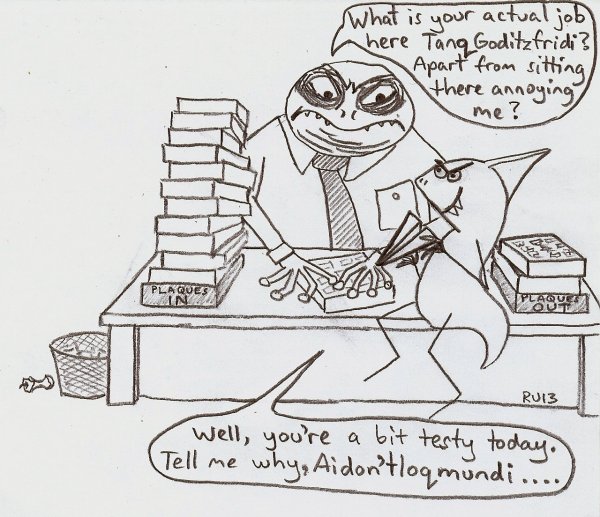
Skink
ravenss
New Member
- Messages
- 17
- Likes Received
- 16
- Trophy Points
- 3
Good god if only UE could get something like this for Queekish. Seriously, one of you guys jump on UE and ask how Queekish works, and Ratty's reply will be something along the lines of
'Every one works it a different way'
I envy you people.
'Every one works it a different way'
I envy you people.
Scar-Veteran
spawning of Bob
Well-Known Member
- Messages
- 2,911
- Likes Received
- 5,630
- Trophy Points
- 113
Hmm.
Ravenss. Rhymes with Skavenss. There could be something going on...
Welcome anyway. We need a few more snackrifices. (look it up: High Saurian page 4)
Speaking as someone who likes his names to mean something, just about the only time I scour this thread is to give a place or a person a good prophetic saurian name.
Often I come up with nothing on the word front but with ideas about how LM might see themselves and their society. My favourite concept is the Quipuraztecah: Quipu-Carriers, the Terradon-riding Skink messengers who take messages in knots of dyed and colored hair to other cities or armies in the field.
But, really High Saurian is a dead language. I don't think you will find even a short phrase in LM fluff.
Queakish is a groovy set of style conventions which suits rats down to the ground - you can use it to denote the jumpy thinking patterns of the rats and it can still be read clearly.
Bob says the Queen's Queekish follows the following rules (Bob has read more Queekish than he has written and breaks his own rules more often than not)
* When a Lustrian chooses to Queekify anything, the Thesaurus is his friend. Of course it is. A Lustrian is friends with all dinosaurs (Ba-boom Ching!)
* Mainly Queekify verbs. as in: "Marteek, you klutz-thing! Why did you kick-smash the door-barrier? You foul-stink this glorious day with your oaf-clumsiness!" unless you count the first, third and fifth examples in this sentence. A better way of saying this is "if you are only going to Queekify ONE thing in the sentence, choose the verb". "I am gonna kill-slay you dead!" is better than "I am gonna kill you dead-dead!"
* As above, pure repetition is lazy. "not-not" being the most common example. Plus, isn't that a double negative? The Scalenazi will get you!
* Scalenex is the master of death. He would say that instead of just kill-killing someone why not stab-kill them, slash-kill them, or pointlessly-but-heroically-kill-them?
* Other Queek terms should be sprinkled in if they are unique skaven cultural concepts. eg. Smell-find, gather-steal, sneak-kill, give-share. Except the last one.
* All rules should be broken if there is a cool phrase or a gag to be made.
eg. "The captives are flee-escaping! Who tied them up?"
"I did not-knot."
"I am going to kill-slay you anyway for that lame-crippled pun."
Ravenss. Rhymes with Skavenss. There could be something going on...
Welcome anyway. We need a few more snackrifices. (look it up: High Saurian page 4)
Speaking as someone who likes his names to mean something, just about the only time I scour this thread is to give a place or a person a good prophetic saurian name.
Often I come up with nothing on the word front but with ideas about how LM might see themselves and their society. My favourite concept is the Quipuraztecah: Quipu-Carriers, the Terradon-riding Skink messengers who take messages in knots of dyed and colored hair to other cities or armies in the field.
But, really High Saurian is a dead language. I don't think you will find even a short phrase in LM fluff.
Queakish is a groovy set of style conventions which suits rats down to the ground - you can use it to denote the jumpy thinking patterns of the rats and it can still be read clearly.
Bob says the Queen's Queekish follows the following rules (Bob has read more Queekish than he has written and breaks his own rules more often than not)
* When a Lustrian chooses to Queekify anything, the Thesaurus is his friend. Of course it is. A Lustrian is friends with all dinosaurs (Ba-boom Ching!)
* Mainly Queekify verbs. as in: "Marteek, you klutz-thing! Why did you kick-smash the door-barrier? You foul-stink this glorious day with your oaf-clumsiness!" unless you count the first, third and fifth examples in this sentence. A better way of saying this is "if you are only going to Queekify ONE thing in the sentence, choose the verb". "I am gonna kill-slay you dead!" is better than "I am gonna kill you dead-dead!"
* As above, pure repetition is lazy. "not-not" being the most common example. Plus, isn't that a double negative? The Scalenazi will get you!
* Scalenex is the master of death. He would say that instead of just kill-killing someone why not stab-kill them, slash-kill them, or pointlessly-but-heroically-kill-them?
* Other Queek terms should be sprinkled in if they are unique skaven cultural concepts. eg. Smell-find, gather-steal, sneak-kill, give-share. Except the last one.
* All rules should be broken if there is a cool phrase or a gag to be made.
eg. "The captives are flee-escaping! Who tied them up?"
"I did not-knot."
"I am going to kill-slay you anyway for that lame-crippled pun."
Scar-Veteran
spawning of Bob
Well-Known Member
- Messages
- 2,911
- Likes Received
- 5,630
- Trophy Points
- 113
I've finally got around to working out the Saurian version of my name, which is entirely linked to my unwritten spawning story.
Reikspiel = Bob - to float aimlessly.
Saurian = Loqtectzi - the dead of the water = dead in the water = floating aimlessly.
My characters are currently in the Old World and use the shorter translation for convenience. I don't have a solution for "Joe" yet.
Reikspiel = Bob - to float aimlessly.
Saurian = Loqtectzi - the dead of the water = dead in the water = floating aimlessly.
My characters are currently in the Old World and use the shorter translation for convenience. I don't have a solution for "Joe" yet.
Last edited:

Slann
Lord-Marcus
Sixth Spawning
- Messages
- 8,949
- Likes Received
- 13,916
- Trophy Points
- 113
This is an extremely interesting read
Slann
Scalenex
Keeper of the Indexes
- Messages
- 11,452
- Likes Received
- 20,359
- Trophy Points
- 113
@Lord-Marcus replied to this, so I thought I might spew on this general topic.
It's only mostly dead!
These are my suggestions for fluff writers wanting to use Saurian (and exotic languages in fantasy general).
Foreign languages are only foreign to foreign people. Foreign is relative.
What does this mean?
In a short story or novel, language should be filtered to your point of view character. That means if the point of view character is a Skink, then you should probably leave out the Saurian altogether or use it very lightly when the Skink is talking to other Lizardmen. The reader should be able to
understand "Saurian" as well as the protagonist can. So for most of us here. English
Now if your point of view character is a clueless human treasure hunter, then all the Lizardmen talk should be Saurian (or guttural unintelligible snarls and chirps). Why bother with Saurian at all? Easter eggs for L-O hard core fans of course!
There is a middle ground. If the character is not a Lizardmen but Saurian is not completely foreign to them, you can use mostly English and mix in a few Saurian words here and there. The two examples that spring to my mind are the character is using an imperfect magical form of translation or the character studied Saurian but is not fully fluent. This also works if your setting has the "Common Tongue." Where some/most/all people have their own tongues but it's there is a language that is close to universal. Dungeons and Dragons lives on this. Game of Thrones dabbles in this. More than a few L-O writers use this trope because they want different factions to interact a lot. If you want to drive home the separation, play up the language barrier. This applies to Saurian as well as any other language. Ulthuan.net has a lot of Eltharin words. Bugmans has a bit Khazalid.
A little bit of fantasy words can make your story seem intriguing and heighten immersion. Too much use of a fake language can bore or annoy readers.
Every reader (and writer) has a different threshold, so I don't know what the perfect amount of exotic words to put in or not. My suggestion is to pick a small number of common words and come up with a with an exotic word for it. My favorite examples include.
Money
Weights and measures
Weapons
Clothes
Titles for leaders
Forms of address (sir, ma'am)
I think an important rule of thumb is that if you are going to pull a word from a Saurian dictionary or something similar (or you want to make something up yourself), use the new word a LOT. If you are going to call the currency "grokel" that make sure your characters are talking about money. "Another day, another grokel." "10 Grokels for this?" "That guy is throwing grokels around like crazy." That's why I like money for adding new words. All you have to do is write one scene where the character is haggling with someone and any reader can figure out what you call your money without writing "Grokels is the base unit of currency." A short story probably shouldn't have more than three exotic words in it (maybe one is best). A 300 page novel can get away with a ceiling of two dozen, at most.
Another thing you can do besides make up new words altogether is use your existing language (presumably English) to describe something in a different way.
Example blowpipe. You can use the Saurian above plus a little bit of fabrication to biqloq'ta which loosely translates into "little death wind." Or you could just have the Skinks refer to blowpipes as "death spitters." Here's a fun idea. What if you have a Skink character who calls his blowpipe "my blowpipe" and another Skink character who calls it "my death spitter." You just revealed characterization. Compared to the first the second Skink takes his role as a warrior and killer more seriously. To the first Skink, the blowpipe is simply a tool. To the second one it's the tool...of death.
Going back to money. Dungeons and Dragons has pushed through a fantasy standard of gold coins, silver coins, and copper coins being the base fantasy standard in a lot of world. Even if you never played D&D (or something like it) most readers can figure out gold > silver > copper and you only have to have a character make change once to show 1 gold piece = 10 silver pieces = 100 coppers. No biggie. But it's a lot more fun sounding if you call your money something different.
Let's just assume they put the emperor or king's face on the coins. Rather than saying gold piece, what if they said "gold crown." Instead of silver piece you can can "silver prince" and call a copper "the king's bit." That's put more character. As an added bonus, if your story is going to eventually involve the royal family is some way this is a good way to plant the seed of "the king is important" in the back your reader's mind even if your first six or seven chapters are all dealing with low born rabble scurrying about alleys.
Dragonlance series has characters refer to the center of a target as the Dragon's eye, not the bull's eye. That demonstrates that dragons exist without beating the reader over the head with it.
"Death spitter," "gold crown" and "dragon's eye." You can insert a lot more "new" words of this nature in one story than words like "biqloq'ta." A common thing Lizardmen stories have is calling immature people (or lizards) tadpoles.
Whether you are creating a new word altogether or repackaging old words for new meanings, make sure you reinforce them with repetition, particularly if the word is brand new. I made sure when I invented a word (and a creature) named the Quatlixa that the characters in that story spent a lot of time fighting Quatlixa.
Accents are only noticeable to foreign people. Foreign is relative. A little bit of accents in your fiction can bring your characters to life. Too much use of an accent can bore or annoy readers.
The biggest thing is I believe accents shouldn't be so thick that's it's a chore to figure out what the characters are saying, unless you want the character to be difficult to understands.
There is a lot of blending with accents and language guidelines. I'm going to focus on Queekish double speak. If my point of view character is a Skaven, I try to use it sparingly. Once per sentence tops. If my point of view character is an enemy or rival of the Skaven (Lizardmen or human), I'm probably going to use twice as many hyphenated words. If I'm going to cover the Skaven from a third person omniscient view, I'll split the difference.
In my opinion. The closer the point of view character is to the speaker, the less extreme the accent should be.
Here are the common guidelines used on Lustria-Online though many writers break these guidelines and that's perfectly fine.
-Slann are usually terse and cryptic.
-Saurus are usually blunt and direct.
-Kroxigor tend to speak terse and direct with very simple sentences.
-Chameleon Skinks exaggerate their "s"s and have trouble with soft consonants.
-Skink priests tend to be formal and sometimes flowery in their language.
-Rank and file Skinks are usually the "normal" base line usually, but if the point of view character is not a Skink, it's not uncommon to make Skinks chatter boxes.
Back to the point of view thing. If the point of view is a Chameleon Skink, I'm going to tone down the sssslurred ssssounds. If the point of view character is a Kroxigor, I'll probably give the protagonist a bit more verbal variety. If the point of view character is a Slann, I'm probably going to make him more chatty than I would if he was a side character.
If the point of view character is a Dwarf, they are probably are not going to sound like a cartoon Scottsman in my pieces. But if they are side character, I'll crank up the "All right ladz, get your cross bows and unleash hell on the Goblins's arses!"
Same goes for every fantasy accent. The more removed the character is from the point of view character, the more extreme their dialect is going to be.
But, really High Saurian is a dead language. I don't think you will find even a short phrase in LM fluff.
It's only mostly dead!
These are my suggestions for fluff writers wanting to use Saurian (and exotic languages in fantasy general).
Foreign languages are only foreign to foreign people. Foreign is relative.
What does this mean?
In a short story or novel, language should be filtered to your point of view character. That means if the point of view character is a Skink, then you should probably leave out the Saurian altogether or use it very lightly when the Skink is talking to other Lizardmen. The reader should be able to
understand "Saurian" as well as the protagonist can. So for most of us here. English
Now if your point of view character is a clueless human treasure hunter, then all the Lizardmen talk should be Saurian (or guttural unintelligible snarls and chirps). Why bother with Saurian at all? Easter eggs for L-O hard core fans of course!
There is a middle ground. If the character is not a Lizardmen but Saurian is not completely foreign to them, you can use mostly English and mix in a few Saurian words here and there. The two examples that spring to my mind are the character is using an imperfect magical form of translation or the character studied Saurian but is not fully fluent. This also works if your setting has the "Common Tongue." Where some/most/all people have their own tongues but it's there is a language that is close to universal. Dungeons and Dragons lives on this. Game of Thrones dabbles in this. More than a few L-O writers use this trope because they want different factions to interact a lot. If you want to drive home the separation, play up the language barrier. This applies to Saurian as well as any other language. Ulthuan.net has a lot of Eltharin words. Bugmans has a bit Khazalid.
A little bit of fantasy words can make your story seem intriguing and heighten immersion. Too much use of a fake language can bore or annoy readers.
Every reader (and writer) has a different threshold, so I don't know what the perfect amount of exotic words to put in or not. My suggestion is to pick a small number of common words and come up with a with an exotic word for it. My favorite examples include.
Money
Weights and measures
Weapons
Clothes
Titles for leaders
Forms of address (sir, ma'am)
I think an important rule of thumb is that if you are going to pull a word from a Saurian dictionary or something similar (or you want to make something up yourself), use the new word a LOT. If you are going to call the currency "grokel" that make sure your characters are talking about money. "Another day, another grokel." "10 Grokels for this?" "That guy is throwing grokels around like crazy." That's why I like money for adding new words. All you have to do is write one scene where the character is haggling with someone and any reader can figure out what you call your money without writing "Grokels is the base unit of currency." A short story probably shouldn't have more than three exotic words in it (maybe one is best). A 300 page novel can get away with a ceiling of two dozen, at most.
Another thing you can do besides make up new words altogether is use your existing language (presumably English) to describe something in a different way.
Example blowpipe. You can use the Saurian above plus a little bit of fabrication to biqloq'ta which loosely translates into "little death wind." Or you could just have the Skinks refer to blowpipes as "death spitters." Here's a fun idea. What if you have a Skink character who calls his blowpipe "my blowpipe" and another Skink character who calls it "my death spitter." You just revealed characterization. Compared to the first the second Skink takes his role as a warrior and killer more seriously. To the first Skink, the blowpipe is simply a tool. To the second one it's the tool...of death.
Going back to money. Dungeons and Dragons has pushed through a fantasy standard of gold coins, silver coins, and copper coins being the base fantasy standard in a lot of world. Even if you never played D&D (or something like it) most readers can figure out gold > silver > copper and you only have to have a character make change once to show 1 gold piece = 10 silver pieces = 100 coppers. No biggie. But it's a lot more fun sounding if you call your money something different.
Let's just assume they put the emperor or king's face on the coins. Rather than saying gold piece, what if they said "gold crown." Instead of silver piece you can can "silver prince" and call a copper "the king's bit." That's put more character. As an added bonus, if your story is going to eventually involve the royal family is some way this is a good way to plant the seed of "the king is important" in the back your reader's mind even if your first six or seven chapters are all dealing with low born rabble scurrying about alleys.
Dragonlance series has characters refer to the center of a target as the Dragon's eye, not the bull's eye. That demonstrates that dragons exist without beating the reader over the head with it.
"Death spitter," "gold crown" and "dragon's eye." You can insert a lot more "new" words of this nature in one story than words like "biqloq'ta." A common thing Lizardmen stories have is calling immature people (or lizards) tadpoles.
Whether you are creating a new word altogether or repackaging old words for new meanings, make sure you reinforce them with repetition, particularly if the word is brand new. I made sure when I invented a word (and a creature) named the Quatlixa that the characters in that story spent a lot of time fighting Quatlixa.
Accents are only noticeable to foreign people. Foreign is relative. A little bit of accents in your fiction can bring your characters to life. Too much use of an accent can bore or annoy readers.
The biggest thing is I believe accents shouldn't be so thick that's it's a chore to figure out what the characters are saying, unless you want the character to be difficult to understands.
There is a lot of blending with accents and language guidelines. I'm going to focus on Queekish double speak. If my point of view character is a Skaven, I try to use it sparingly. Once per sentence tops. If my point of view character is an enemy or rival of the Skaven (Lizardmen or human), I'm probably going to use twice as many hyphenated words. If I'm going to cover the Skaven from a third person omniscient view, I'll split the difference.
In my opinion. The closer the point of view character is to the speaker, the less extreme the accent should be.
Here are the common guidelines used on Lustria-Online though many writers break these guidelines and that's perfectly fine.
-Slann are usually terse and cryptic.
-Saurus are usually blunt and direct.
-Kroxigor tend to speak terse and direct with very simple sentences.
-Chameleon Skinks exaggerate their "s"s and have trouble with soft consonants.
-Skink priests tend to be formal and sometimes flowery in their language.
-Rank and file Skinks are usually the "normal" base line usually, but if the point of view character is not a Skink, it's not uncommon to make Skinks chatter boxes.
Back to the point of view thing. If the point of view is a Chameleon Skink, I'm going to tone down the sssslurred ssssounds. If the point of view character is a Kroxigor, I'll probably give the protagonist a bit more verbal variety. If the point of view character is a Slann, I'm probably going to make him more chatty than I would if he was a side character.
If the point of view character is a Dwarf, they are probably are not going to sound like a cartoon Scottsman in my pieces. But if they are side character, I'll crank up the "All right ladz, get your cross bows and unleash hell on the Goblins's arses!"
Same goes for every fantasy accent. The more removed the character is from the point of view character, the more extreme their dialect is going to be.
Last edited:
Temple Guard
Koriialstraz
Well-Known Member
- Messages
- 206
- Likes Received
- 272
- Trophy Points
- 63
Hi mates,
I'm currently trying to name my army and so, this topic is gold for me !
But, I have some difficulties to understand some parts.
What is an
Can you break down this word ?
Thanks in advance
I'm currently trying to name my army and so, this topic is gold for me !
But, I have some difficulties to understand some parts.
Almost all nouns can be used as comparative words, and those ending in -a will have that changed to -i, such as in chochi, or "Like the Jaguar." Exceptions for this are adjectives that already end in -a, such as itza, or "first."
What is an
?appropriate plural construction to an adjective
Can you break down this word ?
loqtexli'ihuan
Thanks in advance
Temple Guard
Koriialstraz
Well-Known Member
- Messages
- 206
- Likes Received
- 272
- Trophy Points
- 63
So, I tried a first attempt to name my salamander with the things that I understood.
I want something that means : rats killer with fire / incinerator of rats
And I came with this :
Rattyloqtexololoq : Rats The Dead Fire-Death.
I think it's a bit too long and I'm really not sure of what i'm writing.
So, if someone can give me some advice, it would be very welcome
I want something that means : rats killer with fire / incinerator of rats
And I came with this :
Rattyloqtexololoq : Rats The Dead Fire-Death.
I think it's a bit too long and I'm really not sure of what i'm writing.
So, if someone can give me some advice, it would be very welcome
Slann
Scalenex
Keeper of the Indexes
- Messages
- 11,452
- Likes Received
- 20,359
- Trophy Points
- 113
And I came with this :
Rattyloqtexololoq : Rats The Dead Fire-Death.
I think it's a bit too long and I'm really not sure of what i'm writing.
So, if someone can give me some advice, it would be very welcome
Here's a nugget buried among the other nuggets in the Lustriapedia.
Xha-kota: Skaven. A term meaning “unnatural spawn of the Rat”
Kota is pretty easy to say. Next I'd recommend some abbreviation. It's like the equivalent of Bartholomew versus Bart. In the real world, even a lot of "full" names are abbreviations of ancient names or phrases no longer in common use.
Kotoloq. Olkata. Olokat. These are all exotic looking words but fairly intuitive on pronouncing them.