• The forum software have been upgraded to the latest version.

    If you notice anything that looks off, or does not work, please let us know.

    For more information, click here.

Fifty Scales of Grey

Jarassic World-
Replace the raptors with cold ones (smarter though)
Replace the (in)D(ominous) Rex with a Carnosaur
Replace the T Rex with... A stegadon? Another Carnosaur? A Trogolodon? A Saurus? A Kroxigor?
Replace the theme park with (just randomly off the top of my head) a taming/hunting area for lizardmen
Replace the Terasaurs with Ripadactyls or other flying Lustrian creatures
Replace the Mosasaur with some random Lustrian sea thing
Yeah. You get the picture
 
Dr. Strangeslann Or How I Learned to Stop Worrying and Love the Kroak Bomb.

LOL

Relevant.

142015-bookcover.jpg


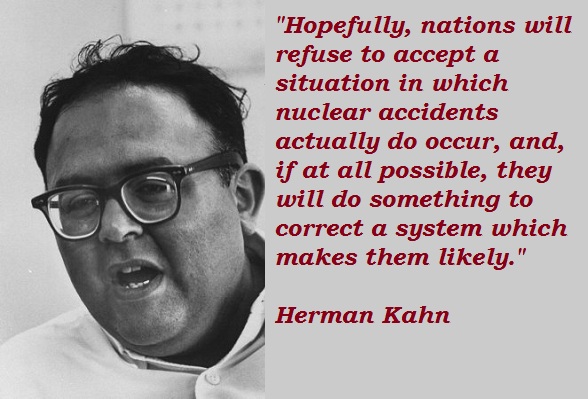
142015-herman-kahns-quotes-2.jpg


The usual image of war today held by many experts as well as most laymen can be summed up in the phrase "orgiastic spasm of destruction," or, "spasm war." Many believe that if one single button is pressed all the buttons will be pressed, and that some 30 minutes or so later missiles will rain enough destruction to terminate the defender's existence as a nation; subsequently, some minutes or hours later, a similar rain of death and destruction will annihilate the attacking nation. Within perhaps an hour or two the war will be effectively over-both combatants having received death blows-with only one question left; "How bad will the radiation be for the rest of the world?"

He flips to a drawing of a spindly boy wearing oversized glasses, hugging an ABC primer, and sniffing a daisy. This is the enemy. " The first [mistake] is to assume that he is a sort of cretinoid idiot, who can't see, think, or anything. It might be a fair, if dangerous, assumption that the enemy is at least as stupid as we are."

He ambles along the platform."Lots of times people say about systems analysis, why don't you guys do an experiment? What the hell are you sitting here figuring things? Why don't you go out and run an experiment? Well we'd love to run experiments,but there are two difficulties. One, in realistic experiments, people get shot down. That's not the major difficulty. We're willing to do it." The audience laughs. "We are. The real difficulty is we're talking weapons which aren't in existence yet."

Actually, even with tested missiles, results of attacks are not really mathematically predictable. The probability of extreme variations in performance, the upper and lower limits, cannot be calculated accurately. But laymen or narrow professionals persist in regarding the matter as a simple problem in engineering and physics.

Even if military advantages were not to be had by deliberately limiting attack to counterforce targets, I suspect that most governments would still prefer to observe such limits. Almost nobody wants to go down in history as the first man to kill 100,000 people.

Few people differentiate between having 10 million dead, 50 million dead, or 100 million dead. It all seems to horrible.

The Doomsday Machine is not sufficiently controllable. Even though it maximizes the probability that deterrence will work (including minimizing the probability of accidents or miscalculations), it is totally unsatisfactory. One must still examine the consequences of a failure. In this case a failure kills too many people and kills them too automatically. There is no chance of human intervention, control, and final decision.And even if we give up the computer and make the Doomsday Machine reliably controllable by the decision makers, it is still not controllable enough. Neither NATO nor the United States, and possibly not even the Soviet Union, would be willing to spend billions of dollars to give a few individuals this particular kind of life and death power over the entire world.

The unacceptability of the Doomsday Machine raises awkward, unpleasant, and complicated questions that must be considered by both policy maker and technician. If it is not acceptable to risk the lives of the three billion inhabitants of the earth in order to protect ourselves from surprise attack, then how many people would we be willing to risk? I believe that both the United States and NATO would reluctantly be willing to envisage the possibility of one or two hundred million people (i.e., about five times more than World War II deaths) dying from the immediate effects, even if one does not include deferred long-term effects due to radiation, if an all-out thermonuclear war results from a failure of Type I Deterrence. With somewhat more controversy, similar numbers would apply to Type II Deterrence. (For example, some experts would concede the statement for an all-out Soviet nuclear attack on Europe, but not if the Soviets restricted themselves to the use of conventional weapons.) We are willing to live with the possibility partly because we think of it as a remote possibility. We do not expect either kind of deterrence to fail, and we do not expect the results to be that cataclysmic if deterrence does fail.

here is another form of deterrence which, while not a Doomsday Machine, is still an"ultimate" of a sort. This could be called the Homicide Pact Machine, an attempt to make a failure of Type I Deterrence mean automatic mutual homicide. The adherents to this somewhat more practical device hope to divide the work of deterrence in a natural way: We destroy the enemy and the enemy destroys us, neither of us cheating by buying any effective Counterforce as Insurance for our respective societies. The Homicide Pact Machine is clearly more satisfactory to both humanitarians and neutrals than the Doomsday Machine and both should make the distinction.

We must not look too dangerous to neutrals. While this is probably less important for us than not looking too dangerous to friends and allies, it is still too important to be ignored. Here again, we must not look excessively destructive. It may be all right to promise the Soviets that if they attack us we will destroy every Soviet citizen in retaliation (though personally I think this far too destructive a proposal), but we should not threaten nonbelligerents with near annihilation because of our quarrel with the Russians. Many of the world's inhabitant perhaps two-thirds of them, do not feel it is their quarrel but feel it is their world. The more destructive we look, the less they like us and our program. To the extent that some in our midst talk and threaten potential world annihilation as a U.S. defense measure, we focus undeserved attention on ourselves as being dangerous and even irresponsible—appearing to be willing to risk uncounted hundreds of millions or billions of bystanders as to our selfish ambitions and desires. Neutrals and bystanders will inevitably suffer heavily in any thermonuclear War. But there is a difference between damage and annihilation.

In college, Herman was determined to show his professors how much brighter he was in their field of expertise, which he was, and which he did to their great annoyance. In the Army, during World War II, he was equally determined to show his brilliance, from the very start at the induction center where the two of us (we were inducted at the same place on the same day) took the Army’s equivalent of an IQ test. Wanting to prove himself, Herman had boned up on every IQ test he could get his hands on. Brimming with confidence he sat next to me, certain he would score 100%, which had never happened before.“Men”, the lieutenant told us, “nobody ever has finished this test, so don’t feel under any pressure to do so. If you give the wrong answers to any of the questions it will count doubly against you, so don’t try and guess. You’ve got 45 minutes to do the best you can. Good luck. Start!” After 20 minutes or so Herman had finished. He rested for a few minutes, checked his answers, and with a few minutes left got up, turned in his paper, and left. A couple of minutes go by and Herman comes rushing back into the room demanding his paper back. “Why do you want it back?”, asked the sergeant. “Because I made an arithmetic mistake on question seventy-four (or whatever number it was) and want to correct it”, said Herman. “Get the hell out of here!”, yelled the sergeant. Herman left. Sure enough he made only one mistake, but that was enough to make him number one in the Army.

 
Last edited:
Bat-Rok fighting with demons of chaos gods with his loyal sidekick - Tehenrobin lustria-online.com/threads/nakais-batman-themed-saurus-oldblood.16751/
 
How about a John Wick-esque movie.

Where a Skaven warlord stole a certain Old Blood's fucking Carnosaur.

And murdered his fucking Haugerdon.
 
Back
Top