• The forum software have been upgraded to the latest version.

    If you notice anything that looks off, or does not work, please let us know.

    For more information, click here.

What is your favorite part of history

I'll be happy to check it out, I really I am looking for history work and stuff like that. I really wish a lot of history stuff wasn't so dry.
that depends on the writer. What do you mean by history work?
 
I have a request that y'all might be able to help me with:

I am searching for pictures and/or descriptions of German archers between 1380 and 1450.
It is rather easy to get info about English or French troops of that time, but others are harder to obtain.

Also: any information about equipment of southern German forces of that time, specifically the Margraviate of Baden would be awesome.
https://en.m.wikipedia.org/wiki/Margraviate_of_Baden

I am trying to get some info from the local museums and so on, but probably one of y'all happens to have some good info in addition to that from your historical sources.
Any help would be appreciated! :)

Other than just reading the wikipedia article, the only other place I recognize the Holy-Roman-Empire-Era Baden from is Europa Universalis, as one of the states in the middle of Europe. Some cool looking heraldry pics out there though.

You working on a warhammer project or something for real life? :D
 
Other than just reading the wikipedia article, the only other place I recognize the Holy-Roman-Empire-Era Baden from is Europa Universalis, as one of the states in the middle of Europe. Some cool looking heraldry pics out there though.

You working on a warhammer project or something for real life? :D

A bit of both. :)
 
In fact Baden has existed in one form or another for 900 years!
It started in the 12th century and was split in the 16th. Then it reunited in the 18th and changed to a Grand Duchy. In the 20th century after WWI it became a democracy, then part of the Third Reich, and is a part of the German state (together with Württemberg) now.

The time frame I am interested in (and the one I really don't know much about) is the medieval period, specifically a part of the late Middle Ages, around 1400, as that is one of my favourite times in history.

Weird that I don't know much about what happened during my favourite time of history, isn't it? The problem is that Baden is rather small and most sources from that time are about important stuff that happened hundreds of kilometers away. Which is a LOT in Europe.
Medieval Europe was very dense, with hundreds of small states, many having their local way of life, technological preferences, language and so on, constantly in war with each other.

I noticed that despite my interest in the period it is actually pretty hard to get good info about many things that happened during that time. European history is looooong and much knowledge was lost at some point. Sometimes when I talk about it with American friends they have a hard time to comprehend that we don't know much about quite some time in our history.
They have it much easier, those few hundred years, hardly any wars on their soil, and all that history happened during times when many people could write, and all had the same language. In Europe that's a completely different thing.
Just an example: the earliest source mentioning the city I live in is a Roman one, from 90 AD. Not even a comparison to some Greek cities or so, but a lot of stuff happened here since then. There are buildings in Germany still standing more than a millenium after they were built. I can go and visit the grave of Charlemagne, who died in 814. It is incredible but at the same time there is so much history, and so much missing...

...Ok I got carried away there a bit. What I wanted to say: without being a historian it is actually pretty hard to find out what was going on 700 years ago. We know the awesome or big or particularly awful things, but not much more.
 
In fact Baden has existed in one form or another for 900 years!
It started in the 12th century and was split in the 16th. Then it reunited in the 18th and changed to a Grand Duchy. In the 20th century after WWI it became a democracy, then part of the Third Reich, and is a part of the German state (together with Württemberg) now.

The time frame I am interested in (and the one I really don't know much about) is the medieval period, specifically a part of the late Middle Ages, around 1400, as that is one of my favourite times in history.

Weird that I don't know much about what happened during my favourite time of history, isn't it? The problem is that Baden is rather small and most sources from that time are about important stuff that happened hundreds of kilometers away. Which is a LOT in Europe.
Medieval Europe was very dense, with hundreds of small states, many having their local way of life, technological preferences, language and so on, constantly in war with each other.

I noticed that despite my interest in the period it is actually pretty hard to get good info about many things that happened during that time. European history is looooong and much knowledge was lost at some point. Sometimes when I talk about it with American friends they have a hard time to comprehend that we don't know much about quite some time in our history.
They have it much easier, those few hundred years, hardly any wars on their soil, and all that history happened during times when many people could write, and all had the same language. In Europe that's a completely different thing.
Just an example: the earliest source mentioning the city I live in is a Roman one, from 90 AD. Not even a comparison to some Greek cities or so, but a lot of stuff happened here since then. There are buildings in Germany still standing more than a millenium after they were built. I can go and visit the grave of Charlemagne, who died in 814. It is incredible but at the same time there is so much history, and so much missing...

...Ok I got carried away there a bit. What I wanted to say: without being a historian it is actually pretty hard to find out what was going on 700 years ago. We know the awesome or big or particularly awful things, but not much more.

Really neat, but I feel your pain! It doesn't help searching for sources if you don't read the language :confused:

On a quick search, I wasn't able to find much. I am betting that is because most of the actual sources from the time period are (shocking) in German! :D I wonder if searching for information on the Holy Roman Empire during that period might help instead? You may only find snippets on some of the smaller states, but it is a starting point.
 
They have it much easier, those few hundred years, hardly any wars on their soil, and all that history happened during times when many people could write, and all had the same language.

Incorrect. There were many wars on American soil, some of which were:
Wars between the Native Americans and the colonists early in the 16th and 17th Centuries
American War of Independence (which they only won because the French helped, and they did so only to beat us British)
American Civil War
Indian Wars (which showed how brutal the Americans could be)
War of 1812 (where they tried to invade Canada but were soundly beaten by the combined forces of Britain, Canada and the Native Americans)

And also the Native American tribes spoke all sorts of different languages other than English.
 
I don't want to insult you but by medieval European standards only two of those even qualify as proper wars.
There wasn't that kind of destruction European wars brought.
Even Sherman's March to the Sea is a joke compared to medieval wars and that stands out as an exceptionally brutal example in American history.

What I meant is: none of those conflicts (except the Genocide on the Native Americans, that slaughter you call "war") wholly destroyed whole communities and their individual culture (individual cities were partly destroyed sometimes though, such as Fredericksburg IIRC). There was no war on American soil that destroyed the bigger part of a millenium of history and knowledge.
I give you the Indian thing though. I was a bit too general there.
 
Last edited:
I don't want to insult you but by medieval European standards only two of those even qualify as proper wars.
There wasn't that kind of destruction European wars brought.
Even Sherman's March to the Sea is a joke compared to medieval wars and that stands out as an exceptionally brutal example in American history.

What I meant is: none of those conflicts (except the Genocide on the Native Americans, that slaughter you call "war") wholly destroyed whole communities and their individual culture. There was no war on anerican soil that destroyed the bigger part of a millenium of history and knowledge.
I give you the Indian thing though. I was a bit too general there.

You’re not insulting me - I’m British, not American, as you probably know. I’m just stating the facts - I’m not trying to say that anything about the wars I’ve mentioned are any more devastating than medieval wars. You just said there were ‘hardly any wars on American soil’ and I am just stating otherwise. The War of 1812 was highly important in Canada’s history as well as that of the Native Americans, even if it seems small in comparison to many of the other wars that were fought, and if it had been lost by the alliance it would have destroyed Canada’s own separate culture as it would have become part of the USA and they would now be ruled by Emperor Palpatine.

Also I agree that the so-called ‘Indian Wars’ were largely a genocide, I was just using a general term for it - I certainly never meant that there was any glory in it - far from it. Certainly the ‘Battle’ of Wounded Knee was nothing more than a cowardly massacre carried out by American barbarians. I primarily called it a ‘war’ because the Native Americans did have some victories, most notably Little Bighorn but also most instances of ambush upon the US army carried out by the natives were a Native American victory. In fact the US army is probably one of the worst armies when it comes to stealth fighting, certainly in the modern era. I love the unique culture of the Native Americans and whenever I’ve played with my miniature cowboys and Indians the Native Americans always won (because when you play with your soldiers you decide who wins) - you won’t find very many bigger Native American supporters than me.
 
Honestly, @Aginor has a point. European conflicts have a certain scale to them. Elayu, for example.
 
Honestly, @Aginor has a point. European conflicts have a certain scale to them. Elayu, for example.
I guess you mean the battle of Eylau? That was a pretty late battle, but yeah, it cost about (we don't even know) 25,000-45,000 people.

The war it belonged to (the War of the Fourth Coalition, it is just one in a big series of wars of the 19th century) had ~700,000 people dying, which is around the amount of the losses of the two biggest wars on American soil (revolutionary war and civil war) combined.

In fact I'll have to check but I am pretty certain that there hasn't been a century in European history since the 14th century (possibly earlier, we don't exactly know), that had less than a million people dying in war.

And the especially important point, a point of much higher importance than the number of dead soldiers, is that European wars almost always had a very high impact on civilians. Burning cities and destruction of culturally important and other historic stuff was normal.

So yeah I am not saying that the wars on American soil were harmless, just that the gaps in history are not as large because they were far less destructive, and at least one side and their stuff (including historic records) survived.


Now, @Warden might want to loudly disagree (and rightly so), because I omitted Mexican stuff. Like many people I tend to do two things:
- mean "North America" when saying "America".
- give the USA and Canada such a focus in my mind that I forget Mexico is part of North America as well, thinking of Mexico as a Central American country (sorry to all Mexicans, I know I should know better).

So yes, the Spanish conquests there killed several (as in: at least 20) million people and destroyed almost _all_ of the local culture and history.
Those wars were European invasions so they brought European-style war with them. Something Europeans should probably be a bit more ashamed of btw.
People like Cortés were war criminals, and mass murderers in the order of magnitude that Hitler, Stalin, Mao, the Khmer Rouge and the like belong to.
 
Now, @Warden might want to loudly disagree (and rightly so), because I omitted Mexican stuff. Like many people I tend to do two things:
- mean "North America" when saying "America".
- give the USA and Canada such a focus in my mind that I forget Mexico is part of North America as well, thinking of Mexico as a Central American country (sorry to all Mexicans, I know I should know better).

So yes, the Spanish conquests there killed several (as in: at least 20) million people and destroyed almost _all_ of the local culture and history.
Those wars were European invasions so they brought European-style war with them. Something Europeans should probably be a bit more ashamed of btw.
People like Cortés were war criminals, and mass murderers in the order of magnitude that Hitler, Stalin, Mao, the Khmer Rouge and the like belong to.

Good point, the conquests of Mexico were truly devastating, especially when you include the fallout that occured in the wake of the Spanish invasions (disease) that wiped out upwards of 1/2 or 2/3 of the New World population within a mere few centuries .
The Spanish conquests of Mexico and the New World are one of the biggest arguements against humankind making alien contact.

We might get lucky if aliens land on Earth, and things go War of the Worlds style and they get wiped out thanks to our superior earthling microbes.

Or what is more likely is that the aliens will introduce a single, innocuous and harmless alien microbe into our planet, and wipe out our ecosystem because either human immunity doesn't exist, or even more deadly, no immunity exists in our plants

Another side note, lets not forget the scale of the conflicts in Europe tend to be on an order of magnitude less than the devastation caused by numerous wars in the Far East, specifically China.

An Lushan Rebellion (Tang Dynasty, Chinese Caesar rebels against the Emperor)
War of the Three Kingdoms
Mongol Conquests of China (founds Yuan Dynasty) and the Mongol Conquests of Asia in general (also partially responsible for the Black Death)
Manchu Conquests of China (founds Qing Dynasty)
Boxer Rebellion (Chinese revolt against European colonialism backed by Qing)
Chinese Revolts against Qing Dynasty --> Warlords Period --> War with Japan/WWII -->Chinese Civil War
 
Celts
I may well disagree with everything you wrote about Celts and Romans and Hill Forts etc. but all of that is all really a worthy topic for a different thread to debate and ponder and agree to disagree about history.

Now then @pendrake, just what do you disagree with about what I wrote in the Warhammer Wild West thread about the Celts and their hillforts?
 
Now then @pendrake, just what do you disagree with about what I wrote in the Warhammer Wild West thread about the Celts and their hillforts?
Oh. Wow. There is already a thread for such things.

***wanders off to figure out how to quote out of one thread to another***
 
Last edited:
Oh. Wow. There is already a thread for such things.

***wanders off to figure out how to quote out of one thread to another***

I simply quoted your post in the Wild West thread and moved to the history thread - I’ve found out that the multi-quote stores all the posts you quote between threads. Ah, the joys of this forum... ;)
 
All this quoted material is from the brainstorming thread. I will sift through it paragraph by paragraph to Catalog the bits where @Lord Agragax of Lunaxoatl causes me to think, “Errrrr, what? wait, No...”

I’ll try to ignore most Warhammer universe aspects.

What I think I know about Warhammer-Albion is from the Albion campaign from the 5th or 6th edition of Warhammer when White Dwarf magazine was in the range of issues 259-268.


Settlers From Albion

...settlers from Albion arriving many year before all the other races when the Empire was causing trouble and invading everyone else, and being an already-established culture by the time all the other races travel over to the new world. I noticed that you forgot to include Albion in your lore, and thought it would be great to do an alternative take on the real-world event of the Vikings first discovering America many hundreds of years before Columbus, by changing it so that it was actually the Celtic-style peoples of Albion who got there first (the Norse being allied with Chaos and too busy fighting the Empire at the time to notice).
I contend that the human population of Warhammer-Albion (as written by GW) was primarily a bunch of primitives that made the Picts look clever and educated.

There were Giants, there were a tiny number of spellcasters (Truthsayers or Emissaries) and a bunch of wretched, cave dwelling mooks.
Of course this is fantasy, so we could say that somehow the tribes of Albion were able to start working on their own large transport ships to take their people across the huge expanse of sea (maybe the Druids and Truthsayers predicted that there was a 'land of bounty' across the wide wide sea and some of the warriors and their families agree to sail over and investigate), and first landed while the Empire was expanding across the Old World. Of course the Empire aren't going to take much notice of Albion because it is small, seemingly insignificant compared to Bretonnia, Estalia and Tilea, and the people there generally kept themselves to themselves.
We agreed ^ that kindly Elves and Stone circles are a simpler explanation.
Anyway, just as the Vikings in the real world did, the people of Albion encounter the natives when they first settle in the New World, but again I plan to include a difference in events. In the real world, the Vikings had superior weaponry but were ousted by the natives due to a combination of having far fewer people and no obvious ways to protect their settlements, but in the Warhammer version the people of Albion are able to construct a hillfort which is far better defended and are able to secure a permanent settlement in the New World, despite the attempts made by the natives to destroy them.
The Vikings were ousted because they were massively outnumbered. Hill Forts need a huge construction force and numerous defenders. It was all down to numbers. I would call that partial agreement.

Viking settlements in the new world were too small to even try a Hill Fort and they were in places where there was little timber for palisades. So I’m disagreeing about the relevance of Hill Forts.
If we look at their real-world Celtic counterparts, we know that the Celts fought each other as much as foreign powers - indeed, warfare was an integral part of Celtic culture. However, one benefit of regularly fighting the neighbours was that necessity demanded that the Celts build their settlements in places that could allow them to be made more resistant to enemy attacks. These hillforts became more and more well defended so that, at the peak of the Celts' power, hillforts were practically impregnable to infantry and cavalry attack - they were the stone castles of their day. Networks of trenches, ditches and earthworks were built so that they would not only slow down an approaching enemy force, but they could also be used to funnel them into just a few places where Celtic defenders could shower them with missiles.
That paragraph is all speculation. Neither of us was alive then, so we don’t really how Hill Forts worked.

They were the earthwork Forts of their day... ...rather than Castles. Castles are smaller.
Indeed hillforts were designed with only one, maximum two or three, gateways, the earthworks around which were purposefully designed to funnel enemies into going that way. Many of these gateways were also supported by ramparts and palisade either side of the main gateway, so that all enemies funnelled into the gateway would be attacked on three sides,...
Or the elaborate gates and multi-layered ramparts had other purposes.

Like controlling the movement of people and livestock on market days maybe.
While hillforts were easily conquered by the Romans, they were only able to do so by using siege engines, which of course they had pioneered during their many conflicts with other nations. The Celts on the other hand had no experience in siege warfare (mainly because they had no interest in practicing it - it was seen as dishonourable to stand back and fire a big catapult or hide in a siege tower when you could be hurling yourself into the thick of it like a true warrior) and so their hillforts were designed exclusively to counter warbands of infantry and cavalry (which was how the Celts fought each other in tribal raids), a job they did perfectly.
If the Celts had no experience with sieges why did they fortify? The whole point of building a fortification is to leave your opponent with no other option but to besiege you. If they had Forts and they warred with each other they had sieges.

The Romans were simply better at assaulting fortifications.

NB: ...siege means surround and isolate an enemy who is Forted up. Assault is the word for smash into the enemy fort.

Siege Warfare entails starving out the Foe or vanquishing an Invader by waiting them out. The Romans didn’t have time for that.

Coincidentally, the preferred fighting style of the Native Americans was also using their large bands of warriors to launch lightning assaults on the enemy, which means then that the hillfort is a devastating counter to the Native Americans' battle tactics, if we're now assuming that we're putting Celts from this world into America in the same time period. Sure, the Native Americans can use their familiarity with their homeland to ambush and slay Celtic war parties, but they would have had absolutely no hope of being able to shift the Celts from their hillforts unless several entire tribes united to launch an attack on one hillfort, and even then there would be a huge number of casualties for the Native Americans.
I don’t think having Hill Forts means automatic superiority for those who are forted up. Without enough numbers to defend its perimeter it is useless.
Therefore, as opposed to the Vikings whose settlements were relatively unprotected, the Celts, and indeed the peoples of Albion, would have been able to construct settlements to ensure that they were here to stay. [...snip Warhammer stuff... ]
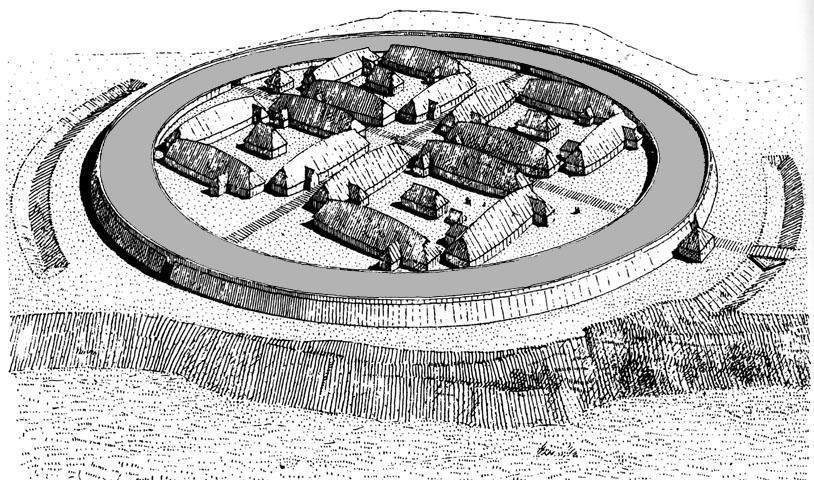
Disagree. The Vikings did build places fortified with earthen ramparts. There is an example in Denmark.

 
There are seven [known] examples [mostly] in Denmark.

tre04.jpg
 
Last edited:
Back
Top