
Slann
NIGHTBRINGER
Second Spawning
- Messages
- 90,987
- Likes Received
- 279,043
- Trophy Points
- 113

@NIGHTBRINGER I've always had a bit of attention on the physics of Dwarf fighting.
If they have short legs and arms, then they are both close to the ground and have small reach. It doesn't seem to make sense physically that they would outclass a normal size human who is also trained as the human would have far superior reach.
The same two points would also theoretically mean that they would only be able to use short weapons, further limiting their reach.
Thoughts?

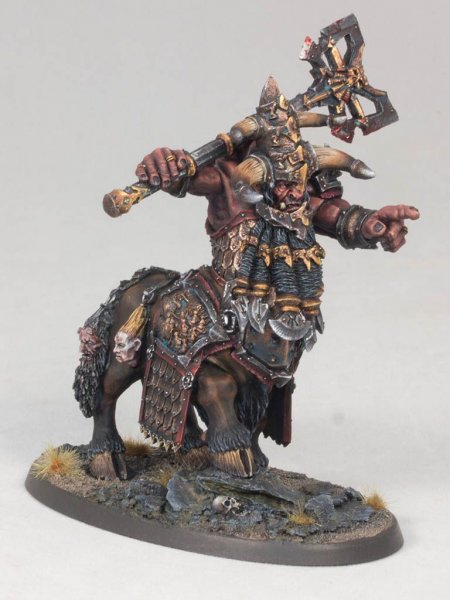
Let's see your long arms help you now puny human!!

I know, I know... I apologize but I simply couldn't help it. That image popped into my mind immediately.Yes, but Bull Centaurs notwithstanding?
I know, I know... I apologize but I simply couldn't help it. That image popped into my mind immediately.
More seriously, while humans would indeed enjoy an advantage in terms of reach, speed and agility, the Dwarfs too have attributes that would most certainly swing in their favour. Dwarfs are typically more powerfully built and are certainly more durable (in comparison to normal humans and not those that are Chaos blessed!). What they lack in height they make up for in terms of broader shoulders and musculature. I'd be very curious as to who would have the weight advantage, the taller and leaner humans or the shorter and stockier Dwarfs. In a real world example, combat sports such as boxing and mma separate fighters based on weight and not by height. Weight is by far a greater factor than height. And while these sports typically talk at length about a "reach advantage", there are innumerable examples of the stockier fighter winning the contest against their rangier opponent. Similarly, in the animal kingdom there are quite a few creatures that punch far outside of their weight class. Honey badgers and wolverines are examples of animals that can fend of predators that are many times both their size and weight (and the Dwarfs in Warhammer are likely not giving up a weight advantage at all). Another example is a pit bull which can easily take down most other dogs even if those dogs are bigger than they are. An average chimpanzee is quite a bit shorter and lighter than an average human, but if we discard our intelligence advantage, we know full well how that contest would end.
Real world UFC/MMA example, Mark Hunt (5'10") vs. Stefan Struve (7'0")
Moving back to the topic it hand, I can see many reasons why a Dwarf could contend with a human:
- Dwarfs are stronger and sturdier physically
- Dwarfs have the very best armour and weapons in the form of runic items
- Dwarfs have a much more resilient and disciplined disposition
- Dwarfs' longer lifespan affords them more time to practice and improve their skills
- On the battlefield, army organization, strategy and discipline often overshadow individual prowess, these are all advantages that fall on the Dwarfs' side of the ledger
- Dwarfs have the best warmachines, how's that for reach?
All this is not to say that humans can't compete with Dwarfs. The humans in the Warhammer world have many advantages too (in addition to height & reach). Humans are more numerous, more adaptive (in that they are willing to experiment outside the rigid bounds of tradition), can utilize mounts, can wield magic and so on.
So we're left with our original question, is the height and reach advantage enjoyed by humans insurmountable? For the reasons detailed above, I'd say no.
 Nice. All good points.


Anyway, long story short; don't fight dwarves unless you can flank them and have sufficiently powerfull weapons to crack open their armour otherwise you're going to have a bad time
I fully agree that strength is less important when using close combat weapons as compared to unarmed combat, but it is still a big advantage. This is not to say that strength will overcome a major skill deficit, but when the skill levels are similar, strength can often be a deciding factor. How much of an advantage it confers will vary greatly in response to a multitude of factors, but big or small, it is there.As for their weight and strength advantage; that's mostly relevant in unarmed combat.
Definitely not, for all the reasons I previously listed...Simply put, humans and dwarves are still in the same strength class. Which makes the difference largely irrelevant as soon as weapons are involved
1 v 1 either would be screwed, because the Ogre is that much stronger, heavier and larger. However, assuming equal skill, a group of strong individuals would stand a better chance against the Ogre than a group of weak individuals.Not sure if the difference would be large enough to give dwarfs an easier time against ogres though. I'd expect both the dwarf and the human to be equally screwed to be honest.
)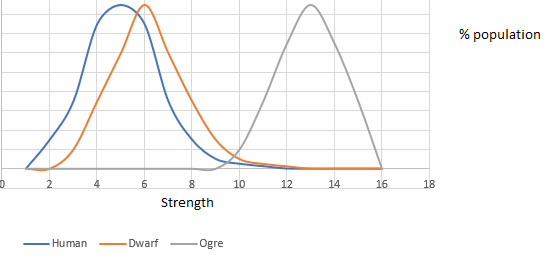
So yeah, for the general population the difference would be significant. It'd be equivalent to letting say a group of men fight a group of women. On average one group is stronger than the other, and that will have some advantages like you listed.
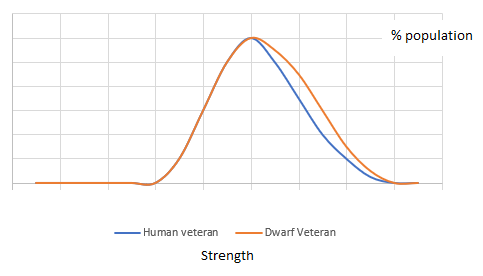
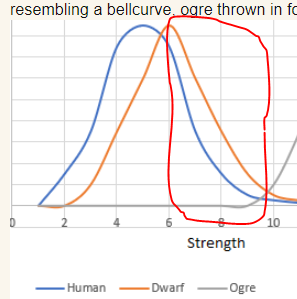
However, if you start looking at the veteran warriors things change and You'l see something more akin to this:

The bellcurves are no longer all that different. And while yeah, the dwarfs are still a little bit stronger on average, and there's still relativly more strong dwarfs than strong humans, the difference is no longer anywhere as pronounced as in the general population.
All of this in battlefield terms would essentially translate to; an untrained dwarven levy is far stronger than an untrained human levy, to the point they can wear heavier armour, have an easier time using a shield and heavy weapons etc. But veteran troops of the two races would be more or less comparible.
I think the inaccuracy of my completly made-up graphs gets kind of in the way here. I should probably have made the dwarf graph taller and not just thinner, that wasn't sufficient to get my point across. Plus the comparison of males versus females isn't exactly perfect. Anyway let me explain what I mean.An interesting take, but I ultimately disagree with the conclusion.
The average male is stronger than the average female. If we were to take the very best from both of these groups (i.e. the veterans in your example), the veteran males will be stronger than the veteran females. If we were to test actual real world soldiers (males vs. females) from militaries from around the world, we would see exactly this. The exact same will be true for the Dwarfs vs. Humans comparison.
I think your first chart illustrates this...
View attachment 95612
If we assume that soldiers are selected from the stronger subset of each population (those represented on the right side of the curve), on your own graph we can see that the veteran soldiers from each group still vary significantly in terms of strength... and in favour of the Dwarfs.
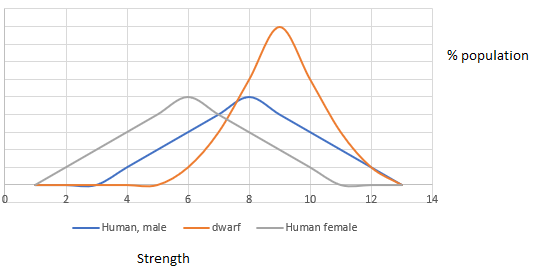
They are lovely graphs.Also bear with me, cuz drawing these things precisely is a pain, so I might be off by a little bit, but the idea should be clear
I don't think that holds for dwarves. They have also have a higher average and a higher minimum (for healthy individuals), but the same (rough) maximum potential.
That is truth of it.I think the main point here is that all of the data about Dwarves are ENTIRELY made up, so it doesn't exactly break down well to scientific inspection.
As if that ever stopped anyone from making up stuff and discussing it on the internet in a pseudo scientific mannerI think the main point here is that all of the data about Dwarves are ENTIRELY made up, so it doesn't exactly break down well to scientific inspection.
I haven't seen any stories of dwarfs doing anything a human can't do though. If they also had a higher maximum I would expect some stories, or just bits of fluff, like we see with for example greenskins. Fluff for orks is filled with feats of strength a human can't copy.That's the assumption from which our disagreement stems. If I were to adopt your original assumption, then the rest of your argument does hold true. Personally, I am assuming that the entire curve for the Dwarfs would be shifted to the right, meaning that they would have a higher minimum, higher average and a higher maximum (the same as we see between men and women).
Admittedly there is no real direct answer (that I know of). We've both got our assumptions. I base mine off of:I haven't seen any stories of dwarfs doing anything a human can't do though. If they also had a higher maximum I would expect some stories, or just bits of fluff, like we see with for example greenskins. Fluff for orks is filled with feats of strength a human can't copy.
)